Full Size Table Tennis Table Dimensions: The Complete Guide
Whether you’re buying your first ping pong table for family fun, setting up a serious practice area, or planning a dedicated games room, understanding official table tennis table dimensions is extremely important.
The size of the table affects gameplay quality, player movement, ball bounce consistency, and even the amount of space you need around the table. Many buyers focus only on the table itself and forget about room clearance, tabletop thickness, or whether a mini, midsize, or regulation model best suits their needs.
A regulation full size table tennis table follows internationally recognized standards used in tournaments, sports clubs, schools, and professional training facilities worldwide. These measurements ensure fair play and a consistent experience for beginners and advanced players alike. Choosing the correct size can improve skill development, comfort during rallies, and overall enjoyment of the game.
Today, table tennis is one of the most popular indoor sports globally because it combines fast reflexes, strategy, coordination, and exercise in a compact playing area. From casual home games to Olympic-level competition, the dimensions of the table remain a critical part of the sport.
In this complete guide, you’ll learn the official full size table tennis table dimensions in feet, inches, centimeters, and meters. You’ll also discover differences between mini, midsize, and full-size tables, ideal room space recommendations, table thickness comparisons, indoor versus outdoor models, buying tips, and answers to the most commonly asked questions.
Quick Answer
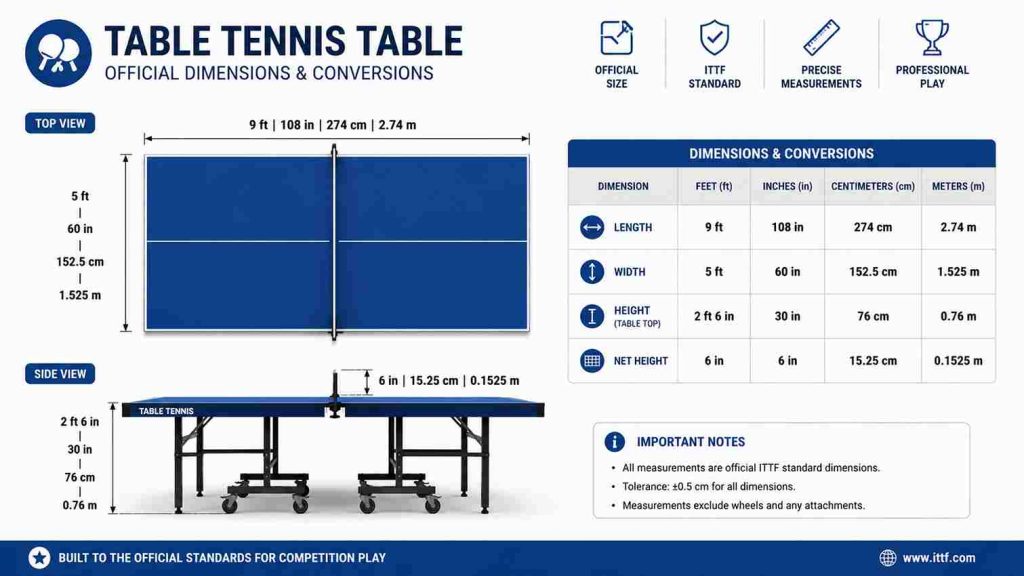
A standard full-size table tennis table measures 9 feet long, 5 feet wide, and 2.5 feet high (274 cm × 152.5 cm × 76 cm). These are the official dimensions approved for tournament and competitive play worldwide.
Quick Dimensions Table
Playing Space Recommendations:
- Casual play: At least 19 ft × 11 ft
- Recreational play: Around 22 ft × 13 ft
- Club or tournament play: 28 ft × 13 ft or larger
Official Full Size Table Tennis Table Dimensions
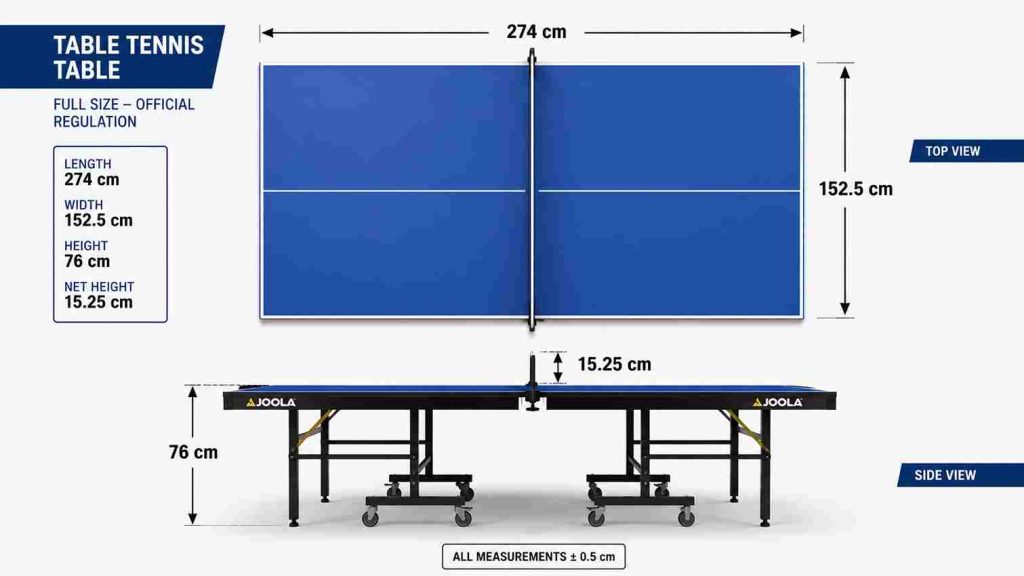
The official dimensions of a table tennis table are standardized by the International Table Tennis Federation (ITTF), the governing body responsible for competitive table tennis worldwide.
A regulation table must measure exactly:
- 2.74 meters long
- 1.525 meters wide
- 76 centimeters high
The playing surface must remain perfectly horizontal to ensure fair and predictable ball bounce during matches. A net stretches across the center of the table and divides it into two equal halves.
The net itself stands 15.25 cm (6 inches) above the playing surface. White boundary lines mark the edges of the table, while a thinner center line is used during doubles matches.
These regulation dimensions create the balanced playing experience required for both recreational and professional table tennis. The size allows players enough space for fast rallies, spin shots, defensive movement, and doubles play while maintaining consistent tournament standards.
Table Tennis Table Size in Different Units
People around the world use different measurement systems, so understanding dimensions in multiple units can make planning easier.
Table Tennis Table Size in Feet
A regulation table measures:
- 9 feet long
- 5 feet wide
- 2.5 feet high
This is the most common way homeowners visualize available room space.
Table Tennis Table Size in Inches
The dimensions in inches are:
- 108 inches long
- 60 inches wide
- 30 inches high
This measurement format is often useful when comparing room dimensions or storage areas.
Table Tennis Table Size in CM and Meters
Official international measurements include:
- 274 cm × 152.5 cm × 76 cm
- 2.74 m × 1.525 m × 0.76 m
Most tournament and professional specifications use centimeters and meters because these are the official ITTF standards.
Mini vs Midsize vs Full-Size Comparison
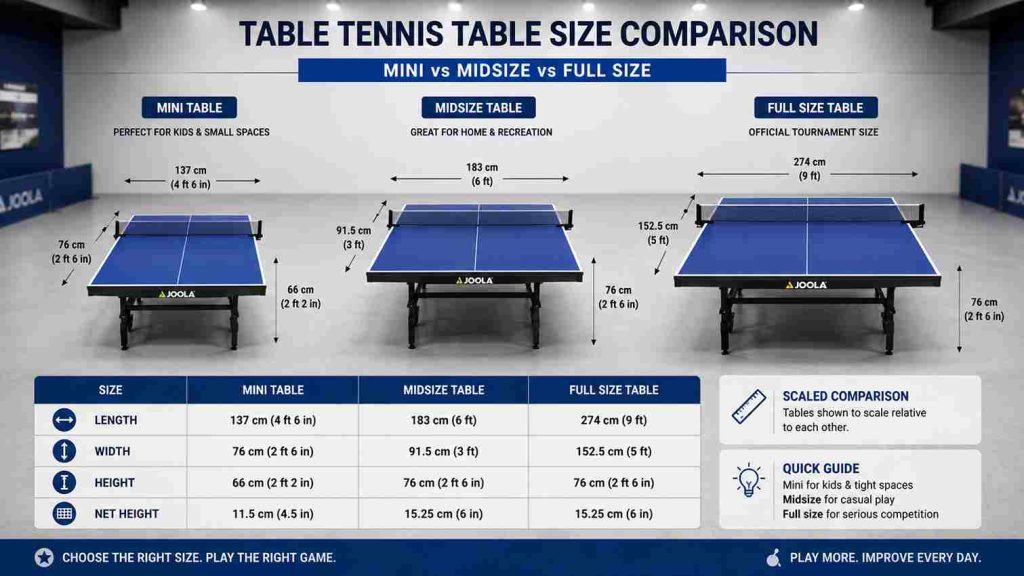
Not every player has enough space for a full-size table. Smaller options can still provide enjoyable gameplay for casual use.
Midsize tables are popular because they maintain regulation height while reducing overall length and width. This creates a more realistic bounce and playing experience compared to mini tables.
Mini tables are excellent for children and occasional family entertainment, but they do not accurately simulate tournament conditions or advanced gameplay.
If you are buying a table for children or casual family use, a midsize model may provide enough playing experience while saving valuable floor space.
Table Tennis Table Thickness and Bounce Quality
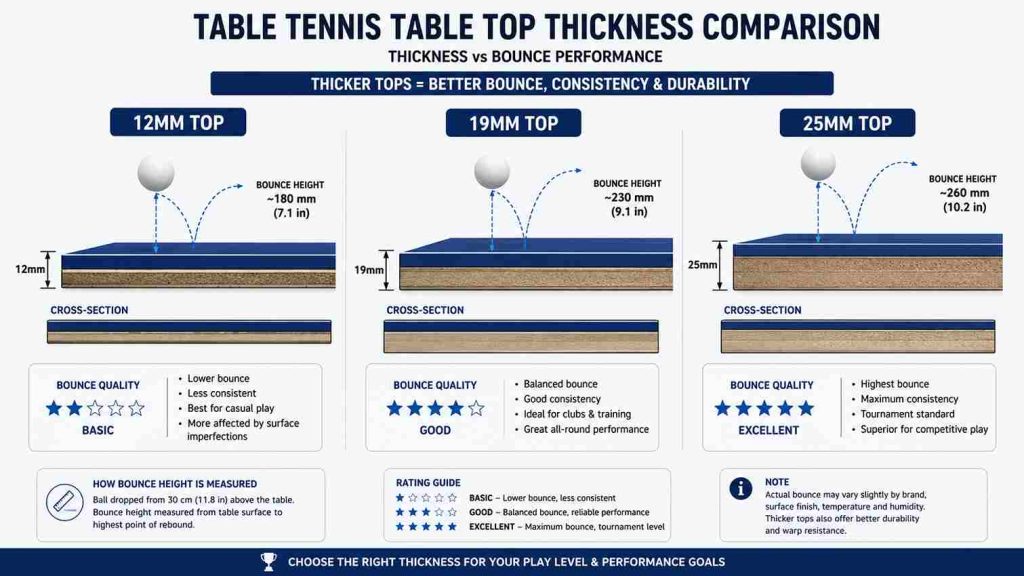
The thickness of the tabletop significantly affects gameplay quality and ball bounce consistency.
A thicker tabletop produces a more reliable and tournament-style bounce because the surface absorbs less energy during ball contact. Thicker tops also resist warping better over time, especially in areas with changing humidity or temperature.
Many experienced players recommend at least 18–22 mm thickness for enjoyable recreational play. Competitive players often prefer 22–25 mm tops because they deliver more consistent performance during fast rallies and spin shots.
A simple bounce test can help evaluate quality. Drop the ball from around 30 cm above the table surface. On a high-quality table, the ball should rebound close to 23 cm.
Indoor vs Outdoor Table Tennis Tables
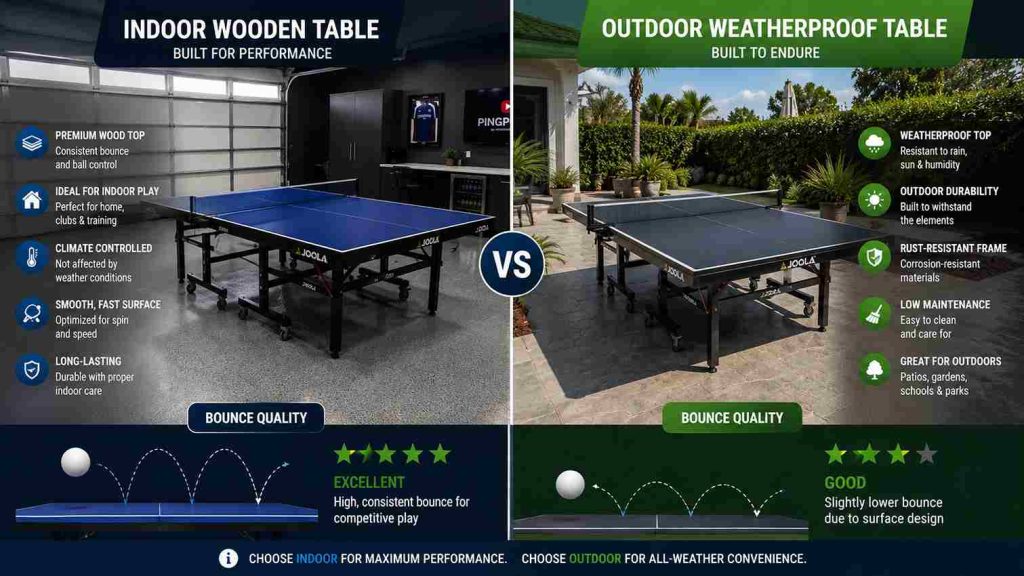
Choosing between an indoor and outdoor table depends largely on where you plan to play.
Indoor table tennis tables usually use MDF or wooden tops that deliver the most consistent bounce and better overall playing performance. However, moisture can damage these surfaces if they are stored in damp conditions.
Outdoor tables are built with weather-resistant materials designed to handle sunlight, humidity, and rain. While they are more durable outdoors, the bounce is often slightly less responsive compared to quality indoor models.
Most regular players prefer indoor tables because they provide a more authentic playing experience.
Recommended Playing Space and Room Size
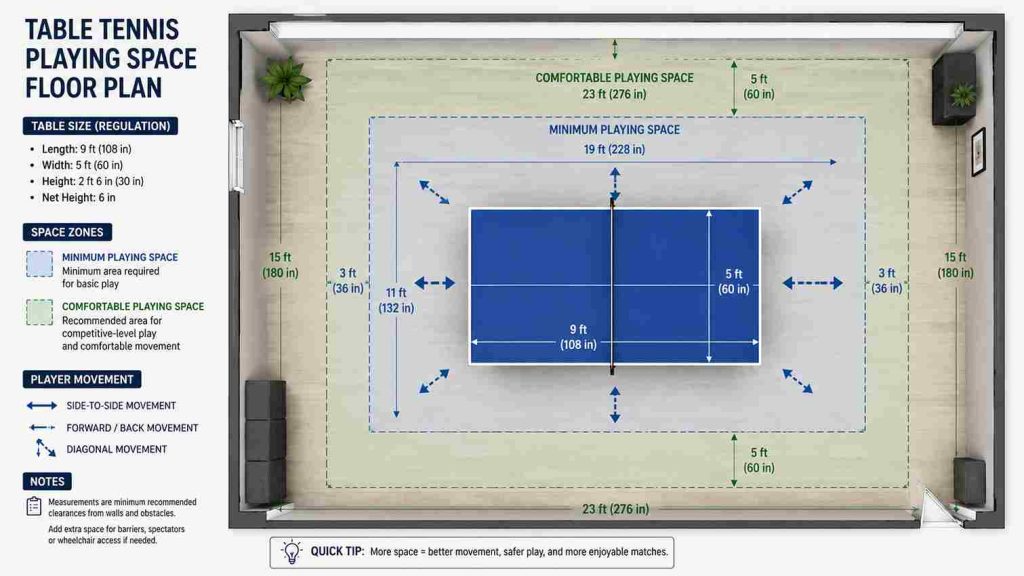
The table itself is only part of the setup. You also need enough room around it for comfortable movement and gameplay.
Many buyers underestimate the amount of movement required during fast rallies. Limited room space can make gameplay frustrating and reduce enjoyment.
Always measure your available area carefully with the table fully unfolded. Leave additional clearance behind each player whenever possible.
Size of Table Tennis Ball and Other Specifications
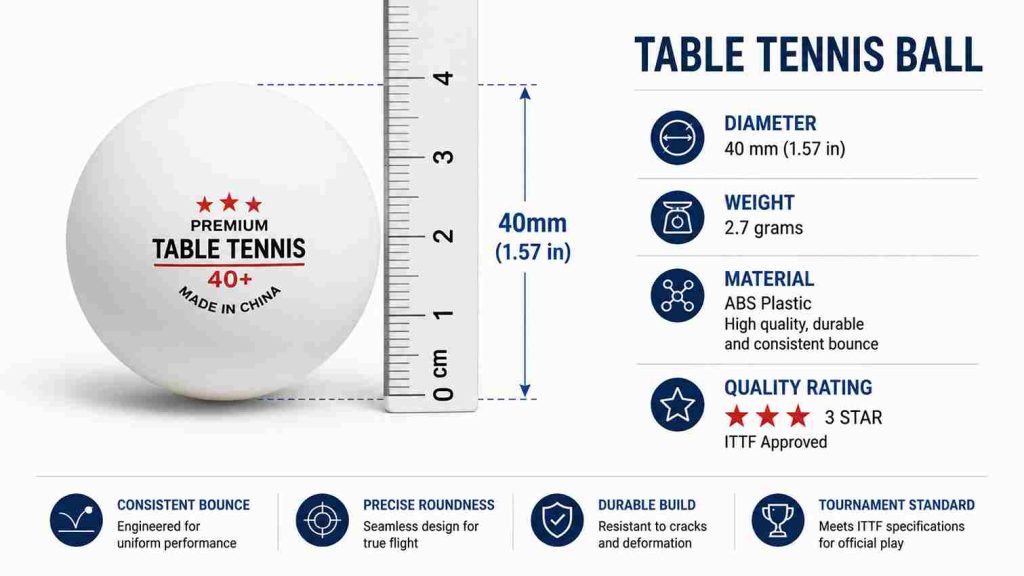
Official table tennis balls are carefully standardized to maintain fair gameplay.
The current official specifications include:
- Diameter: 40 mm
- Weight: 2.7 grams
- Material: Plastic
- Color: Usually white or orange
Professional players often use 3-star balls because they provide the best roundness, consistency, and durability.
The size of the ball plays an important role in speed, spin, and bounce characteristics during matches.
Buying Tips and Common Mistakes
Choosing the right table depends on your available space, playing frequency, budget, and skill level.
Best Table Size for Homes and Apartments
For smaller homes or apartments, a foldable full-size table or midsize model can work extremely well.
Compact folding designs with wheels make storage easier and help maximize room space.
Best Option for Serious Players
Competitive players should prioritize table thickness, stability, wheel quality, and ITTF-style dimensions over compact storage features.
A high-quality 22–25 mm table generally provides the best playing experience for advanced practice.
Common Buying Mistakes
Some of the most common mistakes include:
- Buying a table that is too thin
- Ignoring room clearance requirements
- Choosing outdoor models for indoor play
- Focusing only on price instead of bounce quality
- Forgetting to measure storage space
Testing the bounce quality before purchasing can help avoid disappointment later.
Setup Tips and Storage Considerations
Proper setup can greatly improve gameplay quality and table longevity.
Use a spirit level to ensure the playing surface remains perfectly flat. Uneven floors can affect ball bounce and fairness during matches.
If you plan to store the table frequently, look for features such as:
- Locking wheels
- Safety folding systems
- Compact folding design
- Strong frame support
For extremely tight spaces, some homeowners use table tennis conversion tops that fit over pool tables or dining tables.
Frequently Asked Questions
Before choosing a table, many buyers still have a few common questions about sizing, gameplay, health benefits, and professional standards.

Conclusion
Understanding full size table tennis table dimensions helps you choose the right setup for your space, budget, and playing goals. A regulation 9 ft by 5 ft table delivers the authentic playing experience used in tournaments, sports clubs, schools, and serious home practice around the world.
Before buying a table, carefully measure your available room space and think about how often you plan to play. Factors such as tabletop thickness, bounce quality, folding design, storage convenience, and indoor versus outdoor use can make a major difference in your overall experience.
For casual family entertainment, a midsize or foldable table may be the most practical solution. Players who want realistic gameplay and long-term skill development should invest in a regulation-size model with a thicker playing surface.
It’s also important to remember that the surrounding playing area matters almost as much as the table itself. Comfortable movement space allows players to enjoy longer rallies, improve footwork, and play more naturally.
A quality table tennis setup can provide years of exercise, competition, entertainment, and social fun for players of all ages. Whether you are practicing seriously, introducing children to the sport, or simply enjoying games with friends, choosing the correct table size creates a much better overall experience.
Take accurate measurements, compare your options carefully, and choose a table that fits both your space and playing style. With the right setup, you’ll be ready to enjoy fast-paced rallies and exciting matches for years to come.

Lin Xiaoyu
Lin Xiaoyu is a table tennis author with a strong understanding of competitive gameplay, match tactics, and player development. Through years of game analysis, technical study, and close observation of the sport, Lin brings practical insight and clear, reader-friendly explanations to every article.
She specializes in covering table tennis techniques, playing styles, equipment knowledge, footwork, spin control, and match strategy in a way that helps players, coaches, and fans better understand the speed, precision, and tactical depth of modern table tennis.