Netball Court Dimensions in Australia: Your Complete Guide
If you’ve ever stepped onto a netball court or watched a fast-paced match and wondered exactly how large the playing area is, you’re definitely not alone. Understanding netball court dimensions in Australia is useful for far more people than just professional players. Parents enrolling children in junior competitions, school sports coordinators, coaches planning training sessions, facility managers designing courts, and even casual fans all benefit from knowing how a standard netball court is structured.
Netball has become deeply woven into Australian sporting culture, with thousands of players participating every week at community, school, and elite levels. Because the sport relies heavily on spacing, movement, and positional restrictions, court measurements play a major role in how the game feels and functions. Even small differences in court markings or safety clearances can affect player performance and injury prevention.
Having spent years around local clubs and competitive netball environments, I’ve seen how proper court dimensions improve both gameplay and player confidence. A well-marked court allows smoother transitions, safer movement, and better tactical positioning for players at every level. In contrast, poorly planned court spacing can quickly affect the quality of play.
In this complete guide, we’ll break down everything clearly — including official measurements in metres and feet, court markings, player positions, indoor vs outdoor differences, junior court setups, safety requirements, and practical tips that many other articles fail to explain properly.
Official Netball Court Dimensions in Australia
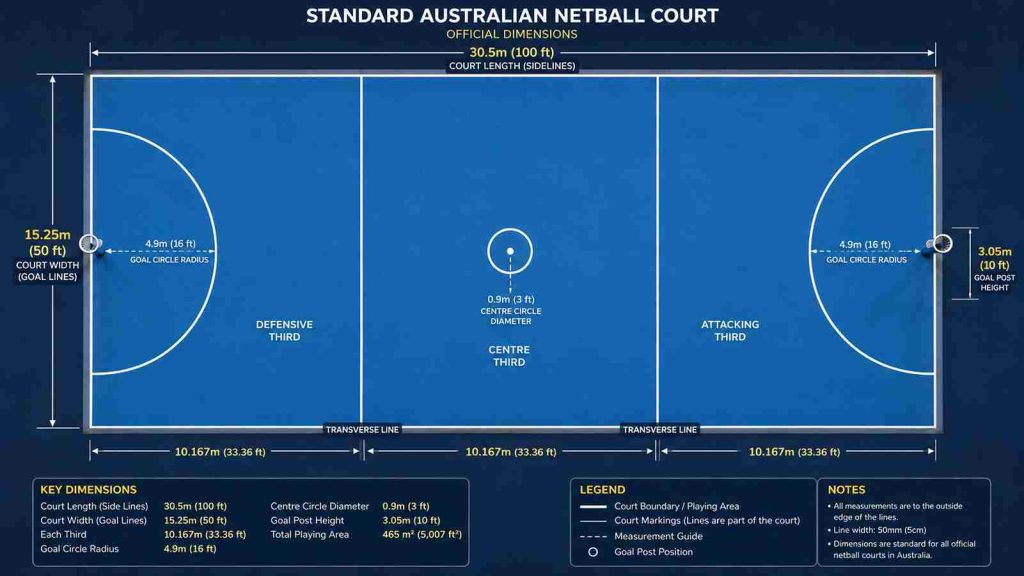
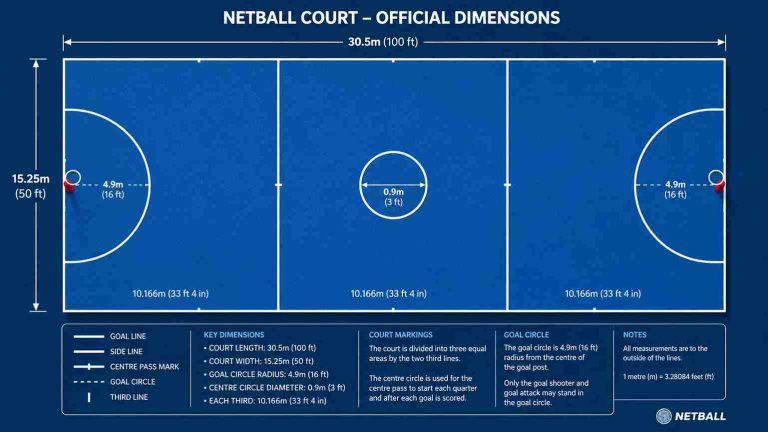
A standard senior netball court in Australia measures:
- 30.5 metres long
- 15.25 metres wide
These official dimensions apply across school competitions, local clubs, state leagues, and professional netball matches throughout Australia.
The longer boundaries are known as the side lines, while the shorter ends are called the goal lines. Together, they create a rectangular playing surface covering approximately 465 square metres.
These dimensions are carefully balanced to support the fast-paced nature of the game. Players need enough space to move freely, create passing lanes, defend effectively, and transition quickly between attack and defence.
The court may seem compact on television, but once fourteen players and umpires are moving at speed, every metre matters. Good spacing becomes essential for maintaining flow and avoiding congestion.
All official measurements are taken to the outside edge of the court markings, and the lines themselves form part of the playing area. Standard line width is usually 50mm.
Netball Court Measurements in Metres and Feet
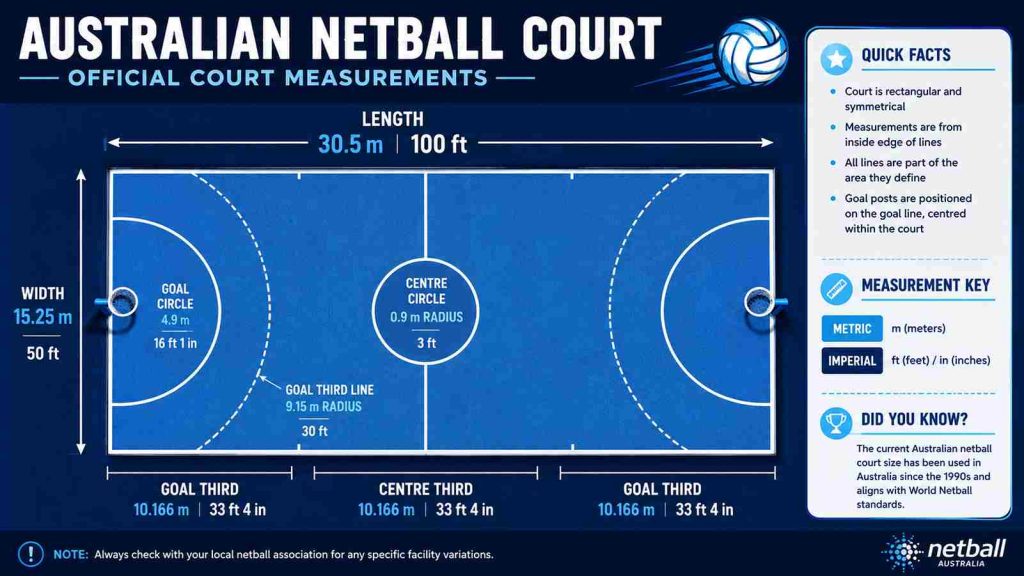
The table below shows official netball court dimensions in australia in metres and feet for quick reference.
| Measurement | Metres | Feet (Approx.) |
|---|---|---|
| Court Length | 30.5 m | 100 ft |
| Court Width | 15.25 m | 50 ft |
| Playing Area | 465 m² | ~5,007 ft² |
| Each Third | 10.167 m | ~33.36 ft |
| Goal Circle Radius | 4.9 m | 16 ft |
| Centre Circle Diameter | 0.9 m | 3 ft |
| Goal Post Height | 3.05 m | 10 ft |
These measurements are especially useful for schools, clubs, and facility planners comparing netball courts with basketball, volleyball, or multi-purpose sports surfaces.
Understanding conversions between metric and imperial measurements also helps readers searching for netball court size in feet or reviewing older facility plans.
Court Markings and Key Areas Explained
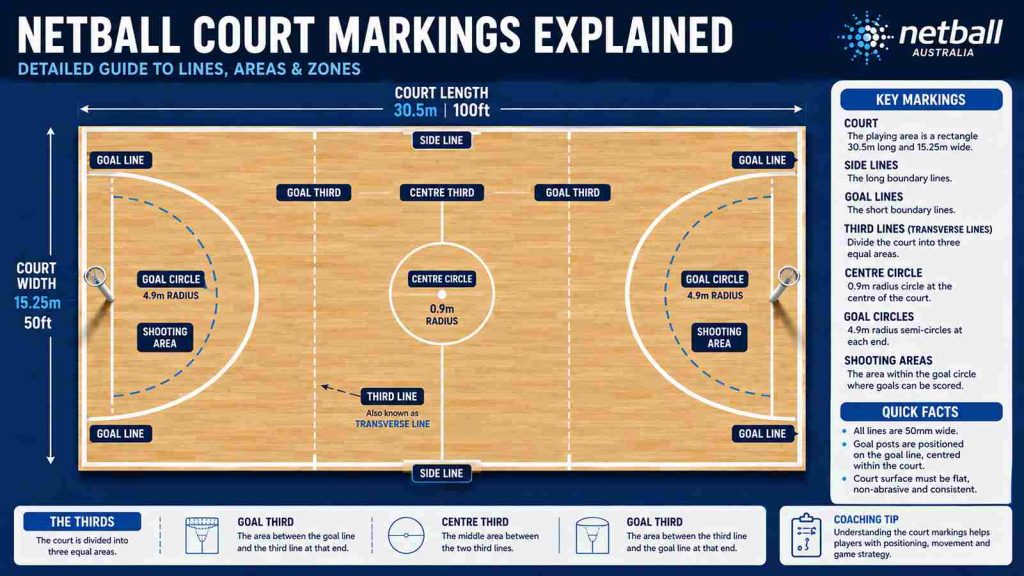
One of the most unique aspects of netball is its structured court layout. Every section of the court has a specific purpose, and positional restrictions shape how the game is played.
The court is divided into three equal sections, commonly known as thirds:
- Defensive Third
- Centre Third
- Attacking Third
Two transverse lines divide the court evenly across its width.
Centre Third
The centre third contains the centre circle, where play begins after each goal through the centre pass.
- Centre circle diameter: 0.9 metres
- Positioned exactly in the middle of the court
This area becomes one of the busiest zones during matches because players constantly transition through it.
Goal Thirds and Shooting Circles
At each end of the court is a goal circle (also called a shooting circle).
Key measurements:
- Radius: 4.9 metres
- Semi-circular shape
- Measured from the midpoint of the goal line
Only:
- Goal Shooter (GS)
- Goal Attack (GA)
can attempt shots from inside the shooting circle.
Court Line Visibility
Court lines are normally painted in:
- White
- Yellow
- Other high-contrast colours
High visibility is important because players make rapid footwork decisions during gameplay.
Netball Court Diagram Description
A standard netball court diagram typically shows:
- A rectangular playing area
- Three equal court sections
- A centre circle
- Two semi-circular shooting areas
- Goal posts centred on each goal line
Many modern instructional diagrams also include:
- Player zones
- Positional restrictions
- Movement examples
- Colour-coded court sections
Netball Court Positions and Player Zones
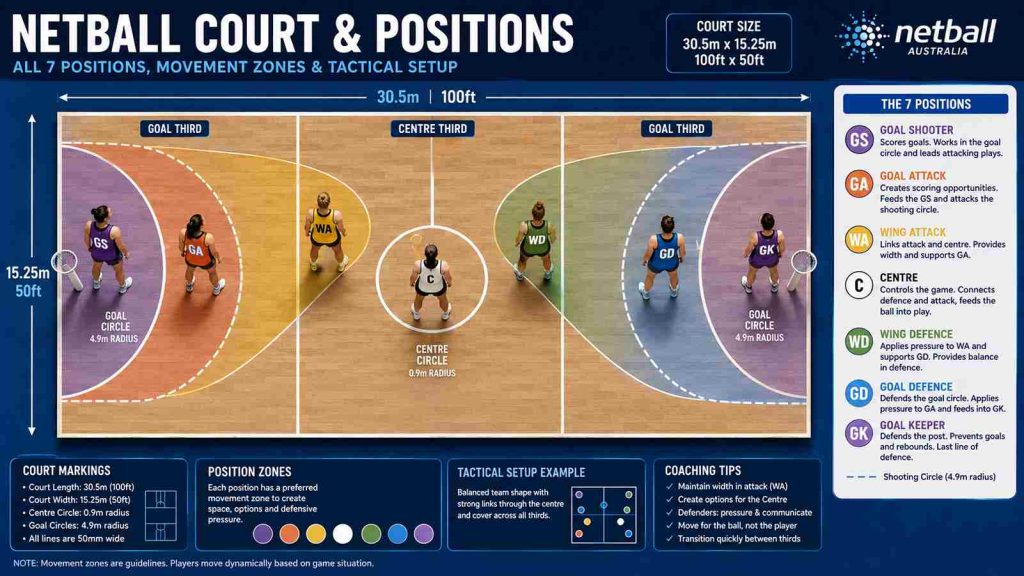
Netball differs from many sports because players cannot move freely across the entire court. Each position has designated playing areas.
These restrictions improve:
- Team structure
- Tactical movement
- Passing accuracy
- Game balance
Standard Netball Court Positions
| Position | Abbreviation | Allowed Areas | Main Role |
|---|---|---|---|
| Goal Keeper | GK | Defensive goal third + circle | Defend shots and rebounds |
| Goal Defence | GD | Defensive & centre thirds + circle | Support defence |
| Wing Defence | WD | Defensive & centre thirds | Pressure attacking feeds |
| Centre | C | All thirds except circles | Link attack and defence |
| Wing Attack | WA | Centre & attacking thirds | Feed shooters |
| Goal Attack | GA | Centre & attacking thirds + circle | Assist scoring |
| Goal Shooter | GS | Attacking goal third + circle | Main scorer |
Understanding Positioning
The positional restrictions are what make netball strategically unique.
For example:
- The Centre covers the most ground during a match.
- The Goal Shooter focuses mainly around the shooting circle.
- Wing players control movement through the sidelines and centre channels.
This structure prevents overcrowding while encouraging coordinated passing and movement.
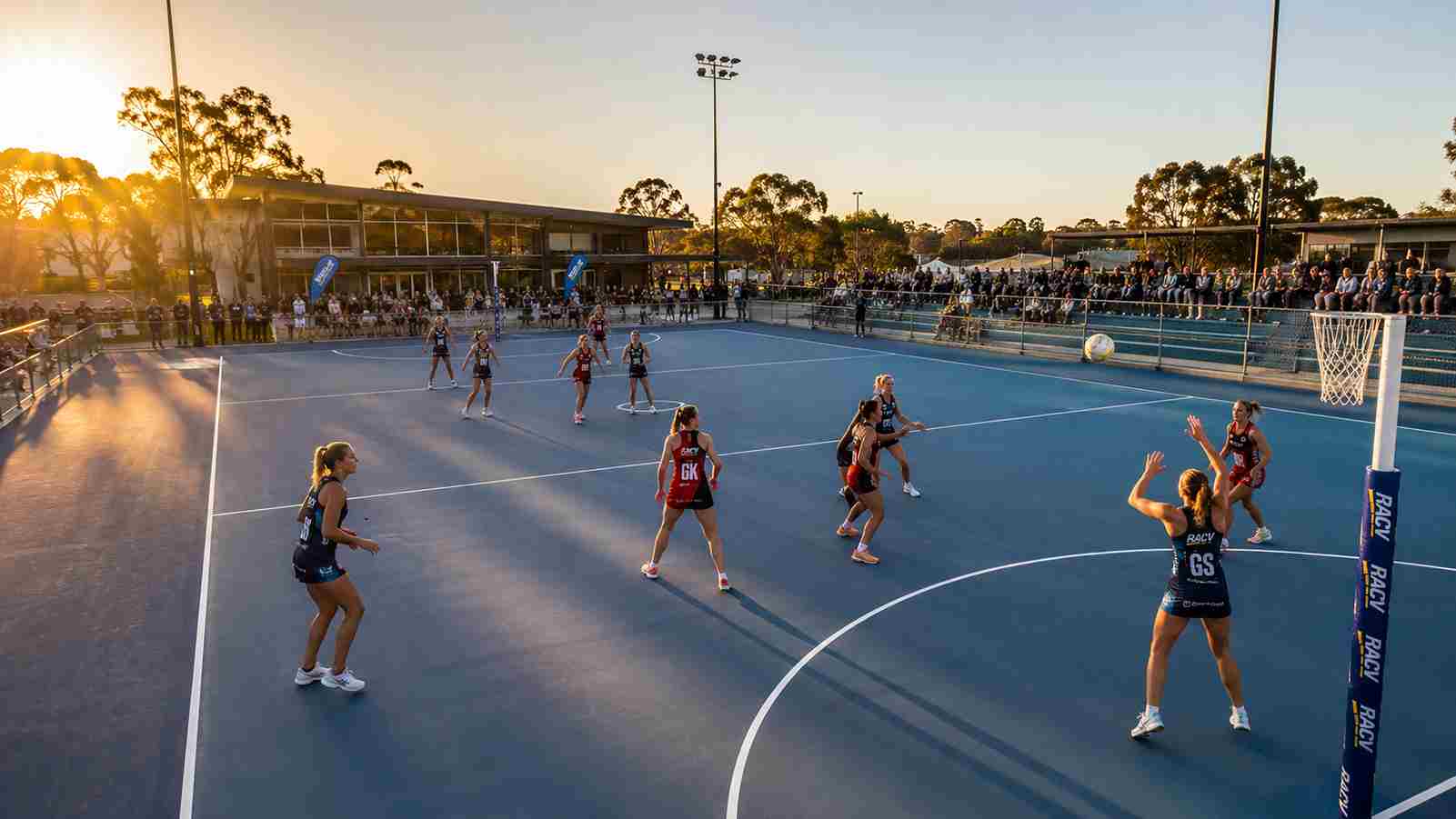
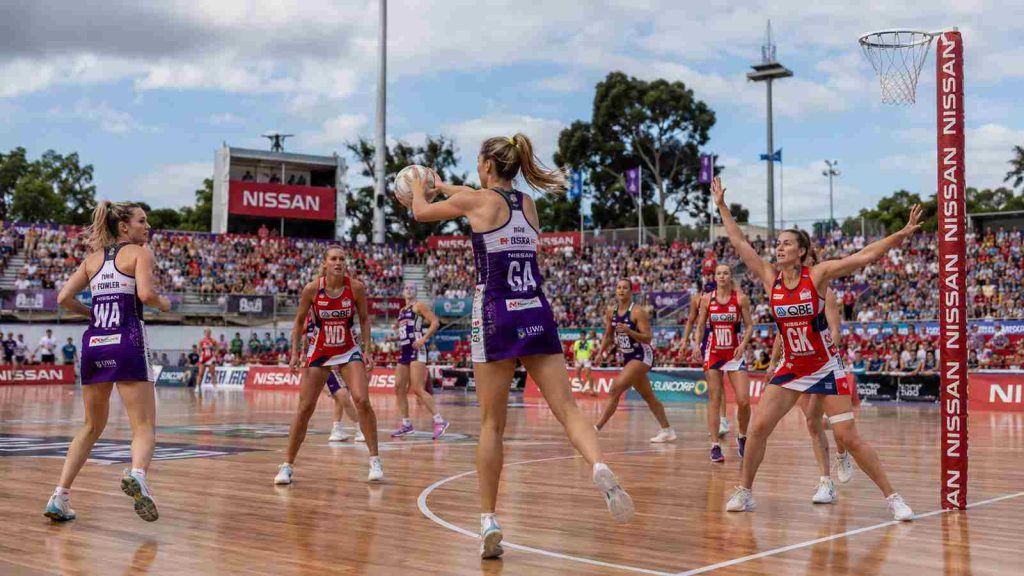
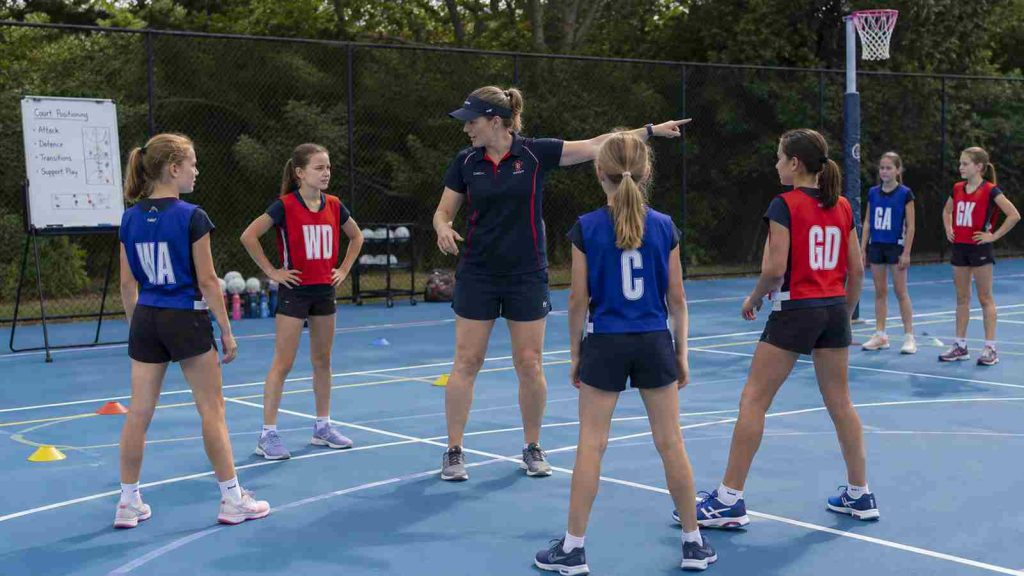
Netball Court With Players
In most tactical diagrams showing a netball court with players, you’ll see:
- GS and GA positioned inside or near the shooting circle
- WA controlling attacking feeds
- Centre moving through all thirds
- Defensive players mirroring attackers in their zones
These diagrams help beginners quickly understand positional responsibilities.
Indoor vs Outdoor Netball Court Dimensions
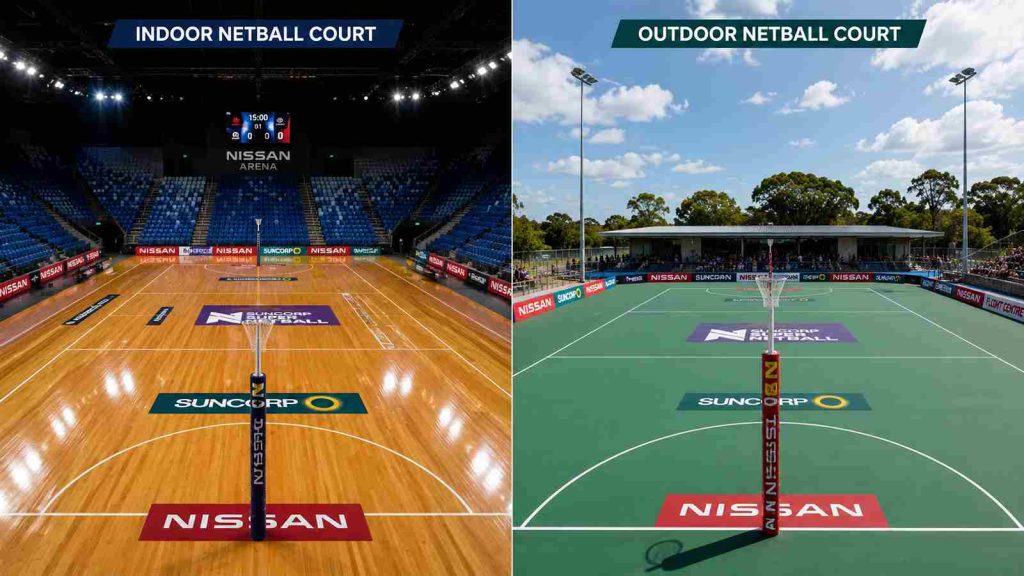
Official playing dimensions stay the same whether the court is indoors or outdoors. However, the surrounding conditions and surfaces differ significantly.
| Aspect | Indoor Court | Outdoor Court |
|---|---|---|
| Playing Dimensions | 30.5m × 15.25m | Same |
| Surface Type | Timber or sprung flooring | Asphalt/acrylic/concrete |
| Drainage | Flat surface | Slight drainage slope |
| Ceiling Height | Minimum 8.3m | Open-air |
| Weather Impact | None | Wind/rain possible |
| Best For | Competitive consistency | Community access |
Indoor courts usually provide:
- Better grip
- More consistent movement
- Reduced weather interruptions
- Improved lighting conditions
Outdoor courts remain extremely common across Australia due to accessibility and lower maintenance costs.
Safety Clearances and Court Space Requirements
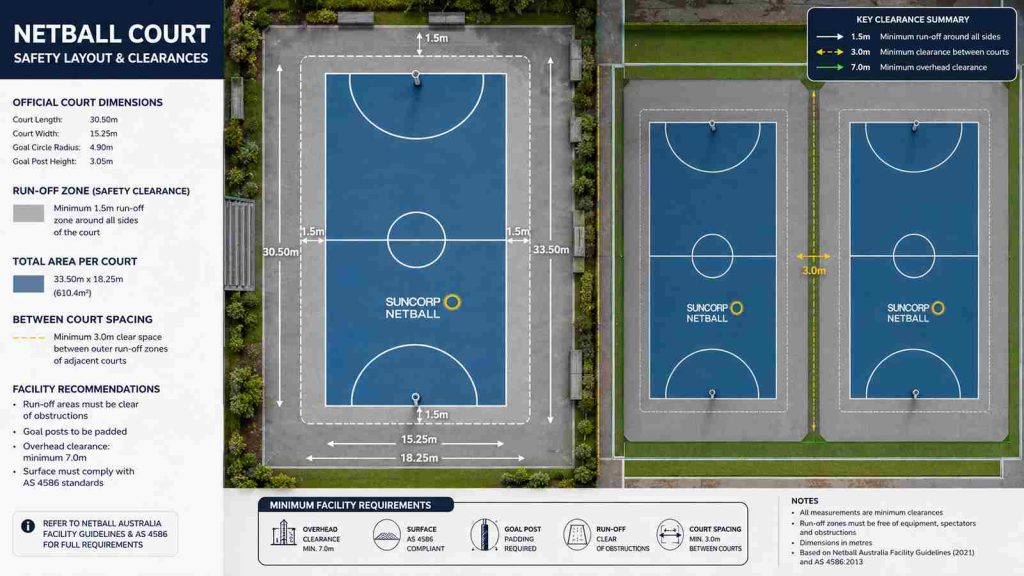
One of the most overlooked aspects of court planning is the surrounding safety area.
Recommended Run-Off Space
Official recommendations require:
- A minimum 3.05-metre clear run-off zone around the entire court
For facilities with multiple courts:
- Spacing between courts should increase to approximately 3.65 metres
Total Space Needed
Including run-off areas, a complete court footprint generally requires:
| Area | Approximate Measurement |
|---|---|
| Total Length | ~36.6 m |
| Total Width | ~21.35 m |
This additional space helps players slow down safely after chasing loose balls and gives umpires enough room to move freely.
Additional Safety Recommendations
Experienced facility managers often recommend:
- Non-slip surfaces
- Padded goal posts
- Clear spectator separation
- Proper lighting systems
- Smooth drainage design
These small details significantly improve both safety and player confidence.
Netball Court Measurements for Kids and Juniors
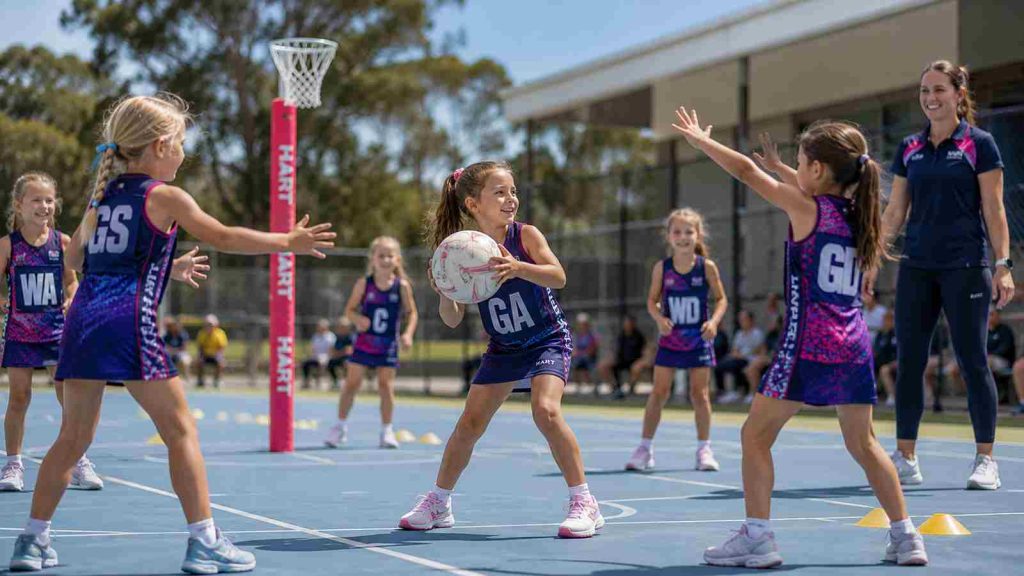
Junior netball often uses modified setups to help younger players develop skills more comfortably.
Junior Court Modifications
Many Australian junior competitions use:
- Full-size courts
- Lowered goal posts
For example:
- Netta competitions (ages 8–10) commonly use 2.4m goal posts
Younger beginner groups may also use:
- Smaller courts
- Reduced playing areas
- Lower rings
Junior Netball Setup Table
| Age Group | Court Setup | Goal Height |
|---|---|---|
| Netta (8–10 years) | Full-size court | 2.4 m |
| Beginner Juniors | Modified smaller court | 2.4–2.75 m |
| Senior Competition | Full-size court | 3.05 m |
These modifications make the game more enjoyable and allow younger players to build confidence gradually.
Common Beginner Mistakes and Expert Tips
Even experienced organisers sometimes overlook important details when setting up or maintaining a netball court.
Common Mistakes
Ignoring Run-Off Space
Placing courts too close to fences or seating areas creates unnecessary injury risks.
Incorrect Court Measurements
Small measuring errors become noticeable during competitive play.
Poor Surface Choice
Slippery or uneven surfaces increase ankle and knee injury risks.
Wrong Goal Heights for Juniors
Using adult ring heights for young players can slow skill development and reduce enjoyment.
Expert Tips
- Always double-check measurements before painting permanent lines.
- Use high-contrast markings for better visibility.
- Teach positional zones early during junior coaching.
- Prioritise non-slip court surfaces.
- Leave extra safety space whenever possible.
- Practice centre-pass movements regularly because they shape match rhythm.
Experienced coaches often say that properly understanding court spacing improves player decision-making more than many beginners realise.

Conclusion
Understanding netball court dimensions in Australia gives you much more than just numbers and measurements — it helps you appreciate how carefully the sport is designed for speed, teamwork, safety, and strategy. From the official 30.5m x 15.25m playing area to the goal circles, thirds, player movement zones, and recommended safety clearances, every line on the court serves a purpose.
Whether you’re a coach organising training sessions, a school planning a new sports facility, a parent helping a child learn the game, or simply someone passionate about netball, knowing these measurements can make a real difference. Proper court dimensions help players develop better movement, spacing awareness, and tactical understanding while also reducing injury risks through safe run-off areas and correct equipment setup.
One of the great things about netball is that the game remains accessible for all ages. Junior modifications, indoor facilities, and community courts allow beginners and experienced players alike to enjoy the sport in a safe and structured environment.
The next time you step onto a netball court or watch a match, you’ll notice the game differently. Every pass, movement, and defensive setup is shaped by the dimensions beneath the players’ feet — and once you understand those details, the sport becomes even more enjoyable to follow and play.
Frequently Asked Questions

Olivia Brooks
Olivia Brooks is a netball author with a strong understanding of competitive gameplay, court strategy, and player development. Through years of match analysis, tactical study, and close observation of the sport, Olivia brings practical insight and clear, reader-friendly explanations to every article.
She specializes in covering netball techniques, positional roles, court dimensions, and game strategy in a way that helps players, coaches, and fans better understand the fast-paced and tactical nature of modern netball.