Netball Court Dimensions: The Complete Guide to Official Measurements, Layouts, and Standards
Netball is one of the world’s fastest and most tactical team sports, combining precision passing, intelligent movement, sharp shooting, and disciplined positioning. At the heart of every match lies a carefully designed playing surface that controls how the game flows. Understanding netball court dimensions is essential not only for players and coaches but also for schools, sports facility planners, teachers, and fans who want a deeper appreciation of the sport.
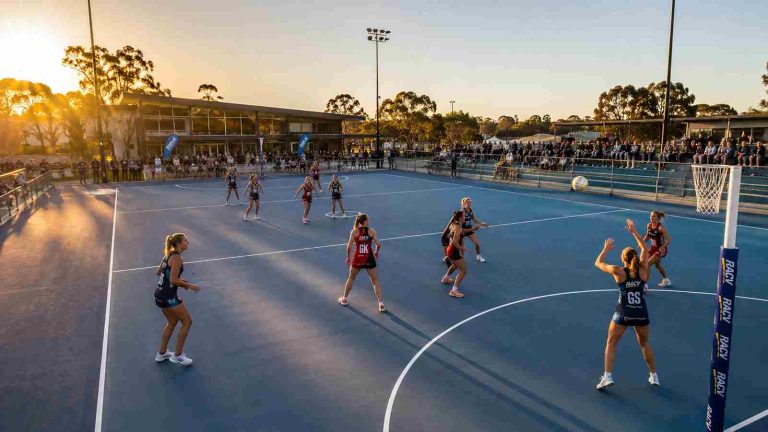
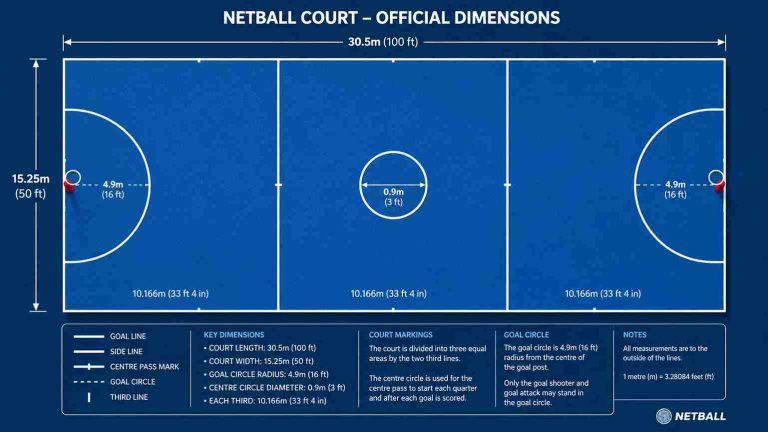
A standard full-size netball court measures 30.5 metres long and 15.25 metres wide, with clearly marked thirds, shooting circles, and restricted player zones. These measurements are used across professional competitions, schools, community clubs, and international tournaments.
Accurate court measurements influence:
- Player safety
- Tactical movement
- Fair competition
- Passing angles
- Defensive spacing
- Shooting opportunities
- Skill development
Whether you are learning the basics or planning a professional facility, understanding the dimensions of a netball court helps you understand why the game feels so structured, fast, and strategic.
In this detailed guide, you’ll learn:
- Official court measurements in metres and feet
- Court layout and markings
- Netball court positions and movement restrictions
- Goal post measurements
- Indoor and outdoor court standards
- Fast5 and mini netball variations
- Australian and New Zealand regulations
- Construction and safety guidelines
- Frequently asked questions about court sizing and rules
Official Netball Court Dimensions
The official dimensions of a netball court are standardized by the International Netball Federation and adopted across most countries, including Australia and New Zealand.
A regulation court is rectangular and divided into three equal playing sections known as thirds. These dimensions create the perfect balance between speed, spacing, tactical movement, and positional restriction.
Standard Measurements
- Court Length: 30.5 metres (100 feet)
- Court Width: 15.25 metres (50 feet)
- Goal Circle Radius: 4.9 metres (16 feet)
- Centre Circle Diameter: 0.9 metres
- Goal Post Height: 3.05 metres (10 feet)
- Line Width: 50 mm
These standard netball court dimensions are used for:
- Professional matches
- International competitions
- School tournaments
- Club leagues
- National championships
The consistency of these measurements ensures players experience the same court layout regardless of venue or country.
Netball Court Measurements in Meters and Feet
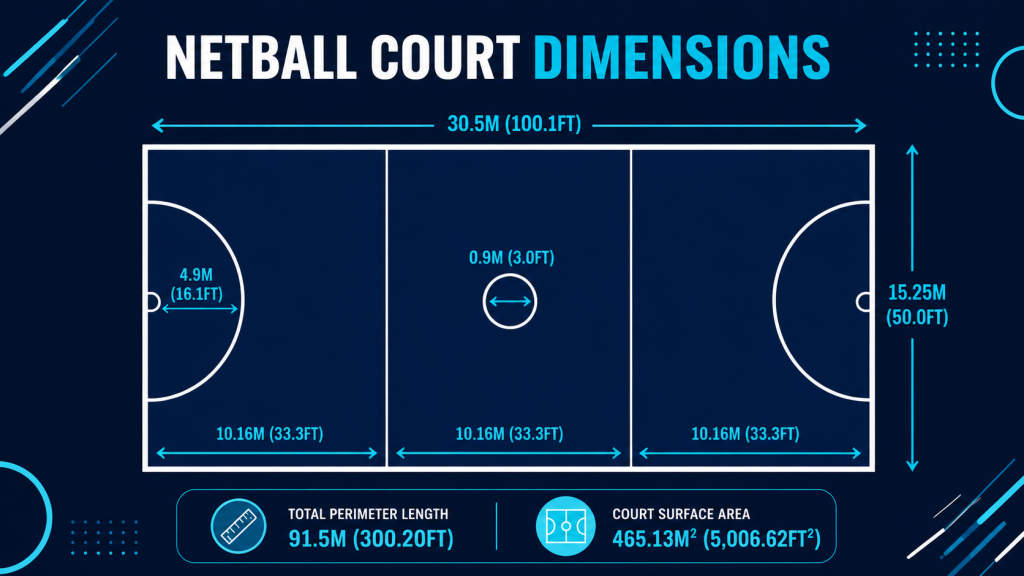
Many players, coaches, and schools use either metric or imperial systems. The following table compares the official measurements clearly.
Official Netball Court Measurements Table
These measurements remain the benchmark for official competitions worldwide.
Netball Court Layout and Dimensions
The netball court layout is designed to create structured movement and tactical balance. Unlike basketball or football, players cannot move freely across the entire court. Position restrictions are central to the sport.
Main Court Areas
The court contains:
- Two goal thirds
- One centre third
- Two shooting circles
- One centre circle
- Sidelines and goal lines
Each section has a specific role in gameplay.
Court Thirds
Two transverse lines divide the court into three equal sections.
The Three Court Thirds
- Attacking Third
- Centre Third
- Defending Third
Each third measures approximately 10.17 metres in length.
These divisions:
- Prevent overcrowding
- Create tactical spacing
- Encourage structured passing
- Support one-on-one matchups
Elite coaches often use court thirds during training drills to improve player spacing and transition play.
Centre Circle
The centre circle sits in the exact middle of the court and measures 0.9 metres in diameter.
This area is used for:
- Starting play
- Restarting after goals
- Centre passes
The centre player begins each restart from this circle.
Shooting Circles
At each end of the court is a semi-circle with a 4.9-metre radius.
Only:
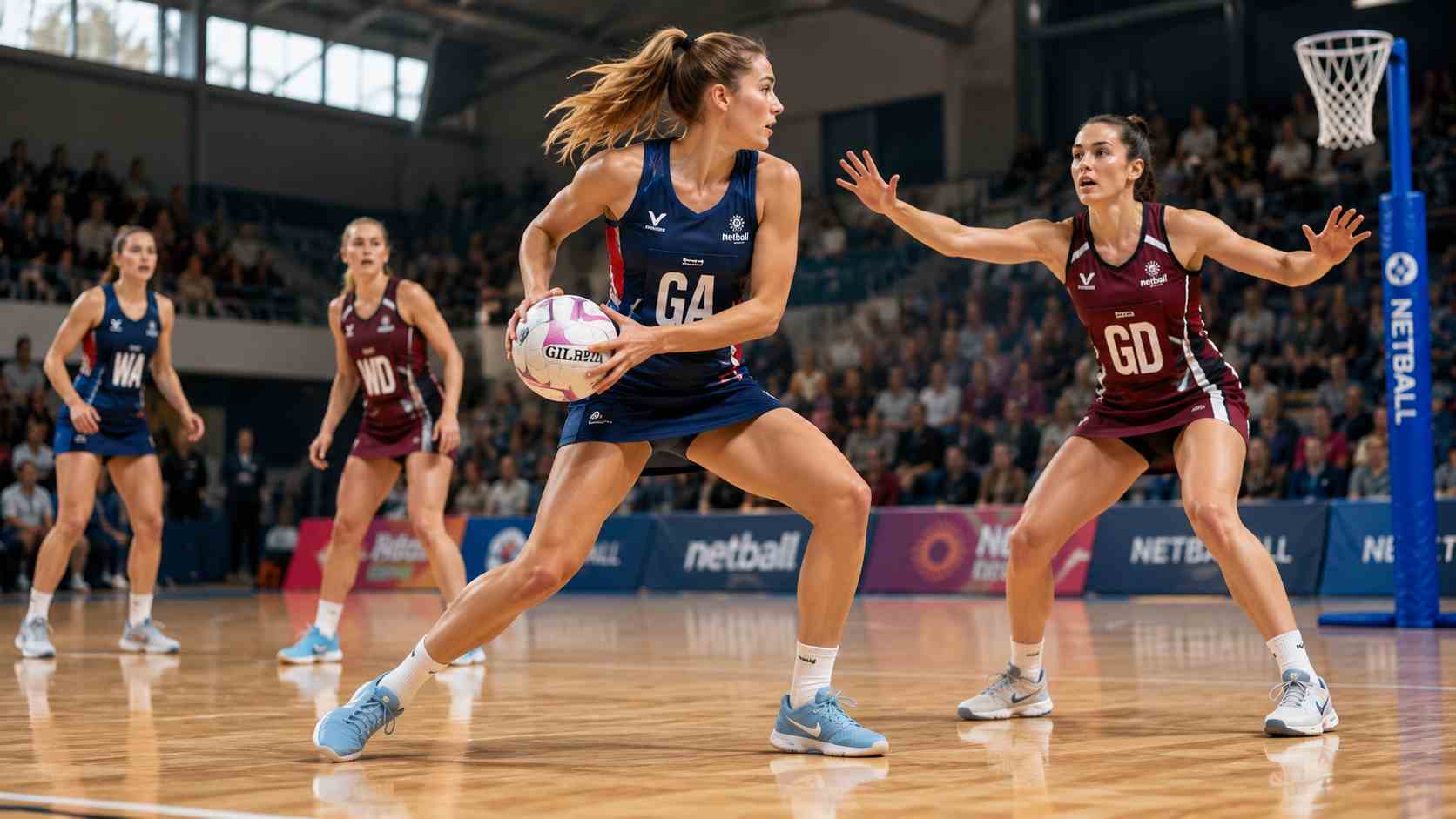
- Goal Shooter (GS)
- Goal Attack (GA)
may score from inside this area.
These circles are among the most tactical zones in netball because:
- Space is limited
- Defensive pressure is intense
- Footwork becomes critical
- Positioning determines shooting success
Boundary Lines
Sidelines
The longer sides of the court are called the sidelines.
Goal Lines
The shorter end boundaries are known as the goal lines.
If a player steps on or over a line while holding the ball, possession is lost.
All lines are:
- 50 mm wide
- Considered part of the playing area
Quick Facts About Netball Courts
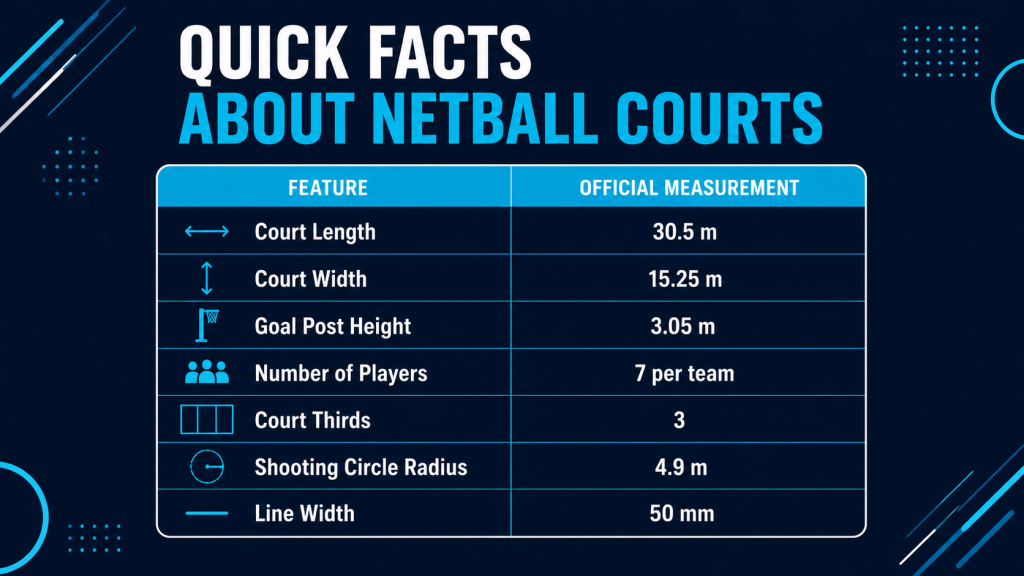
Diagram of Netball Court With Measurements
A proper diagram of a netball court with players and measurement typically includes:
- Court thirds
- Shooting circles
- Centre circle
- Goal posts
- Player zones
- Boundary markings
These diagrams are extremely valuable for:
- Beginner coaching
- School sports programs
- Tactical analysis
- Referee education
- Player positioning drills
Suggested Diagram Labels
- Netball court dimensions in meters
- Netball court with player zones
- Standard netball court layout
- Shooting circle measurements
- Indoor netball court dimensions
- Fast5 court layout
Netball Court Positions Explained
One of the defining features of netball is positional restriction. Every player has designated zones where they may move.
Netball Positions Table
Detailed Breakdown of Each Position
Goal Shooter (GS)
The Goal Shooter operates closest to the goal.
Responsibilities
- Scoring goals
- Holding position
- Rebounding missed shots
- Creating space inside the circle
Key Skills
- Accuracy
- Strength
- Footwork
- Balance under pressure
Goal Attack (GA)
The Goal Attack supports scoring while helping transition the ball into attack.
Responsibilities
- Feeding the shooter
- Creating movement
- Taking shots
- Supporting centre passes
The GA is often one of the most versatile attacking players.
Wing Attack (WA)
The Wing Attack controls attacking flow outside the shooting circle.
Responsibilities
- Delivering accurate passes
- Creating width
- Driving into open space
- Supporting attacking transitions
Strong vision and timing are essential.
Centre (C)
The Centre is the engine of the team.
Responsibilities
- Taking centre passes
- Linking defence and attack
- Controlling tempo
- Supporting transitions
The Centre covers the most ground during a match.
Wing Defence (WD)
The Wing Defence aims to disrupt attacking movement.
Responsibilities
- Intercepting passes
- Applying pressure
- Blocking passing lanes
- Supporting defensive transitions
Goal Defence (GD)
The Goal Defence protects the shooting area while also helping transition play.
Responsibilities
- Defending the Goal Attack
- Contesting shots
- Rebounding
- Creating turnovers
Goal Keeper (GK)
The Goal Keeper anchors the defensive circle.
Responsibilities
- Contesting shots
- Blocking passes
- Protecting the goal area
- Securing rebounds
Height, timing, and anticipation are major advantages in this role.
Netball Goal Post Measurements
Netball goal post measurements are standardized internationally.
Official Goal Specifications
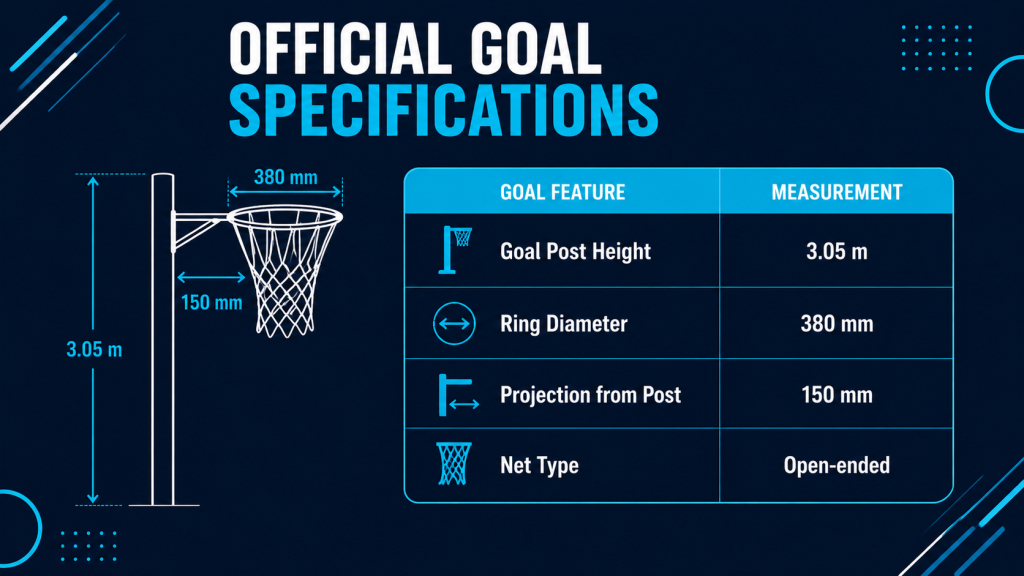
The posts must:
- Be stable
- Be securely installed
- Include safety padding
- Align correctly with the goal line
Proper installation is critical for both fairness and safety.
Indoor Netball Court Dimensions
Indoor netball court dimensions use the same official playing size:
- 30.5 metres x 15.25 metres
However, indoor facilities require additional standards.
Indoor Court Requirements
Flooring
Preferred indoor surfaces include:
- Sprung timber floors
- Synthetic sports flooring
- Shock-absorbing materials
Ceiling Height
Most indoor venues require:
- Minimum 7.5–8.5 metre clearance
Lighting
Indoor courts require:
- Even lighting distribution
- Reduced glare
- Clear visibility for passing and shooting
Indoor surfaces are generally preferred for elite competition because they:
- Reduce joint stress
- Improve grip consistency
- Allow smoother movement
Outdoor Netball Court Surfaces
Outdoor courts are designed for durability and weather resistance.
Common Outdoor Surfaces
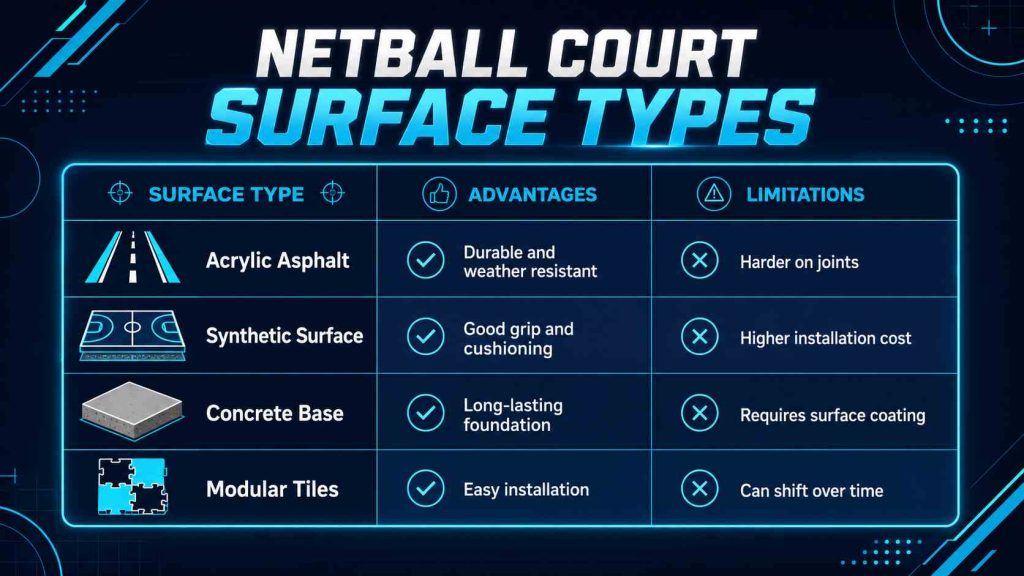
Proper drainage is essential for outdoor courts.
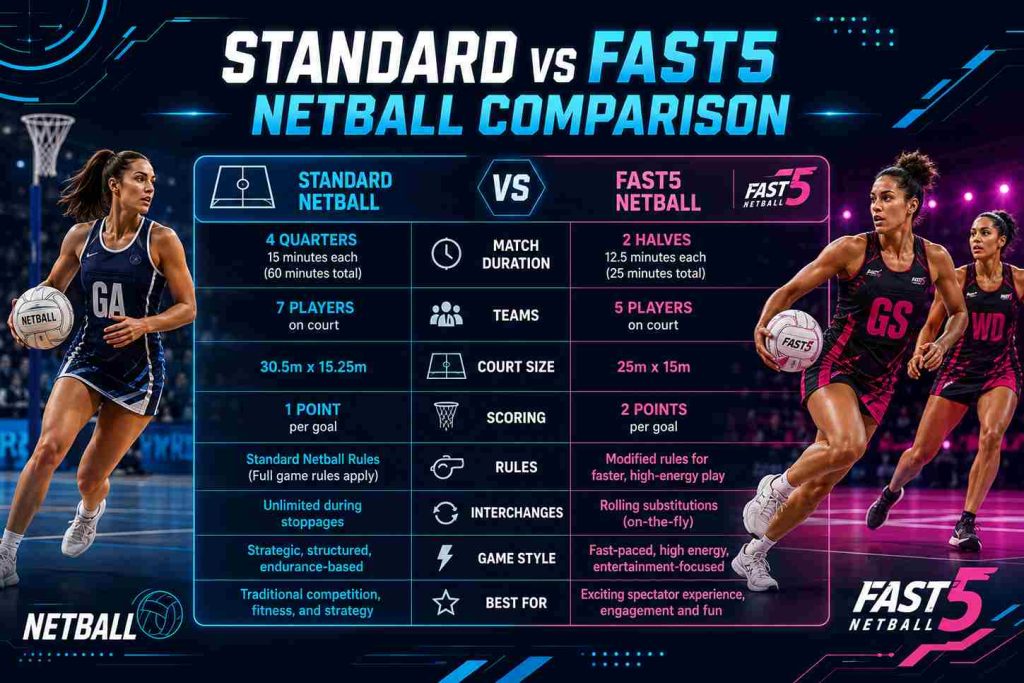
Fast5 Netball Court Dimensions
Fast5 netball uses standard court measurements but introduces modified gameplay rules.
Fast5 Features
- Five players per team
- Shorter quarters
- Power-play periods
- Bonus scoring zones
- Faster gameplay
Fast5 Shooting Zones
Different scoring values are awarded depending on shooting distance:
- 1 point
- 2 points
- 3 points
This creates:
- More aggressive tactics
- Faster transitions
- Greater emphasis on long-range shooting
Standard vs Fast5 Netball Comparison
Mini Netball Court Dimensions

Mini netball is designed for younger players developing foundational skills.
Typical Mini Netball Measurements
These modifications help children:
- Build confidence
- Improve coordination
- Learn spacing
- Develop passing skills safely
Australian and New Zealand Netball Court Standards
Both Australia and New Zealand follow International Netball Federation standards for elite competition.
Netball Australia Court Dimensions
Australian courts use:
- Official international measurements
- Safety runoff areas
- All-weather surfaces
- Professional lighting systems
Australia places strong emphasis on:
- Community participation
- School netball development
- Facility quality
Netball Court Dimensions NZ
New Zealand facilities also follow international standards while focusing heavily on:
- Durable outdoor courts
- Club accessibility
- Junior player development
Both countries are global leaders in netball infrastructure and coaching systems.
Safety Runoff Areas
Professional courts include extra clear space around the playing area.
Recommended Runoff Space
These spaces reduce collision risks and improve player safety.
Netball Court Construction Guidelines
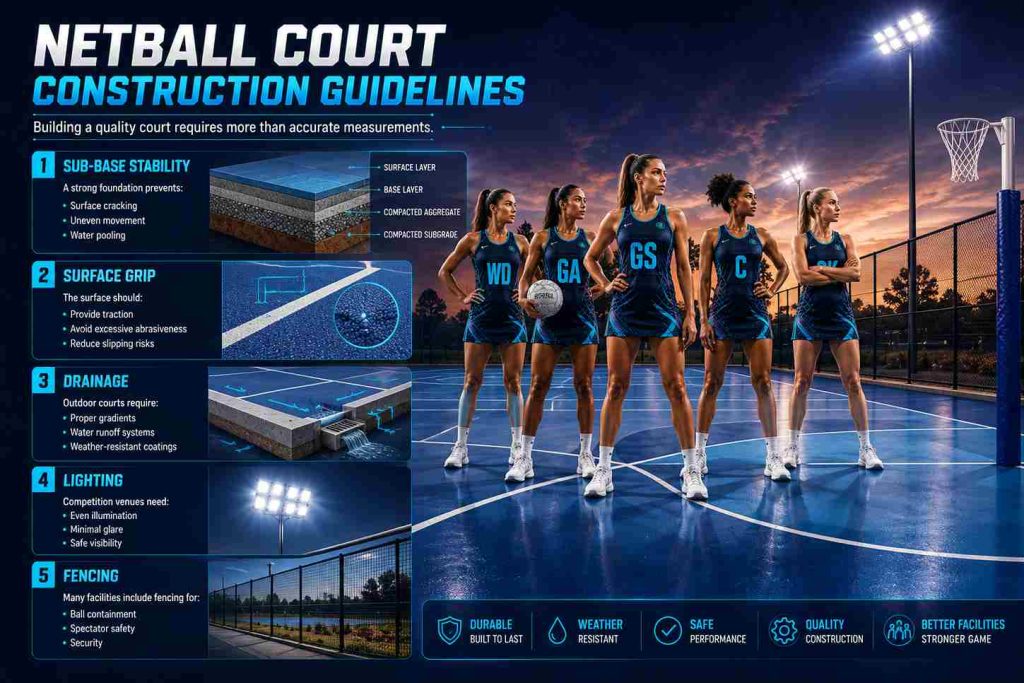
Building a quality court requires more than accurate measurements.
Key Construction Factors
Sub-base Stability
A strong foundation prevents:
- Surface cracking
- Uneven movement
- Water pooling
Surface Grip
The surface should:
- Provide traction
- Avoid excessive abrasiveness
- Reduce slipping risks
Drainage
Outdoor courts require:
- Proper gradients
- Water runoff systems
- Weather-resistant coatings
Lighting
Competition venues need:
- Even illumination
- Minimal glare
- Safe visibility
Fencing
Many facilities include fencing for:
- Ball containment
- Spectator safety
- Security
Why Accurate Court Dimensions Matter
Correct court dimensions directly affect gameplay quality.
Benefits of Proper Measurements
- Fair competition
- Consistent gameplay
- Better tactical spacing
- Improved training quality
- Enhanced player safety
- Accurate positional discipline
Even small measurement errors can affect:
- Passing angles
- Shooting distance
- Defensive positioning
- Player movement timing
Professional coaches frequently use court markings during drills to teach:
- Spatial awareness
- Timing
- Defensive pressure
- Transition movement
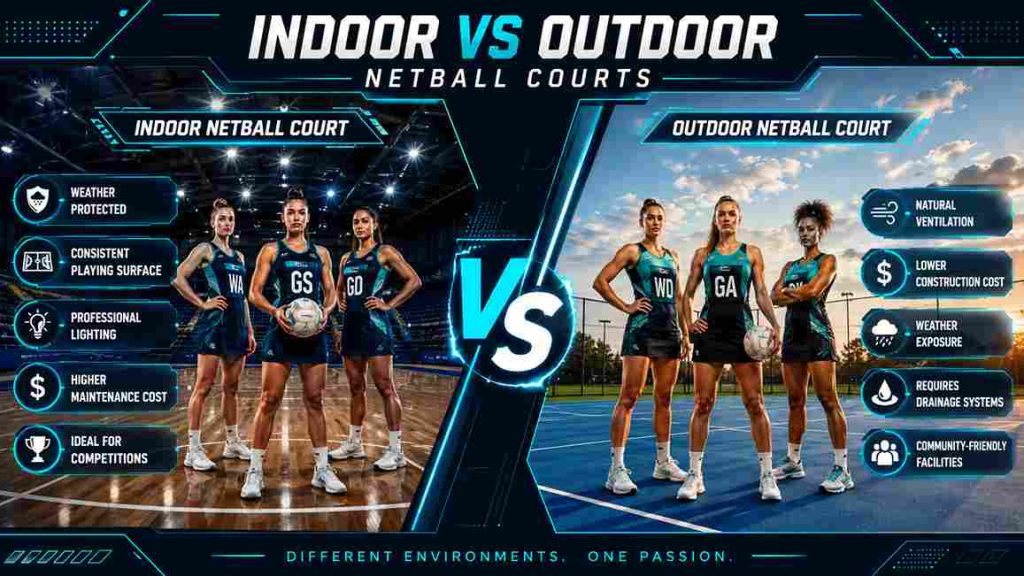
Indoor vs Outdoor Netball Courts
Conclusion
Understanding netball court dimensions helps players, coaches, teachers, and fans appreciate the structure and strategy behind the sport. Every line, circle, and measurement plays a specific role in shaping movement, spacing, passing angles, and defensive tactics.
The standard 30.5-metre by 15.25-metre court has been carefully designed to balance speed, skill, and positional discipline. From the centre third to the shooting circles, every area contributes to the fast-paced yet highly organized nature of netball.
Whether examining official netball court dimensions in Australia and New Zealand, learning about Fast5 modifications, or exploring mini netball layouts for younger athletes, it becomes clear that court design directly influences player development and match quality.
Indoor and outdoor surfaces, proper runoff areas, accurate line markings, and regulation goal post measurements all contribute to safer and more enjoyable gameplay. Coaches rely heavily on these measurements to teach tactical awareness, while facility planners use them to build compliant courts for schools and competitive venues.
As netball continues growing internationally, maintaining accurate court standards remains essential for fairness, safety, and player progression. The next time you watch or play a match, the court itself will feel less like a simple playing surface and more like a carefully engineered part of the game’s tactical identity.
Frequently Asked Questions About Netball Courts

Olivia Brooks
Olivia Brooks is a netball author with a strong understanding of competitive gameplay, court strategy, and player development. Through years of match analysis, tactical study, and close observation of the sport, Olivia brings practical insight and clear, reader-friendly explanations to every article.
She specializes in covering netball techniques, positional roles, court dimensions, and game strategy in a way that helps players, coaches, and fans better understand the fast-paced and tactical nature of modern netball.