
Badminton Court Dimensions: The Complete Guide (Feet, Meters, CM & Inches)
If you’ve ever stood on a badminton court holding a tape measure, wondering whether the line six feet from the net is actually in the right place, you already know why badminton court dimensions aren’t something you can eyeball.
A few centimeters off on the service line, and you’ve got players arguing calls all afternoon. A ceiling that’s a meter too low, and nobody can hit a proper clear. This guide covers every official measurement — in feet, meters, centimeters, and inches — plus the practical details that most court guides skip:
what facilities actually build versus what the rulebook technically requires, how to mark a court yourself, and a handful of related questions players search for constantly, including whether badminton and pickleball courts share the same footprint.
Quick answer: A regulation badminton court measures 13.41 m (44 ft) long. Width is 6.1 m (20 ft) for doubles and 5.18 m (17 ft) for singles. The net stands 1.55 m (5 ft 1 in) high at the posts and 1.524 m (5 ft) at the center.
Everything below expands on that answer — with the reasoning, the exceptions, and the numbers nobody bothers to explain.
Quick Reference Summary
- Court length (singles & doubles): 13.41 m / 44 ft
- Court width, doubles: 6.1 m / 20 ft
- Court width, singles: 5.18 m / 17 ft
- Net height, posts: 1.55 m / 5 ft 1 in
- Net height, center: 1.524 m / 5 ft
- Short service line: 1.98 m / 6 ft 6 in from net
- Long service line (doubles): 0.76 m / 2 ft 6 in from back boundary
- Diagonal (doubles court): 14.37 m / 47.15 ft
- Line thickness: 40 mm / 1.5 in
- Recommended clearance: 1.5–2 m / 5–6.5 ft on all sides
- Recommended ceiling height: 9 m / 30 ft for competitive play
Why Exact Badminton Court Dimensions Actually Matter
It’s tempting to think a few centimeters won’t change much in a game played with a shuttlecock that weighs about five grams. In practice, it changes everything. The short service line exists to stop players from serving too close to the net, which would make the serve nearly unreturnable.
Move that line even 15 cm, and you’ve fundamentally altered the serve-return dynamic of the game. The same goes for the net height difference between the posts and the center — that 2.6 cm dip is there because a perfectly flat net would sag in the middle anyway, and the rule accounts for it rather than fighting it.
This is also why the dimensions of a badminton court are identical everywhere in the world that the sport is sanctioned. Unlike, say, baseball fields, which vary stadium to stadium, badminton has one universal spec set by the Badminton World Federation (BWF), and every certified court — from a school gymnasium in Ohio to the arena hosting the All England Open — follows it without regional variation.
A Brief History Behind These Numbers
The current badminton court dimensions aren’t a modern invention — they trace back to the sport’s codification in England in the late 1800s and were formalized as the game spread internationally through what eventually became the Badminton World Federation.
Early badminton, played informally on lawns, had no fixed size at all; courts varied from house to house. As the sport moved indoors and became competitive, a standard size became necessary simply so that two clubs could actually agree on what a “fair” court looked like before a match started.
What’s notable is how little these regulation badminton court dimensions have changed since standardization. Unlike sports such as basketball, where the three-point line has been moved multiple times, or American football, where field markings have seen periodic tweaks, badminton’s court size has remained essentially frozen for well over a century.
The only real adjustments over the decades have been to service line placement — largely because racket and shuttlecock technology changed how serves were played, not because the court itself needed resizing.
This stability is actually a practical advantage if you’re researching standard badminton court dimensions today: a spec sheet from decades ago is still accurate, and any source claiming a “new” or “updated” court size for BWF play should be treated with skepticism unless it cites an actual rule change.
Badminton Court Dimensions for Different Play Settings
Not every court needs to be built to full competition standard, and it’s worth being upfront about that rather than pretending every backyard setup needs BWF certification.
- Competitive/BWF-sanctioned play: Full official badminton court dimensions, 9 m+ ceiling clearance, 1.5–2 m side buffer, professional flooring (usually a sprung wood or synthetic mat system).
- School and club gymnasiums: Same court markings, but ceiling height often compromises down to 7–7.6 m, and side clearance frequently shrinks to fit multiple courts in one hall.
- Driveway or backyard courts: Many recreational players don’t mark full dimensions for a badminton court at all — they use a portable net system and rough visual boundaries. This is fine for casual play, but it does mean line calls become subjective, which is exactly why serious backyard players eventually invest in proper marking tape.
- Multi-sport gym conversions: Facilities that host badminton, pickleball, and volleyball on the same floor often paint badminton lines in one color and other sports’ lines in another, which is where a lot of confusion about dimensions of shuttle badminton court markings comes from — players sometimes follow the wrong colored line by mistake in a shared space.
Knowing which setting you’re building for changes which parts of the spec actually matter. A backyard court doesn’t need a 9-meter ceiling. A club aiming to host BWF-sanctioned tournaments doesn’t have room to compromise on any of it.
What to Do With These Numbers
If you’re building or marking a court, start with the diagonal check — it catches more layout errors than any other single measurement. If you’re coaching or settling a rules argument, the service line distances are the ones that actually decide points.
And if you’re just here because a search result raised more questions than it answered, you now have every conversion, every line, and every edge case in one place — no need to go digging through five more articles to fill in the gaps.
Official Badminton Court Dimensions: Full Unit Conversion Table
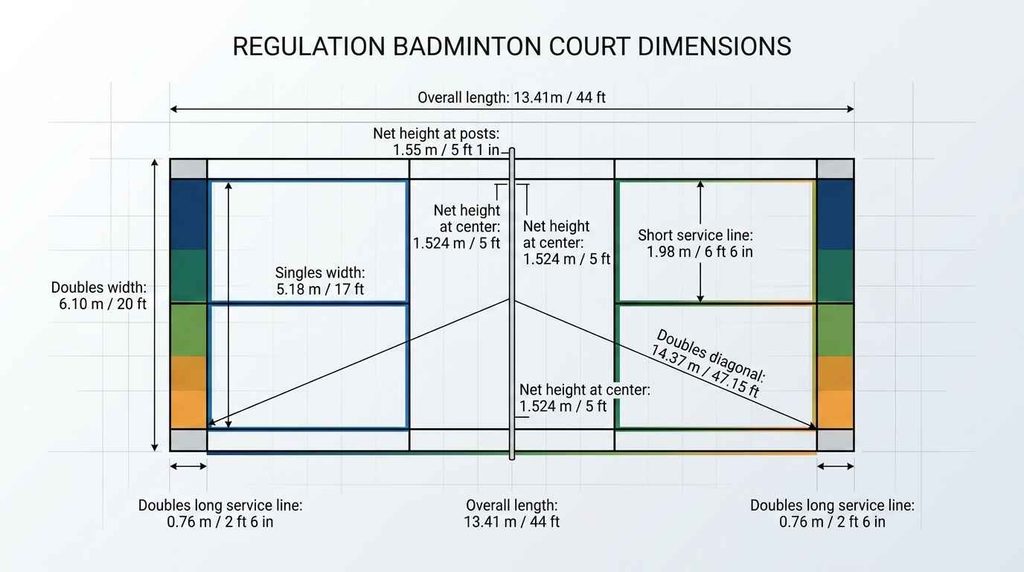
Most articles give you one unit and expect you to do the math yourself. Here’s every measurement converted across all four units people actually search for — meters, feet, centimeters, and inches — so you don’t have to touch a calculator.
This table alone answers most of the direct searches people run — badminton court dimensions in cm, badminton court dimensions in inches, badminton court size in meter, and badminton court size in feet — in one place, instead of forcing you to hunt across five different pages.
Badminton Court Size in Feet vs. Meters — And a Printable Version
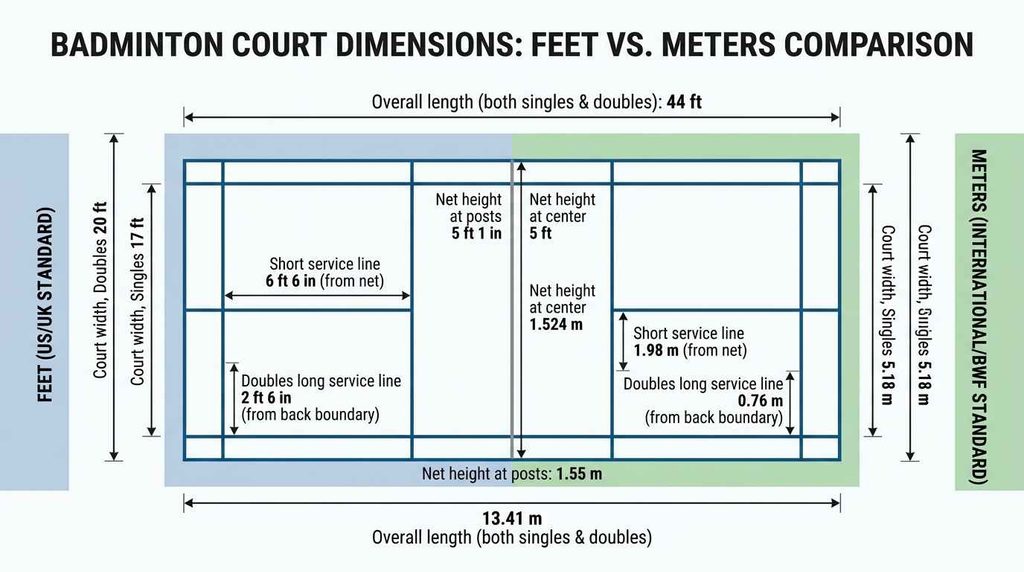
Because so many facilities in the US and UK plan construction in feet, while most of the rest of the world (and the official BWF rulebook itself) works in meters, it’s worth breaking these two out separately rather than burying them in a giant table.
In feet:
- Doubles court: 44 ft long x 20 ft wide
- Singles court: 44 ft long x 17 ft wide
- Net height: 5 ft 1 in at posts, 5 ft at center
- Short service line: 6 ft 6 in from the net
- Long service line: 2 ft 6 in from the back boundary
In meters:
- Doubles court: 13.41 m long x 6.1 m wide
- Singles court: 13.41 m long x 5.18 m wide
- Net height: 1.55 m at posts, 1.524 m at center
- Short service line: 1.98 m from the net
- Long service line: 0.76 m from the back boundary
If you’re the kind of person searching for badminton court size in feet pdf because you want something to print and pin on a clubhouse wall or hand to a contractor,
the cleanest way to build one yourself is to take the feet table above, drop it into a single-page document with a simple court diagram, and print it at actual scale on an A3 or tabloid sheet — that’s genuinely how most facility managers create their reference sheets rather than downloading a generic one, since court specs rarely change and a locally-made sheet stays accurate.
Singles vs. Doubles Court Dimensions
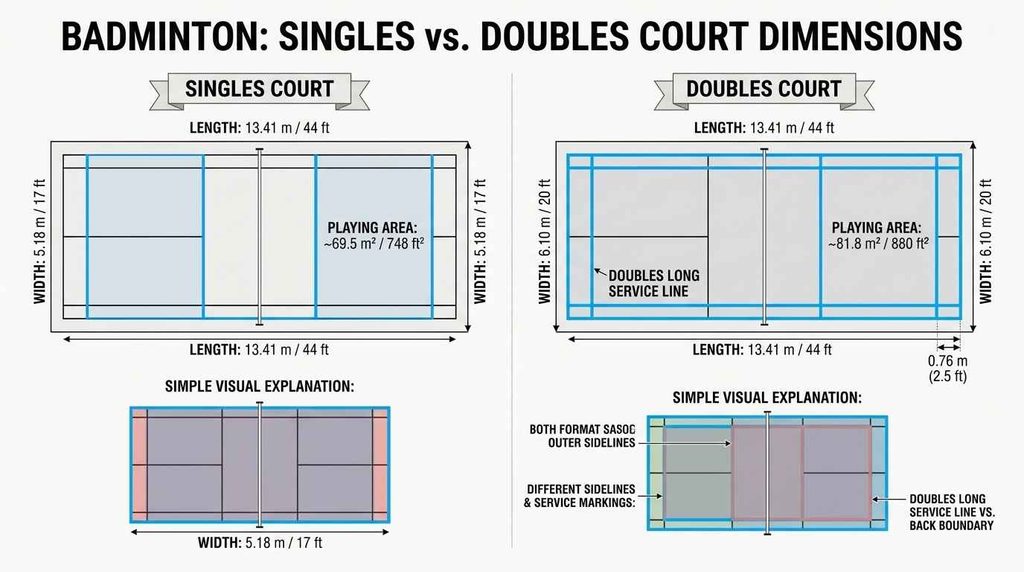
Here’s something that trips up a lot of first-time court builders: singles and doubles badminton are not played on differently sized courts in terms of overall footprint — they’re played on the same physical rectangle, but with different sidelines marked. The doubles court uses the full outer width; the singles court uses inner lines that are set in by 0.46 m (1.5 ft) on each side.
The practical reason for this difference comes down to court coverage. In singles, one player has to cover the entire depth of the court alone, so the width is narrowed to keep rallies manageable — a full-width singles court would make it nearly impossible to defend the sidelines.
In doubles, two players share the width, so the full 6.1 m is playable, but the serve has to land closer to the net (bounded by the long service line) since a deep serve in doubles is too easy to attack with two players ready at the net.
Most courts you’ll see at a club or school are marked with both sets of lines simultaneously — singles sidelines drawn inside the doubles boundary — which is why a badminton court can look like it has more lines than a tennis court despite being smaller.
Badminton Court Net Size and Height
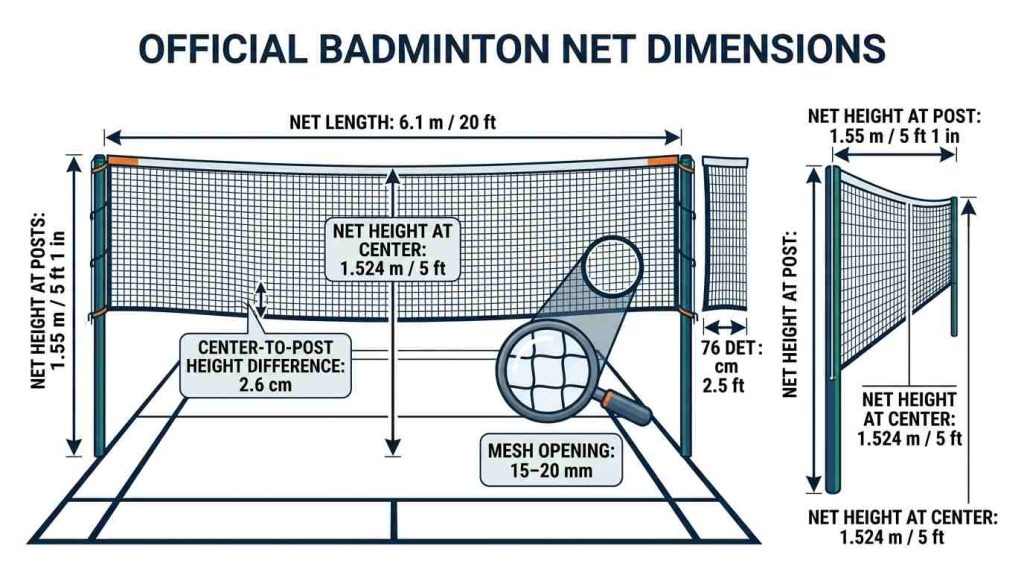
The badminton court net size spec is short but easy to get wrong, especially the height difference between the posts and the middle.
- Net length: 6.1 m (20 ft) — spans the full width of the doubles court
- Net depth: 76 cm (2.5 ft)
- Height at the posts/sidelines: 1.55 m (5 ft 1 in)
- Height at the center: 1.524 m (5 ft)
- Mesh: Dark-colored, with mesh holes between 15–20 mm
That post-to-center height difference of 2.6 cm isn’t arbitrary — it’s there because nets sag under their own tension no matter how tightly you pull them. Rather than fighting physics with a stiffer net, the rule simply defines the correct sag as part of the spec. If you’re setting up a net and it measures dead level at 1.524 m across the entire width, it’s actually strung slightly too high at the center — a small detail nearly every recreational setup gets wrong because people assume “level” means “correct.”
Net posts themselves sit just outside the doubles sidelines, not on them, and should not lean inward or outward — a leaning post changes the shuttle’s flight margin at that side of the court more than most players realize.
Service Court Lines and Markings
This is the section that decides more disputed points than any other part of the court. The dimension of the court in badminton that governs serving is built around two lines:
- Short service line: 1.98 m (6 ft 6 in) from the net, on both sides of the court, for both singles and doubles. A serve landing short of this line is a fault.
- Long service line: Only relevant in doubles, set 0.76 m (2 ft 6 in) in from the back boundary. A doubles serve landing beyond this line is a fault, even though singles players can serve all the way to the back boundary.
- Center line: Runs from the short service line to the back boundary, splitting each half of the court into left and right service courts.
That gap between the short service line and long service line in doubles creates a noticeably shallow serving box — around 3.88 m x 2.53 m per service court — which is exactly why doubles serves look so flat and low compared to the higher, deeper serves you see in singles.
All court lines, regardless of which boundary they mark, must be 40 mm (1.5 in) thick, and the line is considered part of whichever area it borders — meaning a shuttle landing exactly on a boundary line is in, not out. This trips up recreational players constantly, since the instinct is to call anything touching a line “close” rather than clearly in.
Reading a Badminton Court Layout
If you’re picturing this from scratch: start at one end and walk toward the net. First you cross the back boundary line, then — in doubles — the long service line about 76 cm in. The rest of the court is open until you reach the short service line, roughly two meters from the net.
The center line splits your half into left and right service boxes the entire way. Outside all of that, the doubles sideline marks the true edge of play; the singles sideline sits about half a meter inside it. Mentally walking the lines this way is a faster way to memorize the layout than staring at a diagram, and it’s how most coaches actually teach it to juniors.
Clearance and Ceiling Height Requirements
Here’s where a lot of guides stop short — they quote the official badminton court dimensions for the playing surface and never mention what surrounds it, even though the surrounding space is often the deciding factor in whether a facility can host real competitive play.
The BWF’s technical minimum is a mere 0.61 m (2 ft) clearance around the court perimeter. In practice, almost nobody builds to that minimum, because it’s genuinely dangerous — players lunging for a shot at that range would be one step from a wall.
A regulation doubles court with realistic clearance ends up needing a footprint closer to 16–17 m x 8–9 m, not the bare 13.41 m x 6.1 m of the court itself. This is the single most common reason gymnasiums end up with courts that “technically” meet dimensions but feel cramped in play — they were built to the court size alone, without budgeting for clearance or ceiling.
Ceiling height in particular gets ignored until someone hits a genuine full-power clear and the shuttle grazes a light fixture. Most school gyms, built for basketball, sit around 7–7.6 m — playable for recreational badminton, but well short of the 9 m+ you’ll see in any arena hosting a BWF-sanctioned event.
Badminton Court vs. Other Racket Sport Courts
A question that comes up constantly, especially as pickleball has exploded in popularity: is pickleball court size the same as badminton?
It is not, though the confusion is understandable — pickleball was originally designed to fit inside a badminton court’s footprint, and many facilities have converted badminton courts into pickleball courts using the existing boundary as an outer limit.
The length and width are identical between badminton and pickleball — that’s not a coincidence, it’s a design choice — but the net height is dramatically different, and pickleball uses a solid paddle-and-plastic-ball setup rather than a shuttlecock, so the court surface markings (kitchen lines, etc.) don’t map onto badminton’s service lines at all. Tennis, by contrast, is in a different league of scale entirely: a single tennis court could physically contain nearly three badminton courts side by side.
What Does 1U, 2U, 3U, 4U Mean in Badminton?
This one has nothing to do with court size, but it’s a question that gets typed into search bars by the same people researching badminton specs, so it’s worth clearing up here rather than leaving it unanswered. 1U, 2U, 3U, and 4U refer to racket weight classifications, not court measurements — 1U is the heaviest (roughly 95–99 g unstrung), and each step up in number gets progressively lighter, with 4U sitting around 80–84 g.
Heavier rackets (2U/3U) suit players who want more smash power; lighter ones (4U/5U) suit faster doubles play and less arm fatigue. If you came here specifically for that answer, that’s the full picture — the rest of this article is about the court itself, not the equipment.
Common Mistakes When Building or Marking a Court
Having watched more than a few recreational courts get marked out badly, the same handful of errors show up again and again:
- Using the wrong reference point for the short service line. It should be measured from the net, not from the center line intersection — measuring from the wrong point throws off the entire service box.
- Marking only one set of sidelines. A court marked exclusively for doubles makes singles play technically legal but visually confusing, since players default to using the outer line.
- Skipping the long service line entirely. Some recreational setups mark only the short service line and back boundary, assuming doubles serves just go “deep” — without a marked long service line, doubles serve calls become guesswork.
- Painting lines thinner than 40 mm. Thin lines are harder to call accurately at speed, and shuttles landing near a faint line create more disputes than a properly thick, high-contrast line ever would.
- Ignoring net sag correction. As covered above, a dead-level net at 1.524 m across its full width is actually strung too high at the center.
- Underbuilding clearance. Building exactly to the court’s outer boundary with no buffer is the single most common construction shortcut, and it’s the one players notice fastest — usually the first time someone chases a drop shot into a wall.
How to Mark a Badminton Court Yourself
If you’re setting one up in a driveway, gym, or backyard rather than hiring a contractor, you don’t need much:
- A long tape measure (at least 15 m/50 ft) for laying out length and width accurately
- Chalk line or marking paint — chalk works for temporary courts, paint or vinyl tape for anything semi-permanent
- A carpenter’s square or the 3-4-5 triangle method to confirm your corners are actually 90 degrees before you commit to paint
- Stakes and string to hold reference lines steady while you measure diagonals
The fastest way to check your layout is correct before marking anything permanent: measure both diagonals of your doubles rectangle. If the court is a true rectangle, both diagonals should measure the same 14.37 m (47.15 ft). If they don’t match, one of your corners isn’t square, and it’s worth adjusting before you paint a line you’ll regret.
Conclusion
Getting badminton court dimensions right comes down to a handful of numbers that never change: 13.41 m (44 ft) in length, 6.1 m (20 ft) wide for doubles or 5.18 m (17 ft) for singles, a net that dips to 1.524 m at center, and service lines set 1.98 m and 0.76 m from their reference points.
Everything else in this guide — the clearance recommendations, the common mistakes, the marking method — exists to help you apply those core numbers correctly in a real space, whether that’s a competition arena or a driveway with a portable net.
If you take one thing away from all of this, let it be the diagonal check: measure both diagonals of your court before you commit to paint or tape, and if they match at 14.37 m (47.15 ft), everything else falls into place. Get the rectangle right, and the rest of the layout is just careful measuring from there.
The FAQs below cover the specific questions people ask most often — use them as a fast reference if you just need one answer rather than the full picture.
Frequently Asked Questions

Sora Han
Sora Han is a badminton-focused sports writer who covers both competitive and recreational play. She brings a practical, player-first perspective to her writing, focusing on the techniques, tactics, and fundamentals that matter most on the badminton court.
Her expertise includes badminton footwork, shot selection, serving, returning, court positioning, attacking strategy, and defensive movement. She explains technical concepts in simple language and connects them with real-game situations to help readers understand how and when to apply them.
Sora’s writing emphasizes smart shot placement, efficient movement, rally control, consistency, and tactical decision-making. Her clear and approachable style makes her content useful for beginners, recreational players, and competitive badminton enthusiasts looking to improve their skills and understanding of the game.