Netball Court Dimensions Diagram and Complete Layout Guide
Netball is one of the most structured and strategically organized team sports in the world, and every part of the game begins with a properly measured playing surface. Whether you’re a coach preparing athletes for competition, a teacher organizing school activities, a player learning positional rules, or a facility planner designing a sports venue, understanding the netball court dimensions diagram is essential. Accurate court measurements not only ensure fair gameplay but also improve player safety, movement flow, and overall match quality.
In official terminology used by governing bodies such as international netball federations, the court is described as a “rectangular playing surface with clearly defined thirds, goal circles, and transverse lines measured to exact specifications.” This ensures uniformity across all competitive levels.
Unlike many sports that allow free movement across the entire playing area, netball uses carefully divided sections and positional restrictions that rely heavily on correct court markings. Even small mistakes in line placement or goal circle measurements can affect gameplay and officiating decisions. That is why official dimensions, player zones, and goal post specifications must always follow standardized federation rules.
This complete guide explains everything you need to know about the netball court layout and netball court dimensions diagram, including measurements in meters and feet, court markings, player positions, goal post sizes, indoor court requirements, and practical setup advice. You’ll also find tables, coaching insights, and real-world examples from school and training environments.
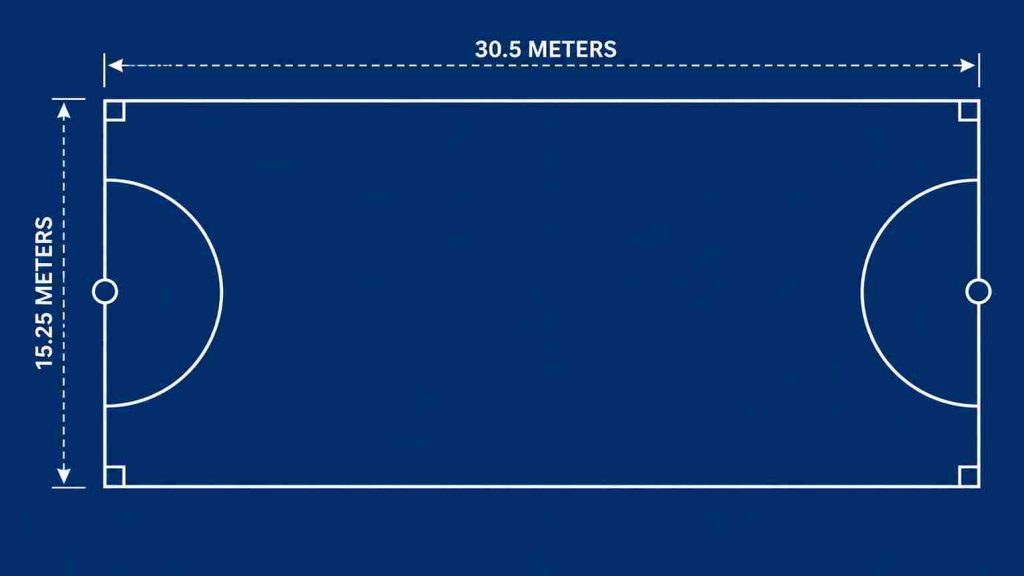
Standard Court Measurements (Official Federation Style)
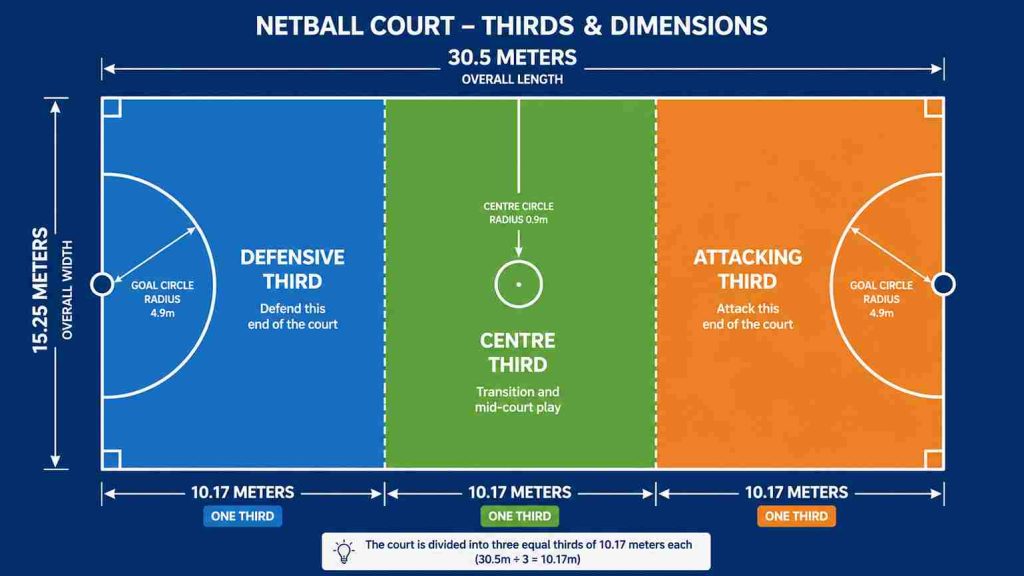
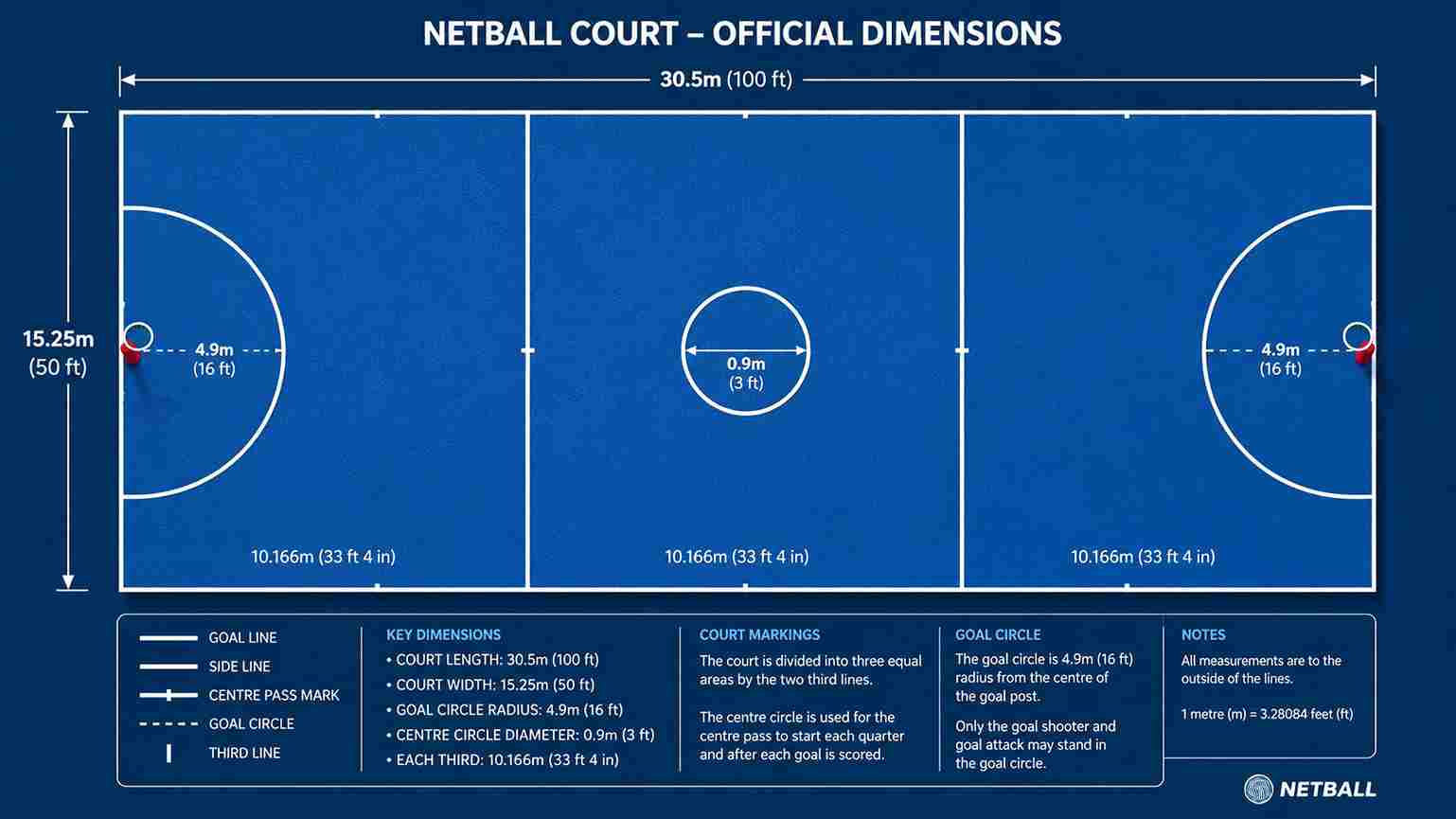
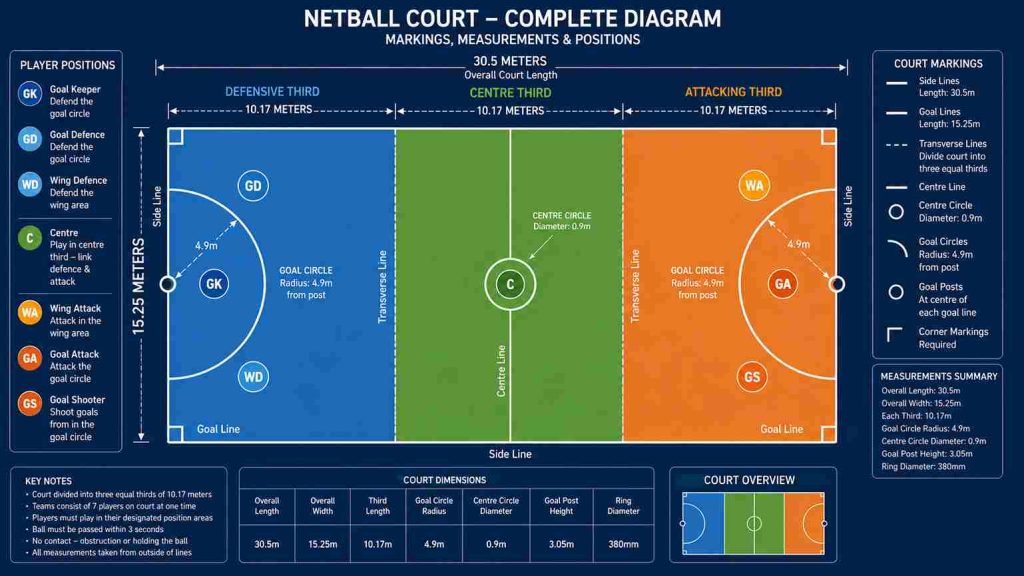
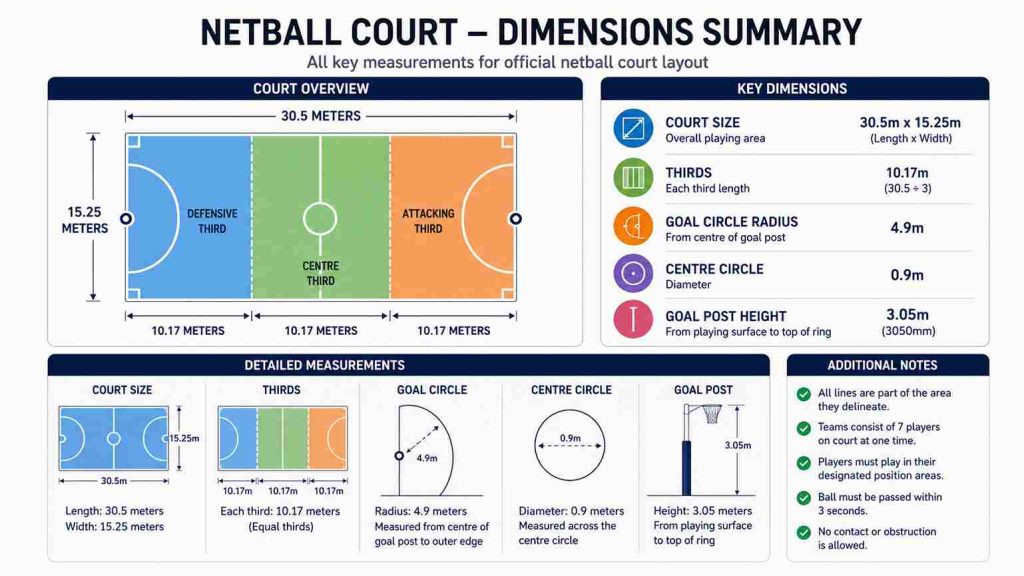
According to official netball federation reference standards, a regulation court is defined as a rectangular playing surface measuring 30.5 meters in length and 15.25 meters in width, with clearly marked thirds and goal areas.
In imperial units, this equals approximately 100 feet by 50 feet.
The court is divided into equal playing zones using transverse lines, ensuring structured movement and positional discipline.
Key Official Notes
- All lines are part of the playing area
- Measurements are taken from outer edge of markings
- Court must be flat, safe, and non-slippery
- Accuracy is essential for sanctioned competition
Real-World Insight (School Setup Example)
In a typical school sports project, even a 10–15 cm error in third division lines can confuse beginner players about movement restrictions. Coaches often use laser measuring tools to ensure every third is equally divided for training consistency.
Netball Court Measurements in Meters and Feet
| Measurement | Meters | Feet (Approx.) |
|---|---|---|
| Full Court Length | 30.5 m | 100 ft |
| Full Court Width | 15.25 m | 50 ft |
| Each Third Length | 10.17 m | 33.37 ft |
| Center Circle Diameter | 0.9 m | 3 ft |
| Goal Circle Radius | 4.9 m | 16.08 ft |
| Goal Post Height | 3.05 m | 10 ft |
| Line Width | 50 mm | 2 inches |
This table is commonly used in coaching manuals and facility planning documents issued by governing sports organizations.
Netball Court Layout Diagram Explained (Thirds & Zones)
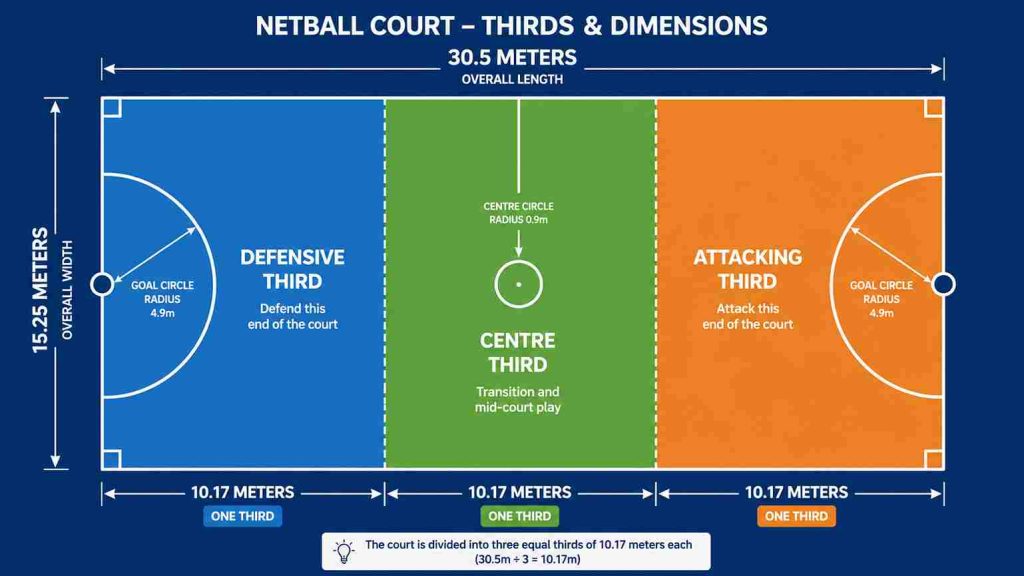
In a netball court dimensions diagram explanation, the court is visually divided into three equal sections known as thirds.
Official Layout Description
- Centre third: Transition zone
- Goal thirds: Attack and defense zones
- Transverse lines: Divide court equally
Coaching Insight Example
During training sessions, coaches often mark cones along the third lines to help players visually understand their restricted movement zones. Beginners typically struggle with staying within their allowed areas until they practice with clear diagram-based guidance.
Court Markings and Netball Court Dimensions Diagram Explained
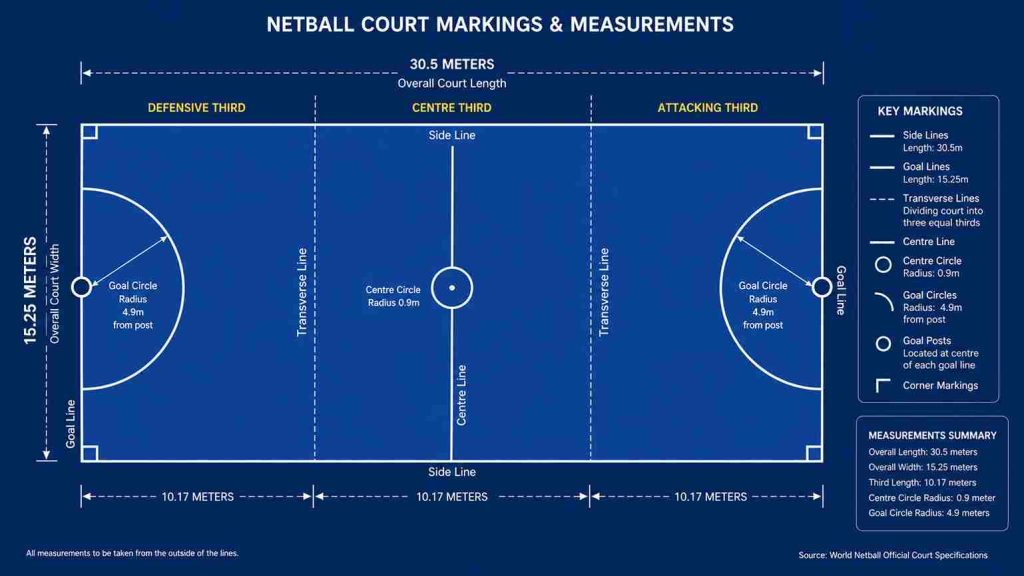
Court markings are not decorative; they define gameplay rules as per official federation wording, which states that “all boundary and internal markings form an integral part of the playing regulation system.”
Key Markings
- Side lines
- Goal lines
- Transverse third lines
- Center circle
- Goal circles
Practical Example
In many school courts, faded markings cause confusion during matches. Coaches often remark that “unclear lines are the most common cause of positioning mistakes in junior netball.”
Goal Circle and Center Circle Measurements
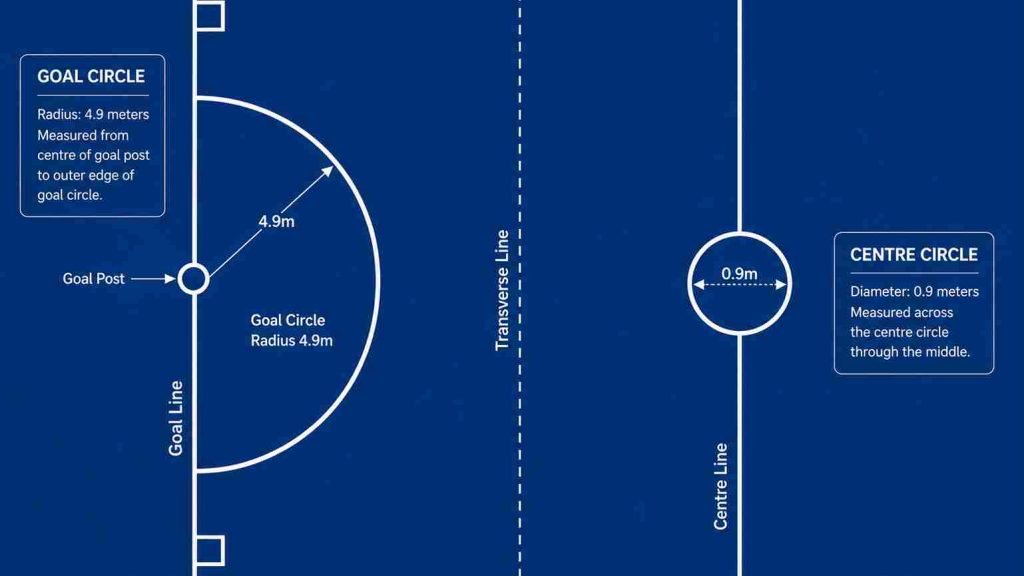
Goal Circle
- Radius: 4.9 meters
- Semi-circular shape
- Defines shooting area
Center Circle
- Diameter: 0.9 meters
- Used for center passes only
Coaching Note
Players new to the game often step outside allowed zones unintentionally. Coaches use diagram-based drills to reinforce spatial awareness within these circles.
Netball Goal Post Measurements
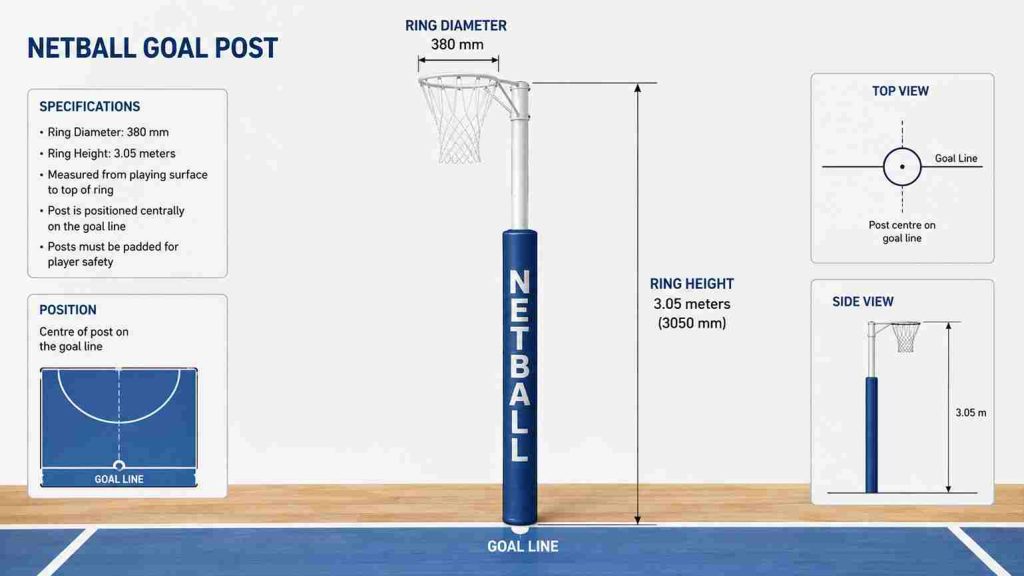
Official specifications state:
| Component | Measurement |
| Height | 3.05 m |
| Ring Diameter | 380 mm |
| Pole Diameter | 65–100 mm |
The goal post is positioned at the center of each goal line according to federation standards.
Indoor Court Requirements
Indoor netball courts maintain the same playing dimensions but require additional safety and structural standards.
- Minimum ceiling height: 8.3 m
- Non-slip flooring required
- Adequate lighting uniformity
- Safe run-off zones mandatory
Netball Court Positions and Movement Areas
Each of the seven positions has strict movement zones.
| Position | Allowed Areas |
| GK | Defensive third + circle |
| GD | Defensive + center thirds |
| WD | Defensive + center thirds |
| C | All thirds except circles |
| WA | Center + attacking thirds |
| GA | Attacking + center + circle |
| GS | Attacking circle only |
Real-World Coaching Example: School Court Setup Case Study
In a school sports facility project, a coach reported that once proper netball court dimensions diagram were accurately marked using official measurements, student performance improved significantly. Players understood their zones better, fewer rule violations occurred, and passing accuracy increased because spatial awareness became clearer.
This demonstrates how correct diagram-based court setup directly impacts learning quality.
Understanding Netball Court Dimensions Diagram with Labeled Dimensions
A standard diagram includes:
- Full rectangular layout
- Equal thirds
- Goal circles
- Center circle
- Player zones
Visualization Method
- Draw 30.5m x 15.25m rectangle
- Divide into 3 equal parts
- Add circles at center and ends
- Label all measurements clearly
Netball vs Basketball Court Comparison
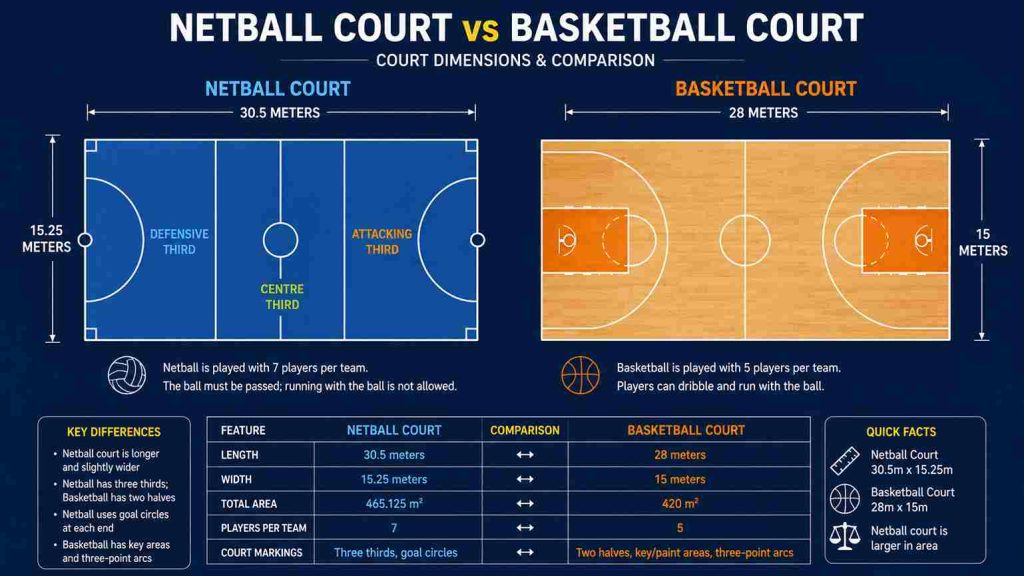
| Feature | Netball | Basketball |
| Length | 30.5 m | 28 m |
| Width | 15.25 m | 15 m |
| Movement | Restricted zones | Free movement |
One-Third Netball Court Measurement Explained
Each third = 10.17 meters (33.37 feet)
Accurate marking is essential because all positional rules depend on these divisions.
Tips for Designing or Marking a Court
- Use certified measuring tools
- Maintain exact third divisions
- Ensure visible line contrast
- Follow safety run-off rules
- Refer to official federation guidelines
Conclusion
Understanding the netball court dimensions diagram is essential for players, coaches, schools, and facility planners who want to create accurate and professional playing environments. According to official federation-style standards, every measurement—from court thirds to goal circle radius—serves a specific purpose in maintaining fairness, structure, and safety during gameplay.
Real-world coaching experiences show that when courts are marked precisely using correct diagram-based dimensions, players develop stronger spatial awareness, fewer rule violations occur, and overall game quality improves significantly. Whether in school environments or competitive leagues, accurate court setup directly influences performance outcomes.
From goal post placement to third-line accuracy, every detail matters. A properly designed court ensures consistency across training and competition, allowing players to focus on skill development rather than confusion over positioning. This is why governing bodies emphasize strict adherence to standardized measurements in all official documentation.
As netball continues to grow globally, the importance of correctly marked and well-understood courts becomes even more significant. A clear understanding of the netball court layout ensures better coaching, better gameplay, and a more enjoyable sporting experience for everyone involved.
FAQs

Olivia Brooks
Olivia Brooks is a netball author with a strong understanding of competitive gameplay, court strategy, and player development. Through years of match analysis, tactical study, and close observation of the sport, Olivia brings practical insight and clear, reader-friendly explanations to every article.
She specializes in covering netball techniques, positional roles, court dimensions, and game strategy in a way that helps players, coaches, and fans better understand the fast-paced and tactical nature of modern netball.