
Complete Volleyball Court Dimensions Diagram with Labels & Sizes
Volleyball is a dynamic sport enjoyed by millions around the world, from casual recreational play to high-level competitive matches. Central to every game is the volleyball court dimensions diagram, which precisely defines the playing area and ensures fairness, safety, and strategic depth.
Whether you are searching for a volleyball court diagram with measurements and labels, volleyball court dimensions diagram in feet, volleyball court dimensions diagram in meters, or a volleyball court dimensions diagram pdf, this guide provides everything you need in one place.
We cover standard indoor and beach specifications, youth variations, historical evolution, practical step-by-step marking instructions, comparison tables, and the most current official measurements.
The volleyball court dimensions diagram serves as the foundation for gameplay. It influences everything from serve placement and defensive positioning to attack angles and block timing.
Understanding these dimensions helps players, coaches, facility managers, and enthusiasts optimize performance and create proper playing environments. This article addresses common user intents, including how to visualize and apply the dimensions of a standard volleyball court in real-world scenarios.
History of Volleyball Court Dimensions

Volleyball was invented in 1895 by William G. Morgan, a physical education director at the YMCA in Holyoke, Massachusetts. Seeking a less strenuous alternative to basketball, Morgan combined elements of tennis, baseball, handball, and basketball into a new game initially called Mintonette.
The original volleyball court dimensions diagram was modest: 25 feet by 50 feet, divided by a net set at 6 feet 6 inches high. The court allowed unlimited players per side, with matches played in nine innings and three serves per team per inning.
As the sport spread internationally during the early 20th century, rules began to standardize. By 1916, the court expanded to 35 feet by 60 feet, and the ball circumference was set at 26 inches with a weight of 7 to 9 ounces.
In 1920, the court size moved closer to modern standards at 30 feet by 60 feet, and players could contact the ball with any body part above the waist. Net height gradually increased, reaching 7 feet 6 inches by 1917.
The Fédération Internationale de Volleyball (FIVB), established in 1947, played a key role in global unification. By the 1970s, the standard indoor volleyball court dimensions diagram settled at 18 meters by 9 meters, with net heights of 2.43 meters for men and 2.24 meters for women.
Beach volleyball, which originated on California beaches in the 1920s, developed separately. Its court size was standardized in 2001 at 16 meters by 8 meters to suit the two-player format and sand surface.
Youth volleyball introduced scaled-down courts to support skill development, with smaller dimensions and lower nets for younger age groups. These historical changes reflect volleyball’s growth into an inclusive, globally recognized sport featured in the Olympics since 1964 (indoor) and 1996 (beach).
Standard Indoor Volleyball Court Dimensions Diagram
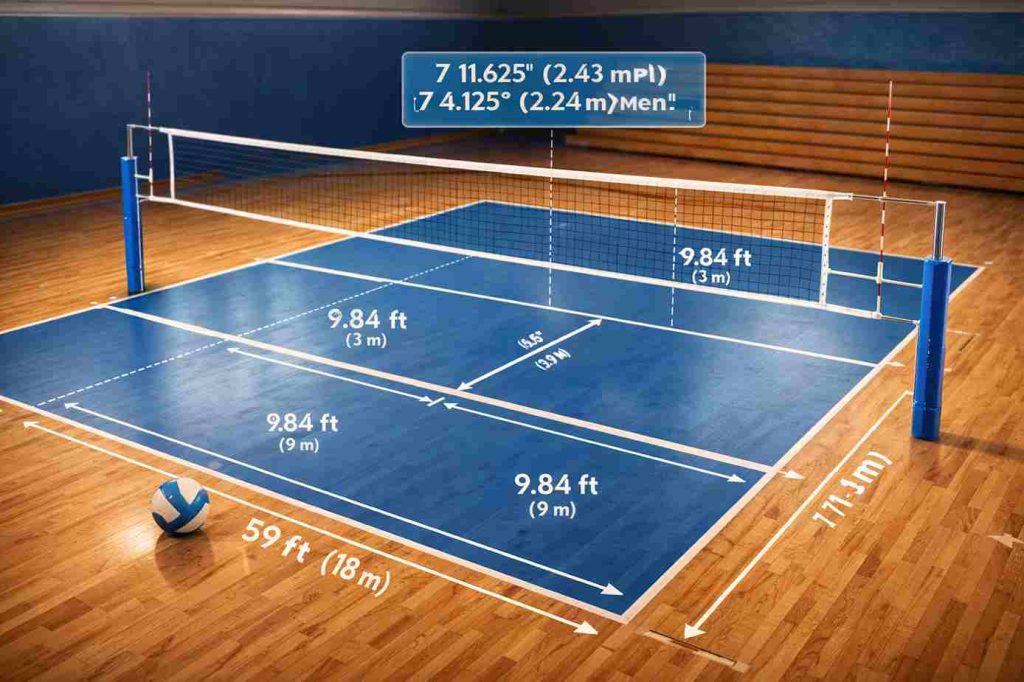
The official indoor volleyball court, according to the latest FIVB rules, measures 18 meters long by 9 meters wide. This creates a rectangular playing area of 162 square meters. The court is divided into two equal 9-meter by 9-meter halves by a center line running directly under the net.
Each side features an attack line positioned 3 meters from the center line, separating the front zone (where back-row players cannot attack above the net from behind this line) from the back zone. Side lines and end lines border the court, all 5 centimeters wide and typically white or a contrasting color for visibility.
The service zone extends the full 9-meter width behind each end line. Players must serve from within this area, and the ball must clear the net without touching it on the serve.
Net specifications are critical:
- Men’s net height: 2.43 meters (7 feet 11 5/8 inches) at the center
- Women’s net height: 2.24 meters (7 feet 4 1/8 inches) at the center
- Net width: 1 meter
- Net length: 9.5 to 10 meters
Antennae extend 1.8 meters above the net on each side to help judges determine if the ball crosses within bounds.
A free zone surrounds the court on all sides, at least 3 meters wide for standard play and 5 to 6 meters for international competitions. The minimum ceiling height is 7 meters, with 12.5 meters recommended for elite events to accommodate high jumps and blocks.
In feet, these measurements translate to approximately 59 feet long by 29 feet 6 inches wide, making the volleyball court dimensions diagram in feet easy to reference for North American audiences.
Beach Volleyball Court Dimensions Diagram
Beach volleyball uses a smaller court to emphasize athleticism and quick play on sand. The official dimensions are 16 meters long by 8 meters wide. There is no attack line, allowing players to attack from anywhere on the court. The free zone is at least 3 meters wide, expanding to 5–6 meters for major tournaments.
Sand must be at least 40 centimeters deep, loosely packed, and free of rocks or debris for player safety. Net heights remain identical to indoor: 2.43 meters for men and 2.24 meters for women. The court boundaries are marked with brightly colored lines or ropes anchored in the sand.
The smaller size suits the two-player format, increasing the physical demands and strategic importance of court coverage.
Youth and Other Variations in Volleyball Court Dimensions
Youth volleyball adapts court dimensions to match developmental stages. For players under 10 years old, many organizations recommend a court of 16 meters by 9 meters with a net height around 1.98 meters (6 feet 6 inches). For even younger groups (8 and under), courts may shrink to 9 meters by 4.5 meters, and nets can drop to 1.80 meters (5 feet 11 inches).
High school and club leagues often use full adult dimensions, though some recreational programs scale down slightly for younger teens. Sitting volleyball, a Paralympic discipline, uses a 10-meter by 6-meter court with a lower net. Snow volleyball follows beach-like dimensions but is played on compacted snow.
These variations ensure the sport remains accessible and enjoyable for all ages and abilities.
Step-by-Step Guide to Marking a Volleyball Court

Marking an accurate volleyball court dimensions diagram requires careful measurement and clear materials. Follow these steps:
- Choose a flat, level surface at least 24 meters long by 15 meters wide (including free zone) for indoor play, or a sand area for beach.
- Mark the outer rectangle: measure and stake out 18 meters by 9 meters for indoor.
- Locate the center and draw the center line across the width, dividing the court into two equal halves.
- From the center line, measure 3 meters toward each end and mark the attack lines parallel to the center line.
- Mark the end lines and side lines to complete the court boundaries. Use 5-centimeter-wide tape, paint, or chalk lines.
- Designate the service zones behind each end line, spanning the full 9-meter width.
- Install net posts 0.5 to 1 meter outside the side lines. Adjust the net to the correct height and attach antennae.
- Extend the free zone at least 3 meters beyond all court lines.
- Double-check all measurements against an official volleyball court dimensions diagram.
Tools needed include a long measuring tape, stakes, string for straight lines, marking paint or tape, and a level. The entire process typically takes 2 to 4 hours depending on surface type.
Tables for Volleyball Court Dimensions Comparisons
Comparison of Key Court Dimensions
Quick Conversion Reference
These tables provide at-a-glance references for volleyball court dimensions diagram in meters and feet.
Latest Official Data
The current FIVB rules maintain the 18 m × 9 m indoor and 16 m × 8 m beach court sizes, with emphasis on enhanced safety zones and sustainable court surfacing materials. No major dimensional changes have occurred in recent rule cycles, ensuring consistency across international, collegiate, and club play.
Conclusion
The volleyball court dimensions diagram is far more than a set of lines and measurements—it defines the very essence of the game. From the sport’s invention in 1895 with a simple 25-by-50-foot court to today’s precisely regulated 18-by-9-meter indoor standard, these dimensions have evolved to balance athletic challenge, safety, and global accessibility.
This guide has explored every key aspect: the full indoor and beach specifications, youth adaptations, historical progression, practical marking instructions, and clear comparison tables.
Whether you need a volleyball court diagram with measurements and labels for coaching, are planning to construct a court using volleyball court dimensions diagram in feet or meters, or simply want to deepen your understanding of the game, these details empower informed decisions.
Accurate dimensions ensure fair play, reduce injury risk through proper free zones, and allow strategic creativity within defined boundaries.
Mastering the volleyball court dimensions diagram enhances appreciation for the sport’s technical beauty—every serve, dig, set, and spike interacts with these carefully measured spaces.
As volleyball continues to grow worldwide, from school gyms to Olympic arenas and sunny beaches, these unchanging yet adaptable specifications remain at the core of its enduring appeal.
Use this knowledge to play better, coach smarter, build safer facilities, or simply enjoy the game with greater insight. The court is ready—now it’s your turn to step onto it.
FAQs

Jordan Blake
Jordan Blake is a racket-sports author with hands-on experience and a strong command of both tennis and pickleball. With a foundation built through years on the tennis court and a successful transition into competitive pickleball, Jordan brings practical insight, strategic clarity, and real-world understanding to every article.
Drawing on personal play, match analysis, and court-level observation, Jordan specializes in breaking down technique, tactics, and the mental aspects of both sports in a clear, data-informed, and accessible way. His dual-sport perspective helps readers understand how skills transfer between games—and where each sport demands its own distinct mastery.