
Volleyball Court Dimensions: Complete Guide for Indoor & Beach Courts
Volleyball court dimensions are the standardized measurements that define the playing area, lines, zones, and clearances for the sport. These specifications include the court’s length, width, net height, and surrounding free zones, ensuring every game is played on a level field—literally and figuratively.
The dimensions of a volleyball court are crucial because they directly affect gameplay, player safety, and rule compliance.For instance, the standard indoor court measures 18 meters long by 9 meters wide (59 feet by 29.5 feet), divided into two equal halves by a net.
This setup allows strategic positioning, such as the attack line 3 meters from the net, which restricts back-row players from spiking. Precision in these volleyball court standard dimensions is non-negotiable; even a few centimeters off can lead to unfair advantages, disputed calls, or higher injury risk from inadequate space.
Why does precision matter? In volleyball, where jumps exceed 3 meters and balls travel at high speeds, accurate dimensions prevent collisions and promote fair competition. Volleyball court dimensions have evolved since the sport’s invention in 1895 by William G.
Morgan, who initially used a 25 by 50 feet court to reduce physical contact compared to basketball. By the 1920s, courts expanded to 30 by 60 feet for better flow, and the FIVB formalized the current standards in 1947. Today, deviations from these standards can void tournament results or cause legal issues in professional settings.
Who needs these details? Schools planning high school or middle school gyms must follow NFHS volleyball court dimensions high school to meet educational standards and avoid penalties.
Clubs and recreational centers in the USA, Canada, UK, and Australia rely on them for leagues, ensuring player retention. Homeowners building backyard courts consult volleyball court dimensions in feet for DIY projects, while NCAA planners prioritize official specs for elite play. Incorrectly built courts can cause unsafe conditions—such as low ceilings causing ball deflections—or regulatory fines.
This guide comprehensively addresses user intents with the latest data, tables, diagrams, costs, and rules. It fills common gaps found in top-ranking content: many sources provide only basic sizes without youth variations, construction costs, historical context, or detailed mistake avoidance.
Some offer diagrams but lack step-by-step guidance or complete FAQs. Others are promotional or outdated. By providing history, conversions, visuals, practical advice, and governing body rules, this guide serves as the definitive reference for anyone searching what are the volleyball court dimensions, volleyball court dimensions in feet, indoor volleyball court dimensions, or related terms.
What Are Volleyball Court Dimensions?
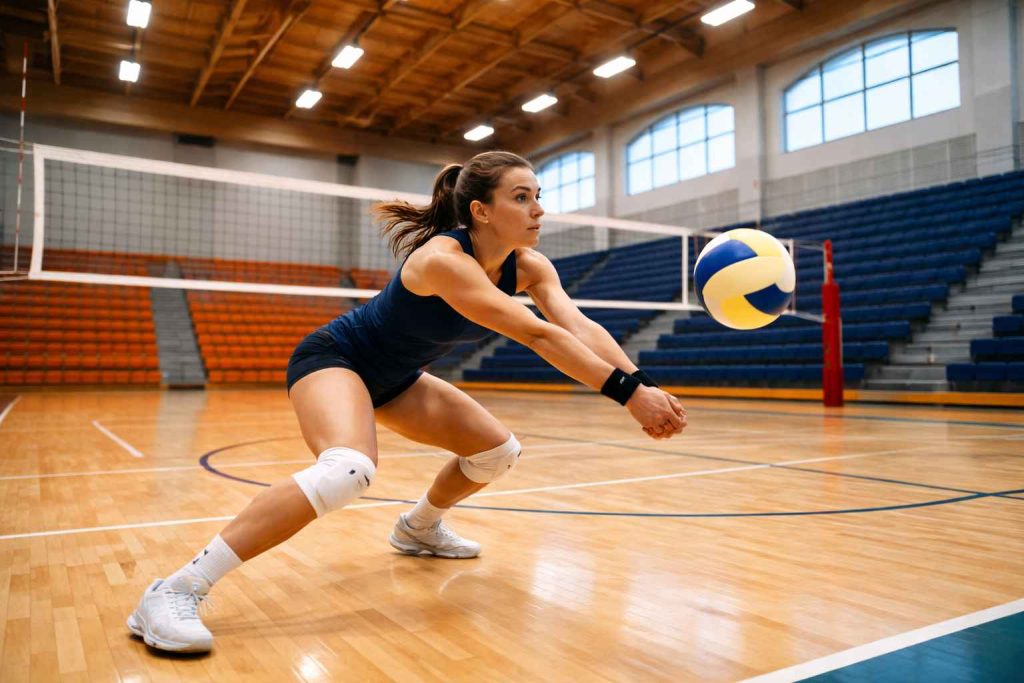
Volleyball court dimensions are the precise specifications defining the size, layout, and features of the playing surface. They include the core rectangle—18 meters long by 9 meters wide for indoor play (59 feet by 29.5 feet)—plus zones like the free zone (minimum 3 meters) and the attack line (3 meters from the net). Boundary lines are 5 cm wide. Dimensions also cover net heights and clearances, which vary slightly for beach or youth play.
Understanding what are the volleyball court dimensions helps appreciate the sport’s structure. Volleyball court dimensions incorporate both metric and imperial units for global use, with feet prevalent in the USA. These measurements account for safety, such as a minimum 7-meter ceiling height to avoid obstructions, ensuring consistency across competitions.
Official Volleyball Court Dimensions (FIVB)
These volleyball court dimensions in meters and volleyball court dimensions in feet align with FIVB standards. Beach courts differ; see the dedicated section below.
Volleyball Court Dimensions by Level
Volleyball court dimensions middle school and volleyball court dimensions for juniors focus on development, often using the same court with lower nets.
Volleyball Court Diagram Explained
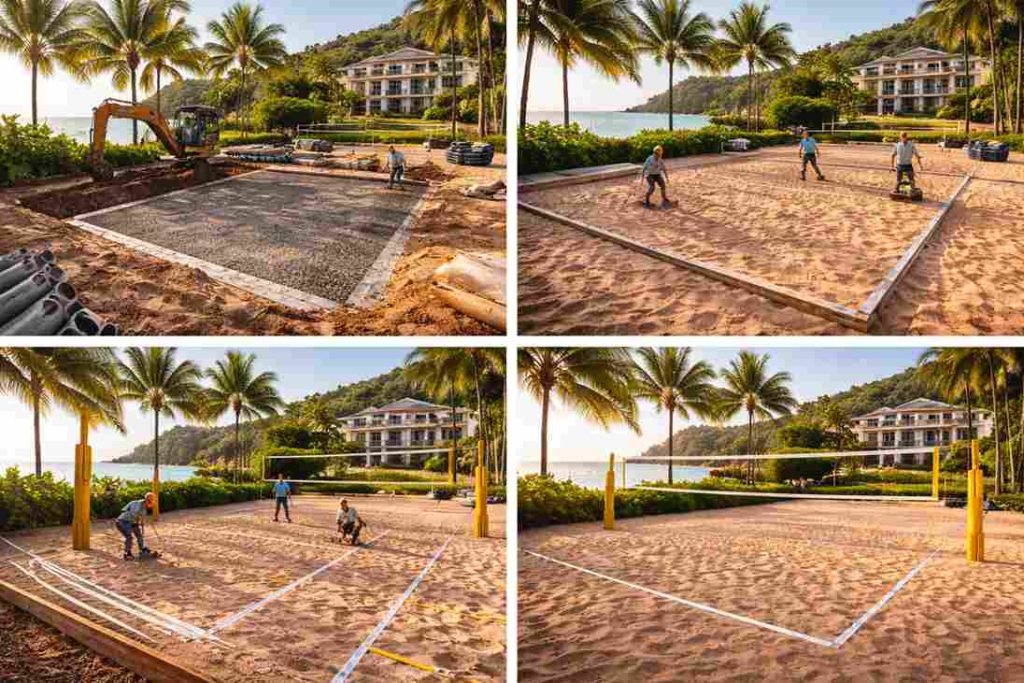
A volleyball court diagram shows functional zones: side lines, end lines (5 cm wide), center line under the net, and attack lines 3 meters from the net dividing front and back zones. The service zone is full width behind the end line. Antennae mark net edges for out-of-bounds.
Use a scale of 1:100, measure diagonals (20.12 m) for squareness. Volleyball court dimensions pdf from FIVB provide official layouts. Diagrams and images assist planning and construction.
Indoor vs Sand Volleyball Court Dimensions
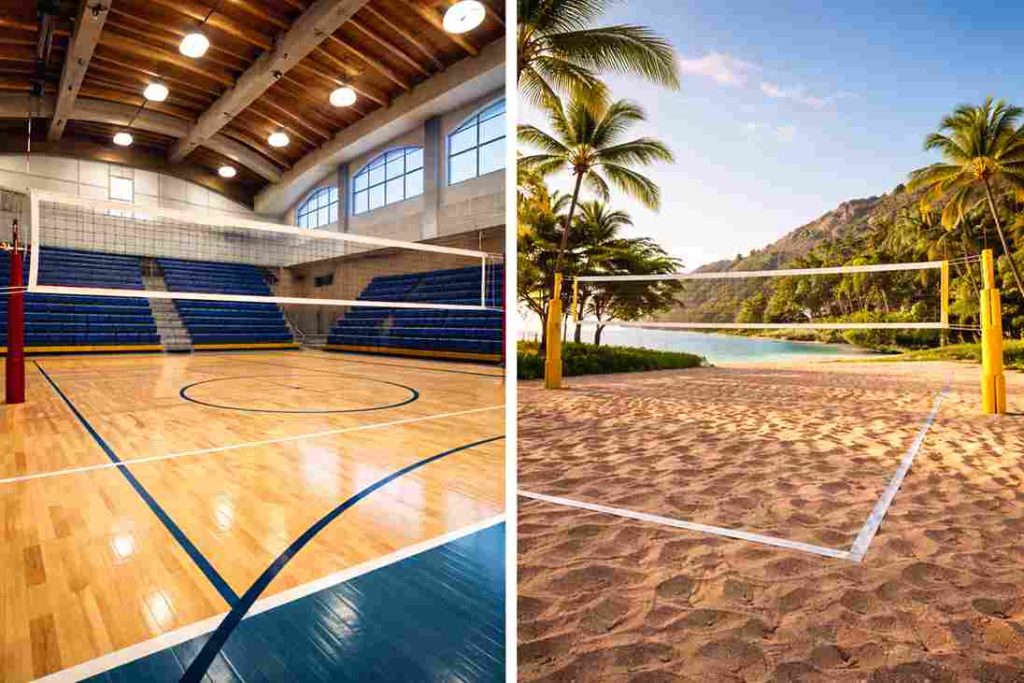
Indoor and sand volleyball court dimensions differ for environmental needs.
- Indoor: 18 m x 9 m, attack lines, hard floor, enclosed.
- Sand: 16 m x 8 m, no attack lines, sand 40 cm deep, exposed to weather.
Key differences:
- Size: Indoor for 6 players; sand compact for 2.
- Lines: Indoor solid; sand ribbon markers.
- Ball: Indoor heavier; sand softer.
- Weather: Indoor controlled; sand must be safe.
Standard outdoor volleyball court dimensions match sand for grass variants.
Why Volleyball Courts Are Built These Sizes
Court sizes optimize play, safety, and reflect historical evolution. Original 25 ft x 50 ft courts (1895) suited indoor YMCA settings. By 1920, expanded to 30 ft x 60 ft for improved dynamics. FIVB standardized international equity. Width allows lateral coverage, length enables deep serves; beach reduced in 2001 for two-player dynamics. Safety zones minimize injury risks.
Space Needed to Build a Volleyball Court
Total space includes court plus buffers:
- Indoor: 24 m x 15 m (free zones 3 m), add 2 m for safety, 7 m ceiling.
- Beach: 22 m x 14 m.
Urban areas may compress zones. Multi-court setups require 6 m between courts. Drainage, access, and adjacent areas add to total footprint.
Volleyball Court Flooring & Construction
- Indoor: Maple hardwood or PVC for shock absorption.
- Beach: Sand, 40 cm, sifted fine.
Step-by-Step Construction:
- Plan: Select site, draw volleyball court dimensions diagram.
- Permits: Check local codes.
- Excavate: Dig base, install drainage.
- Base: Gravel, compact.
- Floor: Lay material, mark lines.
- Install Net: Posts 10.7 m apart.
- Test: Measure, play-test.
- Maintain: Refinish yearly.
Volleyball Court Construction Cost (USA)
Indoor construction: $32,000–$200,000, averaging $100,000.
Sand courts: $10,000–$15,000.
Breakdown: site prep $5,000–$20,000, flooring $20,000–$100,000, labor $10,000–$50,000. Costs depend on location, materials, and size. Grants may be available via USA Volleyball or local sports organizations.
Common Volleyball Court Dimension Mistakes
- Measuring inside lines instead of outer edges.
- Insufficient free zone, increasing injury risk.
- Incorrect net height due to gender mix-up.
- Faded or invisible lines causing disputes.
- Skewed shape from poor diagonal checks.
Verify with professional tools to avoid rework.
Governing Body Rules
- FIVB: Global authority, 18×9 m standard, safety emphasis.
- NCAA: College, aligns with FIVB, recent safety updates.
- NFHS: High school, 60 ft x 30 ft, specific line and marking rules.
All enforce precise volleyball court standard dimensions.
Conclusion
Volleyball court dimensions form the backbone of the sport, blending history, precision, and practicality. From FIVB’s 18 m x 9 m indoor standard to beach 16 m x 8 m, these measurements ensure fairness across all levels: pro, college, high school, middle school, and juniors.
We covered conversions (volleyball court dimensions in feet and meters), diagrams, space requirements, flooring options, USA construction costs, common mistakes, step-by-step guides, and governing rules. Accurate dimensions enhance gameplay for coaches, school administrators, or homeowners.
With volleyball’s growth and beach volleyball’s Olympic spotlight, these standards ensure fair, safe, and innovative play for generations.
Final Expert Recommendation
Consult FIVB or local bodies before construction. Hire surveyors for accuracy. Use sand courts for cost-effective projects. Prioritize certified shock-absorbent indoor flooring and proper drainage outdoors.
Frequently Asked Questions

Jordan Blake
Jordan Blake is a racket-sports author with hands-on experience and a strong command of both tennis and pickleball. With a foundation built through years on the tennis court and a successful transition into competitive pickleball, Jordan brings practical insight, strategic clarity, and real-world understanding to every article.
Drawing on personal play, match analysis, and court-level observation, Jordan specializes in breaking down technique, tactics, and the mental aspects of both sports in a clear, data-informed, and accessible way. His dual-sport perspective helps readers understand how skills transfer between games—and where each sport demands its own distinct mastery.
Jordan Blake
Jordan Blake is a racket-sports author with hands-on experience and a strong command of both tennis and pickleball. With a foundation built through years on the tennis court and a successful transition into competitive pickleball, Jordan brings practical insight, strategic clarity, and real-world understanding to every article.
Drawing on personal play, match analysis, and court-level observation, Jordan specializes in breaking down technique, tactics, and the mental aspects of both sports in a clear, data-informed, and accessible way. His dual-sport perspective helps readers understand how skills transfer between games—and where each sport demands its own distinct mastery.