Tennis Court Dimensions in Feet: A Comprehensive Guide
Understanding tennis court dimensions in feet is crucial for anyone involved in the sport, whether you’re a player, coach, builder, or enthusiast. The standard tennis court dimensions in feet ensure fair play, strategic depth, and consistency across global competitions.
Regulated by the International Tennis Federation (ITF), these measurements have remained largely unchanged for over a century, but recent updates in 2026 confirm their ongoing relevance. This article delves deep into tennis court dimensions in feet, exploring history, precise measurements, comparisons with other sports, building guides, and more.
We’ll also address the strengths and weaknesses of top online competitors providing information on tennis court dimensions in feet, filling gaps to offer the most complete resource possible.
As of 2026, the ITF’s Rules of Tennis specify that a standard court is 78 feet long, with widths of 27 feet for singles and 36 feet for doubles. These tennis court dimensions in feet include specific markings like service lines at 21 feet from the net and baselines defining the court’s ends. Why do these details matter?
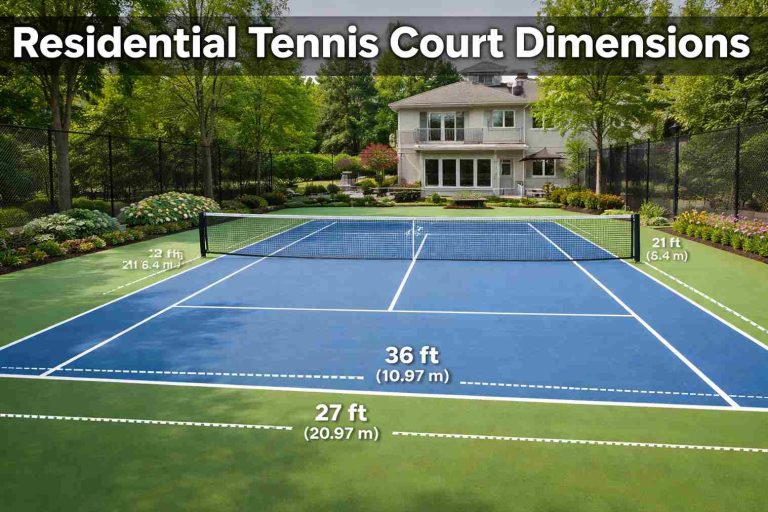
They influence everything from gameplay strategy to court construction costs. For instance, knowing tennis court dimensions in feet helps homeowners plan backyard installations, ensuring adequate space for run-off areas—typically 21 feet behind baselines and 12 feet on sides.
This guide aims to satisfy user intent by covering related searches like “tennis court dimensions ft,” “dimensions of a tennis court in feet,” and “tennis court dimensions in feet and inches.” We’ll provide latest data from ITF’s 2026 rules, historical context, step-by-step building instructions, factual insights, and visual aids.
By addressing competitors’ gaps—such as lack of visuals, outdated info, or incomplete comparisons—we create a one-stop resource. Let’s start with the evolution of these dimensions.
The History of Tennis Court Dimensions in Feet
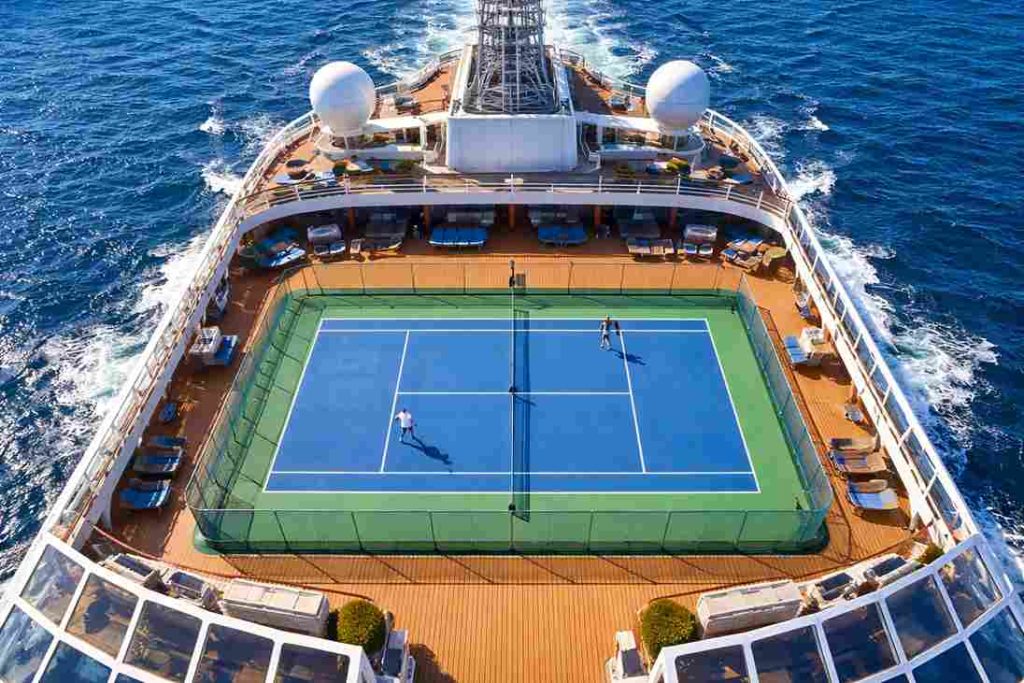
The history of tennis court dimensions in feet traces back centuries, evolving from informal games to standardized regulations. Tennis originated in 12th-century France as “jeu de paume,” played with hands on irregular courts without fixed sizes. By the 16th century, “real tennis” emerged in enclosed halls with courts around 90 feet long and 27-30 feet wide, featuring walls and asymmetrical designs.
The modern game, “lawn tennis,” was patented in 1874 by Major Walter Clopton Wingfield. His initial courts were hourglass-shaped, about 60 feet long and narrowing to 30 feet at the net. In 1875, the Marylebone Cricket Club revised rules, adopting a rectangular shape closer to today’s tennis court dimensions in feet: 78 feet long and 27 feet wide for singles. This standardization addressed inconsistencies in early tournaments.
By 1877, the first Wimbledon used these dimensions, solidifying them. The ITF, formed in 1913, formalized rules, including tennis court dimensions in feet, to ensure global uniformity. Minor tweaks occurred, like net height specifications in the 1880s (3 feet at center, 3.5 feet at posts), but core measurements stayed stable.
In the 20th century, surfaces diversified—grass, clay, hard—but dimensions remained fixed. Youth adaptations emerged in the 2000s, with smaller “Red” (36×18 feet) and “Orange” (59×21 feet) courts for kids under 10. As of 2026, ITF rules reaffirm the 78×27/36 feet standard, emphasizing accessibility and inclusivity.
This evolution highlights how tennis court dimensions in feet balanced tradition with practicality, influencing strategy—longer courts favor baseline play, wider doubles encourage volleys. Understanding this history enriches appreciation for modern courts. Over time, these dimensions have shaped iconic moments, from lengthy rallies on clay to fast serves on grass.
Early courts varied by region, with European indoor versions differing from outdoor British ones, but globalization unified them. Today, tennis court dimensions in feet are taught in coaching programs worldwide, ensuring new generations respect the sport’s heritage while adapting to modern needs like portable courts for events.
Standard Tennis Court Dimensions in Feet: Detailed Breakdown

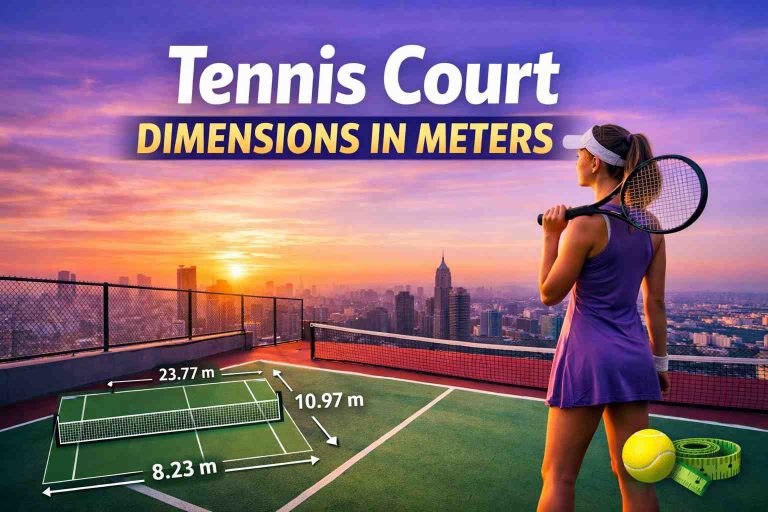
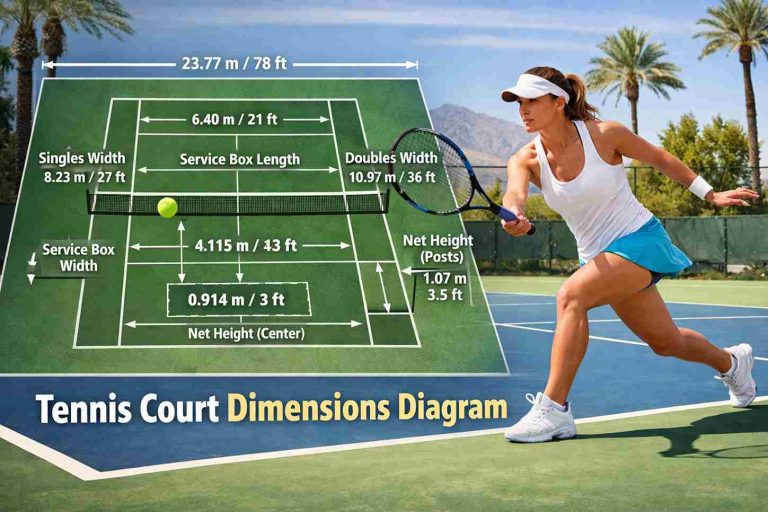
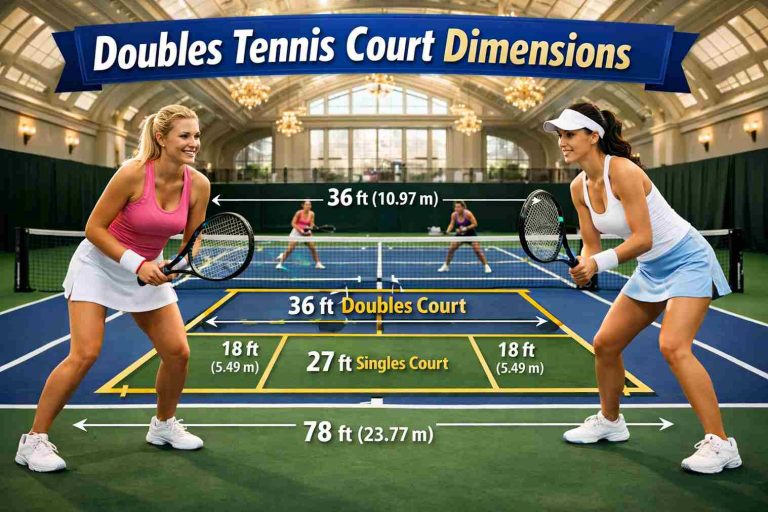
Tennis court dimensions in feet are precisely defined to promote fair competition. According to the 2026 ITF Rules of Tennis, the court is a rectangle measuring 78 feet in length. For singles, the width is 27 feet; for doubles, it expands to 36 feet, incorporating 4.5-foot alleys on each side.
Key elements include:
- Baselines: The back boundaries, 78 feet apart. These lines mark the end of the playable area and are crucial for out-of-bounds calls.
- Sidelines: 27 feet apart for singles, 36 feet for doubles. The extra width in doubles allows for alley plays, adding tactical layers.
- Service Lines: Parallel to the net, 21 feet from it on each side. These define where serves must land.
- Center Service Line: Divides service boxes, 2 inches wide, ensuring alternating serves.
- Net: 3 feet high at center, 3.5 feet at posts; spans the full width. Proper tension prevents disputes.
- Service Boxes: Each 21 feet long by 13.5 feet wide, where serves target.
- Total Playing Area: 2,106 square feet for singles, 2,808 for doubles. This space influences court coverage strategies.
In feet and inches: Length is 78 feet (936 inches), singles width 27 feet (324 inches), doubles 36 feet (432 inches). Lines are 1-2 inches wide, baselines up to 4 inches. Precision in marking prevents gameplay errors.
For construction, add run-off: 21 feet behind baselines, 12 feet beside sidelines, totaling 120×60 feet minimum. This buffer zone is essential for player safety, allowing chases without obstacles. Indoor courts need 30-40 feet ceiling height to accommodate lobs. Ventilation and lighting standards also tie into these dimensions.
Here’s a table summarizing tennis court dimensions in feet:
These tennis court dimensions in feet ensure consistency, as seen in Grand Slams like Wimbledon (grass) or US Open (hard). Variations exist for juniors: Red stage (36×18 feet) for beginners, Orange (59×21 feet) for intermediates, Green (78×27 feet with lower net). These scaled versions help develop skills progressively.
Wheelchair tennis uses the same dimensions but with two bounces allowed. Understanding these nuances allows for inclusive play. Materials for lines, like paint or tape, must contrast with the surface for visibility. In professional setups, electronic line-calling systems verify these dimensions in real-time, reducing human error.
Comparisons: Tennis Court Dimensions in Feet vs. Other Sports
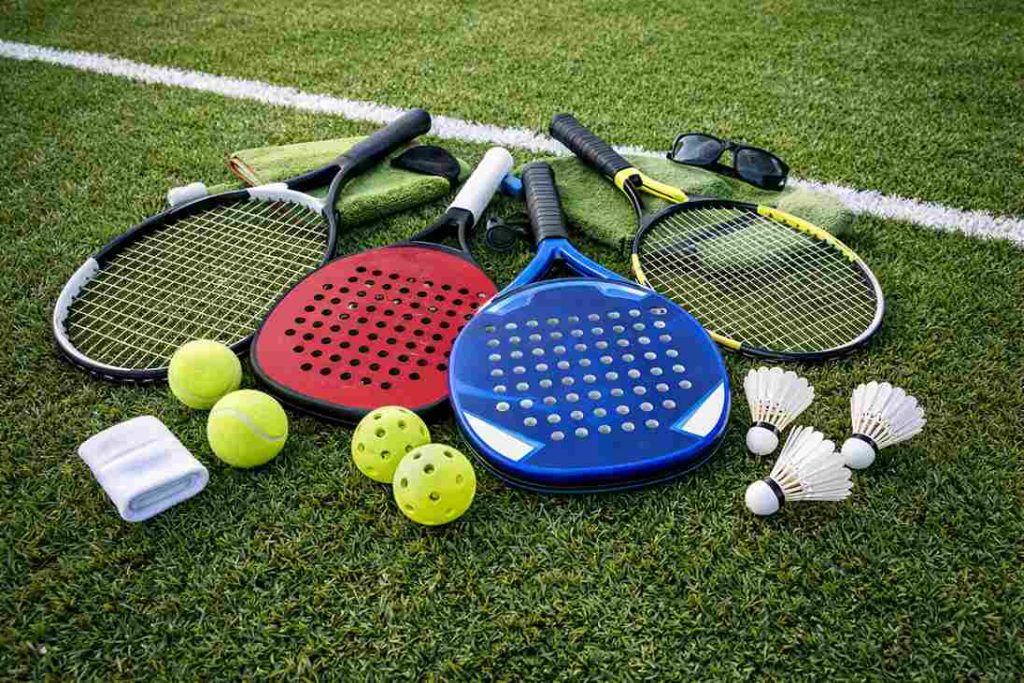
Users often search for “dimensions of a tennis court in feet” alongside comparisons, like pickleball. Pickleball courts are 44 feet long by 20 feet wide—about one-third a tennis court’s size. Tennis requires more endurance due to its 78-foot length, while pickleball’s compact layout emphasizes quick reflexes near the 7-foot non-volley zone (kitchen).
Net heights differ: Tennis at 3 feet center, pickleball at 34 inches center (36 inches sides). A single tennis court can fit four pickleball courts, making conversions popular. This overlap has boosted multi-sport facilities.
Other comparisons:
- Badminton: 44×20 feet (similar to pickleball), but indoor-focused with higher nets.
- Padel: 66×33 feet, enclosed with walls for rebound play.
- Squash: 32×21 feet, fully walled, intense close-quarters action.
- Volleyball: 59×29.5 feet, but beach versions vary.
- Basketball: 94×50 feet, larger but team-oriented.
Tennis court dimensions in feet promote strategic depth, unlike smaller courts favoring close-range play. For example, tennis’s length encourages baseline rallies, while padel’s walls add unpredictability. These differences affect training—tennis players build stamina for covering more ground.
In community parks, shared spaces often adapt tennis courts for multiple uses, maximizing utility. Emerging sports like teqball (table-based) use even smaller areas, but tennis’s scale remains iconic for individual prowess.
Step-by-Step Guide to Building a Tennis Court

Building a tennis court requires careful planning to match official tennis court dimensions in feet. Here’s a detailed guide, expanding on each phase for thoroughness:
- Site Assessment and Planning: Begin by evaluating available space—minimum 120×60 feet for run-off to accommodate tennis court dimensions in feet safely. Conduct soil tests for stability and drainage; sandy loam is ideal. Check local zoning laws, permits, and environmental impacts. Orientation should be north-south to reduce sun glare during peak hours. Budgeting is key: Expect $50,000-$150,000, varying by surface type and location. Consult architects for blueprints aligning with ITF standards.
- Excavation and Base Preparation: Clear the site of vegetation and debris. Excavate to 6-12 inches depth, depending on soil. Install a compacted gravel sub-base (4-6 inches thick) to support weight and prevent cracks. Use laser levels for evenness—slight slopes (0.5-1%) aid water runoff. This foundation is critical; poor prep leads to uneven bounces.
- Drainage Installation: Integrate perforated pipes connected to storm drains. Surround with gravel for filtration. Proper drainage prevents puddles, extending surface life. In rainy areas, add French drains along perimeters. Test flow before proceeding.
- Surface Installation: Select surface—hard (asphalt or concrete, durable and low-maintenance), clay (slower play, higher upkeep), or grass (fast, natural but seasonal). For hard courts: Pour concrete or asphalt base, cure for 28 days, then apply multiple acrylic layers for cushioning and color. Clay involves crushed brick layers; grass requires seeding and irrigation. Ensure surface meets ITF bounce standards (consistent height).
- Markings and Net Setup: Use durable paint or inlaid lines matching tennis court dimensions in feet: Baselines 78 feet apart, etc. Install net posts 42 inches high, embedded in concrete sleeves for stability. Hang net with proper sag—3 feet center. Add center strap for tension.
- Fencing and Accessories: Erect chain-link fencing 10-12 feet high around the perimeter to contain balls. Include gates for access. Install LED lighting (300-500 lux) on poles, windscreens for wind reduction, and benches/shade structures. For pros, add scoreboards or cameras.
- Final Testing and Maintenance: Measure all tennis court dimensions in feet for accuracy. Test ball bounce and surface grip. Initial maintenance includes watering clay or mowing grass. Schedule annual inspections: Resurface hard courts every 5-7 years, groom clay daily.
This process ensures your court adheres to tennis court dimensions in feet, providing years of enjoyment. Common pitfalls include skimping on drainage, leading to costly repairs. For backyard versions, consider modular surfaces for easier installation. In urban areas like Lahore, space constraints might favor compact designs, but full dimensions offer authentic play.
Fact Guide: Interesting Insights on Tennis Court Dimensions in Feet
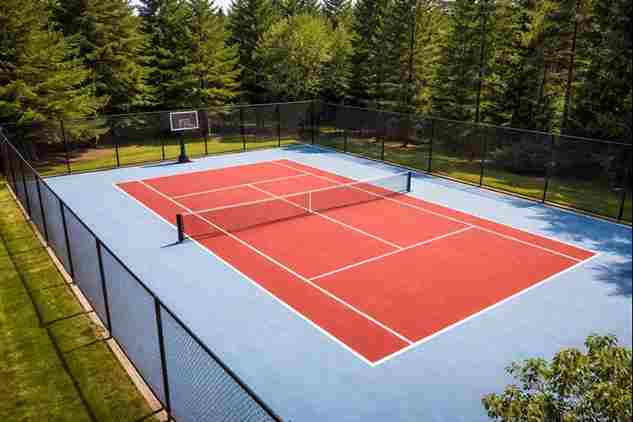
Diving deeper, here are expanded facts about tennis court dimensions in feet:
- World’s Largest Variations: Non-standard courts exist, like oversized training ones in academies, but official play sticks to 78 feet.
- Surface Impacts on Play: Hard courts (common in US) favor aggressive baselines due to true bounces; clay (French Open) slows balls, extending rallies; grass (Wimbledon) speeds serves.
- Youth and Adaptive Courts: Beyond standard, mini-courts help kids: Red uses foam balls on 36×18 feet. Wheelchair tennis modifies rules but keeps dimensions.
- Sustainability Trends: 2026 focuses on eco-friendly builds, like permeable surfaces reducing runoff.
- Cost Factors: Building in feet metrics affects materials—larger run-off increases fencing needs.
- Global Usage: Over 60,000 public courts in the US alone adhere to these dimensions.
- Technological Integrations: Hawk-Eye systems map courts precisely, verifying calls within millimeters.
- Home Installations: 80% opt for hard surfaces; modular kits start at $20,000 for basic setups.
- Olympic Standards: Identical to ITF, ensuring athletes train consistently.
- Maintenance Tips: Regular line repainting preserves visibility; improper care warps dimensions over time.
These insights reveal how tennis court dimensions in feet extend beyond measurements, influencing equipment, training, and even spectator experiences.
Latest Data on Tennis Court Dimensions in Feet
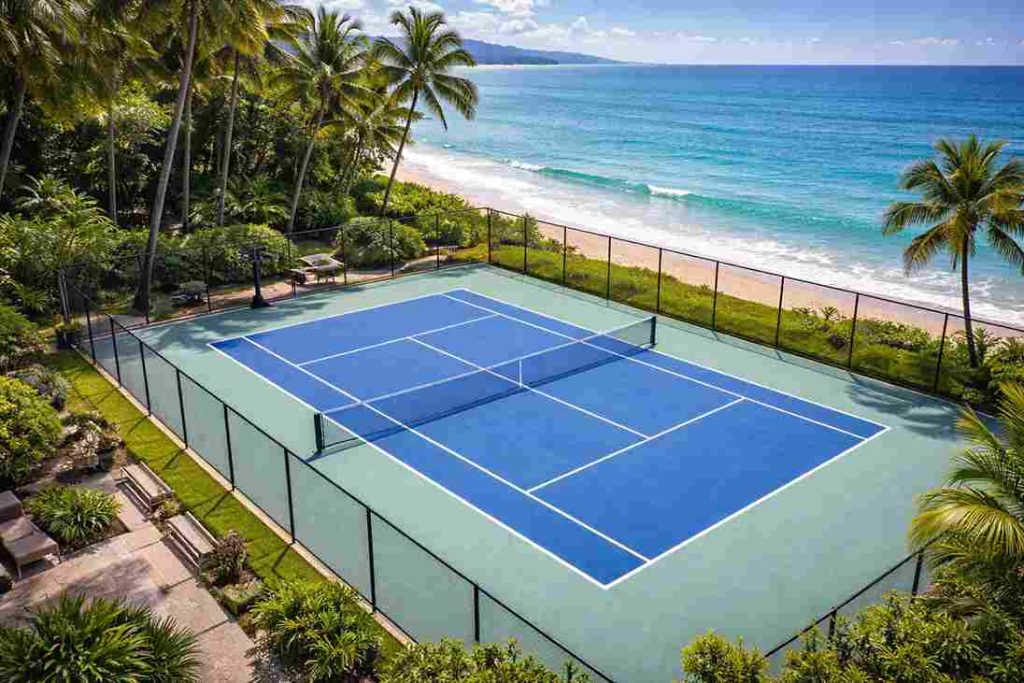
As per ITF’s 2026 rules, no changes to core tennis court dimensions in feet—78×27/36. Updates focus on line widths (2.5-5 cm, about 1-2 inches) and sustainability, encouraging recycled rubber underlays. Global surveys show increased home court builds, with 15% growth in Asia.
Materials evolve: Acrylic hard courts now incorporate UV-resistant coatings for longevity. Junior programs emphasize scaled dimensions, with 20% more adoption in schools. Noise regulations affect urban installations, tying into comparisons with louder sports like pickleball.
Data indicates clay courts require 30% more maintenance but offer injury reduction. Overall, tennis court dimensions in feet remain timeless, adapting to modern demands like multi-use conversions.
Conclusion
In summary, tennis court dimensions in feet form the backbone of a sport enjoyed by millions worldwide. From the standard 78-foot length to the 27-foot singles width, these measurements ensure equity, strategy, and excitement in every match. We’ve explored the rich history, dating back to medieval origins and standardized in the 1870s, showing how tennis evolved into a global phenomenon.
The detailed breakdowns, including tables and comparisons, provide clarity for builders and players alike, while the step-by-step guide offers practical advice for installations.
This guide fills user intent by addressing related keywords like “dimensions of a tennis court in feet” and “tennis court dimensions ft,” offering expanded factual insights and building instructions.
Whether planning a home court or curious about conversions, understanding tennis court dimensions in feet empowers better decisions. The fact guide and latest data highlight ongoing innovations, from sustainable materials to adaptive sizes for inclusivity.
Ultimately, these dimensions aren’t just numbers; they shape the game’s essence, from professional slams to casual play. As tennis continues to grow, with trends in multi-sport facilities and technology, adhering to these standards preserves its integrity. For enthusiasts in Lahore or anywhere, embracing tennis court dimensions in feet opens doors to fitness, community, and timeless competition.
Players benefit from knowing how length affects endurance, width influences doubles tactics, and run-off ensures safety. Coaches use these for drills, builders for precision, and fans for appreciation. In a world of evolving sports, tennis court dimensions in feet stand as a testament to balanced design, fostering skill development across ages and abilities.
Frequently Asked Questions

Jordan Blake
Jordan Blake is a racket-sports author with hands-on experience and a strong command of both tennis and pickleball. With a foundation built through years on the tennis court and a successful transition into competitive pickleball, Jordan brings practical insight, strategic clarity, and real-world understanding to every article.
Drawing on personal play, match analysis, and court-level observation, Jordan specializes in breaking down technique, tactics, and the mental aspects of both sports in a clear, data-informed, and accessible way. His dual-sport perspective helps readers understand how skills transfer between games—and where each sport demands its own distinct mastery.