Singles Tennis Court Dimensions: A Comprehensive Guide
In the world of tennis, understanding singles tennis court dimensions is essential for players, coaches, builders, and enthusiasts alike. Whether you’re planning to construct a new court, marking lines for a recreational game, or simply curious about the official standards, singles tennis court dimensions form the foundation of fair and competitive play.
These measurements ensure consistency across global tournaments and local matches, adhering to rules set by the International Tennis Federation (ITF).
This article provides a detailed exploration of singles tennis court dimensions, incorporating standard tennis court dimensions that apply to singles, official tennis court dimensions, tennis court with dimensions, tennis court dimensions chart, and related concepts such as full size tennis court dimensions and single tennis court layout.
You’ll find historical context, a step-by-step marking guide, a fact guide, clear tables, and in-depth explanations to fully satisfy your informational needs.
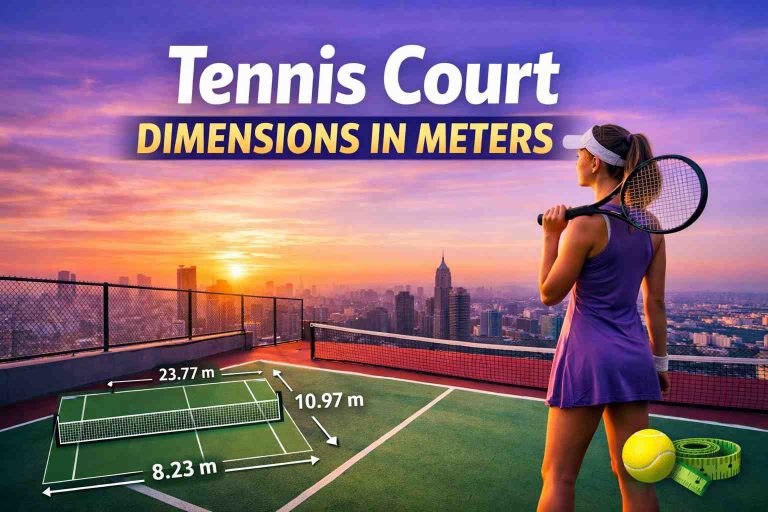
Singles tennis court dimensions have remained remarkably consistent for over a century, with the core measurements being a length of 78 feet (23.77 meters) and a singles width of 27 feet (8.23 meters).
This standardization supports everything from professional Grand Slam events to casual backyard games, emphasizing why precise tennis court size dimensions matter for gameplay, safety, and enjoyment.
History of Singles Tennis Court Dimensions

The origins of singles tennis court dimensions date back to the late 19th century when modern lawn tennis was developed in England. In 1874, Major Walter Clopton Wingfield patented a game called “Sphairistikè,” played on an hourglass-shaped court.
However, the version that became modern tennis was standardized in 1877 by the All England Croquet and Lawn Tennis Club for the inaugural Wimbledon tournament. The court was set at 78 feet long and 27 feet wide for singles—dimensions that have endured to the present day.
In 1913, the International Lawn Tennis Federation (now the ITF) was established and took responsibility for global rules. By 1924, the organization had formalized singles tennis court dimensions to match the measurements used today, prioritizing a rectangular layout for fairness and consistency.
After World War II, the introduction of hard courts, synthetic surfaces, and faster playing styles led to periodic reviews of equipment and rules, yet the fundamental singles tennis court dimensions remained unchanged.
In the 1970s, the addition of tiebreakers and the growing popularity of different surfaces prompted further examination, but the court size stayed the same.
The late 20th century saw the adoption of metric equivalents alongside imperial units to support international play. In 2009, the ITF launched the “Play and Stay” initiative with smaller courts for children and beginners, but full-size singles tennis court dimensions for adult and professional play have never been altered.
As of the latest ITF regulations, these measurements continue to define the sport. The consistency over more than 140 years reflects tennis’s commitment to tradition while allowing evolution in surfaces, equipment, and training methods.
From the grass of Wimbledon to the hard courts of the US Open and the clay of Roland Garros, singles tennis court dimensions ensure every player competes under identical spatial conditions.
Official Singles Tennis Court Dimensions Explained
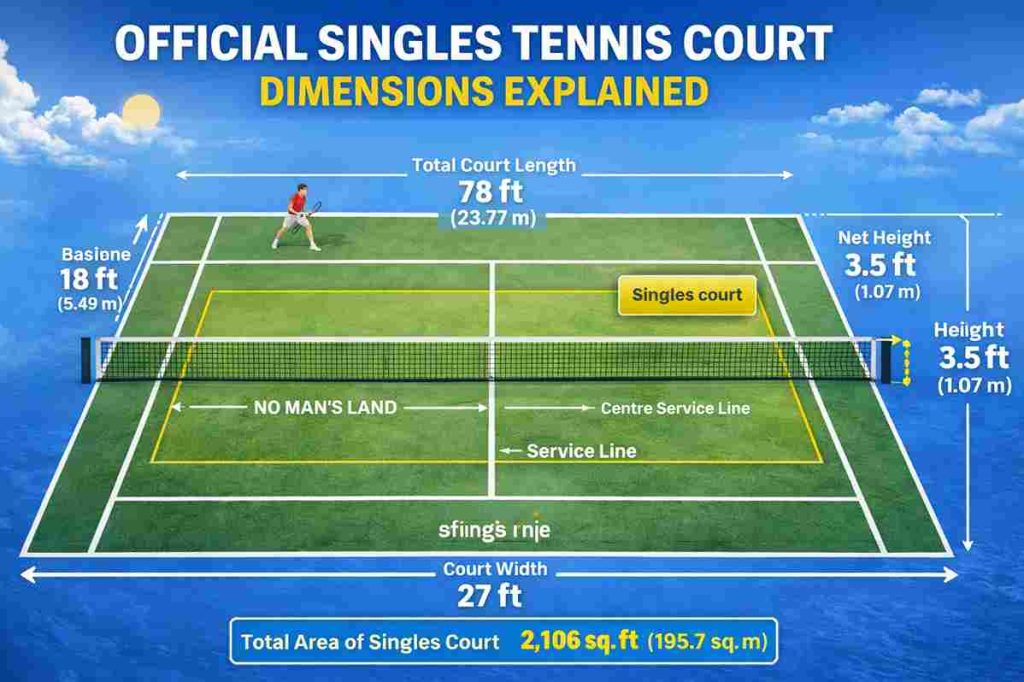
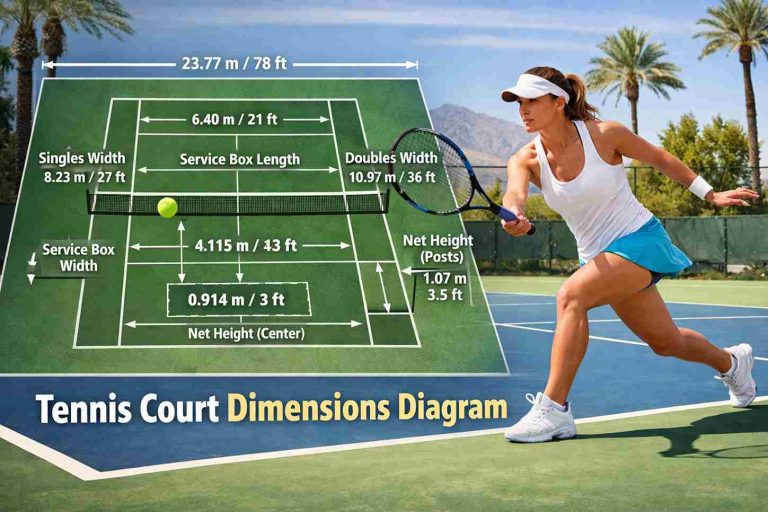
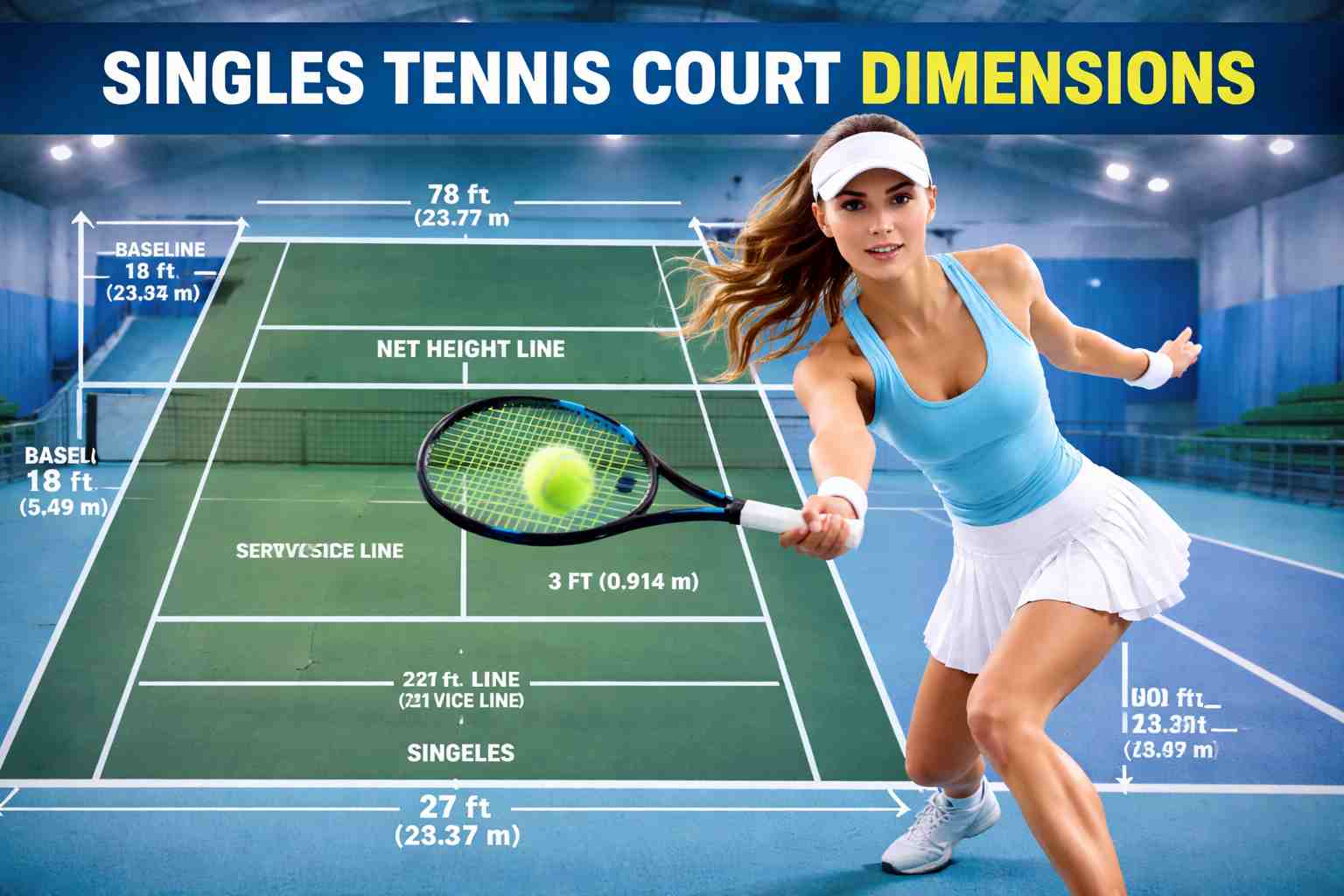
The official singles tennis court dimensions, as defined by the current ITF rules, specify a rectangular playing area measuring 78 feet (23.77 meters) in length and 27 feet (8.23 meters) in width. These figures represent the dimensions between the outer edges of the boundary lines.
Key elements include:
- Baselines — located at each end of the court, 78 feet apart.
- Singles sidelines — running the full length, 27 feet apart.
- Net — positioned exactly in the middle (39 feet from each baseline), with a center height of 3 feet (0.914 meters) and 3.5 feet (1.07 meters) at the posts.
- Service lines — drawn parallel to the baselines, 21 feet (6.40 meters) from the net on each side.
- Service boxes — each measuring 21 feet by 13.5 feet, divided by the center service line.
For visual reference, the following tennis court dimensions chart summarizes the most important measurements:
These standard tennis court dimensions apply universally to singles play. The doubles alleys (4.5 feet / 1.37 meters on each side) are considered out of bounds in singles matches but are marked on most courts to allow flexible use.
The total playable area for singles is approximately 2,106 square feet (195.65 square meters). When including recommended run-off zones for safety (typically 21 feet behind each baseline and 12 feet on the sides), the overall recommended space becomes about 120 feet by 60 feet.
Step-by-Step Guide to Marking a Singles Tennis Court Layout
Creating an accurate single tennis court layout requires careful measurement and attention to detail. Follow this step-by-step guide to achieve official singles tennis court dimensions:
- Select and Prepare the Site Choose a flat, well-drained area with at least 120 feet × 60 feet of space (including run-offs). Level the ground and install the chosen surface (grass, clay, hard court, or artificial turf).
- Mark the Outer Rectangle Use a 100-foot measuring tape or laser tool. Stake out the four corners to form a rectangle 78 feet long and 27 feet wide (singles width).
- Position the Net Posts Place net posts exactly 42 feet from each baseline, measured along the centerline. Set them 3 feet outside the singles sidelines and secure them 3 feet deep so the top is 3.5 feet above the court surface.
- Install the Net Attach the net to the posts and use a center strap to pull it down to exactly 3 feet at the middle. Ensure it is taut with no sagging.
- Draw the Baselines and Singles Sidelines Connect the corners to create the two baselines (78 feet each) and two singles sidelines (27 feet apart). Use chalk line or string for straightness before painting.
- Mark the Service Lines Measure 21 feet from the net on both sides and draw lines parallel to the baselines across the full 27-foot width.
- Add the Center Service Line Locate the exact center of the court (13.5 feet from each singles sideline) and draw a line from the net to each service line.
- Mark the Center Marks On each baseline, add a short 4-inch center mark (inside the court) to assist with serving position.
- Paint All Lines Apply durable, contrasting paint (usually white or yellow). Most lines are 1–2 inches wide; baselines may be up to 4 inches.
- Final Inspection Re-measure all key distances, check for square corners (using the 3-4-5 triangle method), test the net tension, and walk the court to confirm accuracy.
Following these steps ensures your court matches official tennis court dimensions and is safe for play.
Fact Guide: Key Insights on Singles Tennis Court Dimensions
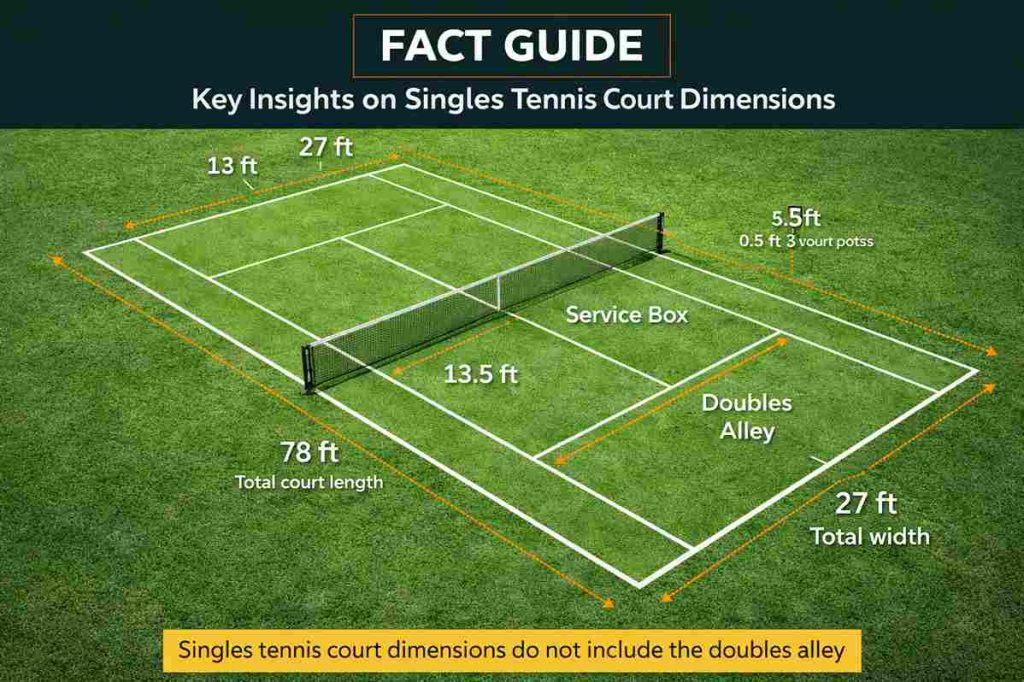
Here are important facts and practical details about singles tennis court dimensions:
- Singles court area: 2,106 square feet (195.65 m²)
- Doubles court area (for comparison): 2,808 square feet (260.87 m²)
- Lines are considered in play — a ball landing on the line counts as inside
- Junior “Red” courts (ages 5–8): 36 ft × 18 ft
- Junior “Orange” courts (ages 9–10): 60 ft × 21–27 ft
- Recommended total space with run-offs: 120 ft × 60 ft
- Net mesh must be small enough to prevent a tennis ball from passing through
- Post diameter must not exceed 6 inches
- Line color must contrast clearly with the court surface
- Modern courts increasingly use eco-friendly, low-VOC paints for line marking
- The same court can be used for both singles and doubles thanks to additional alley lines
These facts help players, coaches, and builders make informed decisions about court design and usage.
Singles vs. Doubles: Dimension Differences
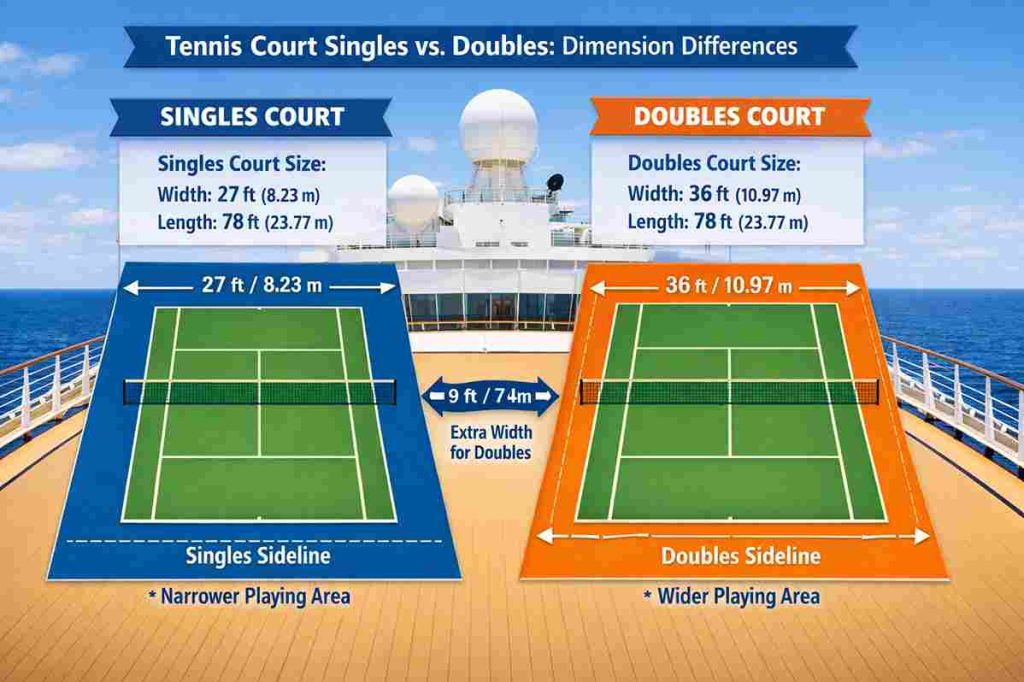
Singles tennis court dimensions measure 78 feet long by 27 feet wide, creating a narrower playing area suited to individual competition. Doubles courts share the same length but extend the width to 36 feet by incorporating 4.5-foot-wide alleys on each side. This added width supports team play, net rushes, and cross-court angles typical in doubles.
The service boxes and net remain identical in both formats. Most modern courts include both sets of lines, allowing easy transition between singles and doubles play. The narrower singles boundaries demand greater precision in shot placement, while the wider doubles court encourages teamwork and coverage strategies.
Surfaces and Maintenance for Optimal Dimensions
Different surfaces affect how singles tennis court dimensions feel during play:
- Grass — Fast and low bounce; requires frequent mowing and line repainting
- Clay — Slower pace, higher bounce; needs regular watering and line maintenance
- Hard (acrylic) — Consistent bounce; durable but requires resurfacing every 5–10 years
- Artificial turf / carpet — Low maintenance; used indoors and outdoors
Regular maintenance includes checking line visibility, net tension, surface cracks, and drainage to preserve accurate singles tennis court dimensions and player safety.
Latest Data and Research on Tennis Courts
Current ITF regulations maintain the traditional singles tennis court dimensions of 78 feet by 27 feet with no proposed changes. Recent focus has shifted toward sustainability, including recycled rubber bases, permeable hard-court surfaces, and environmentally friendly line paints.
Participation in tennis has grown significantly in recent years, particularly for recreational and junior play, driving demand for properly dimensioned community and home courts.
Conclusion
Singles tennis court dimensions—78 feet in length and 27 feet in width—represent far more than simple measurements; they are the unchanging framework that defines the sport’s fairness, strategy, and beauty.
For over a century, these precise figures have ensured that every player, from weekend enthusiasts to Grand Slam champions, competes under identical spatial conditions.
Whether on the iconic grass of Wimbledon, the red clay of Roland Garros, the hard courts of Melbourne or New York, or a local community facility, the dimensions create a level playing field where skill, athleticism, and mental toughness determine the outcome.
This comprehensive guide has explored the historical development of these measurements, provided exact official specifications, offered a practical step-by-step marking process, summarized key facts in clear tables and lists, compared singles and doubles layouts, and discussed surface types and maintenance considerations.
By covering related terms such as standard tennis court size, full size tennis court dimensions, tennis court dimensions chart, and single tennis court layout, the article addresses the full spectrum of user intent—whether you’re researching for construction, coaching, playing, or general curiosity.
The enduring nature of singles tennis court dimensions highlights tennis’s unique blend of tradition and adaptability. While surfaces, rackets, strings, and even ball technology have evolved dramatically, the court itself remains a constant.
This stability allows players across generations and continents to share the same fundamental experience. For anyone building, maintaining, or simply appreciating a tennis court, understanding these dimensions is the first step toward creating or enjoying a space where great tennis can happen.
In the end, every great rally, every perfectly placed serve, and every thrilling point begins and ends within the timeless boundaries of 78 feet by 27 feet.
Frequently Asked Questions

Jordan Blake
Jordan Blake is a racket-sports author with hands-on experience and a strong command of both tennis and pickleball. With a foundation built through years on the tennis court and a successful transition into competitive pickleball, Jordan brings practical insight, strategic clarity, and real-world understanding to every article.
Drawing on personal play, match analysis, and court-level observation, Jordan specializes in breaking down technique, tactics, and the mental aspects of both sports in a clear, data-informed, and accessible way. His dual-sport perspective helps readers understand how skills transfer between games—and where each sport demands its own distinct mastery.