Padel Tennis Court Dimensions: Complete Guide to Size, Layout & Specifications
Padel tennis, a fast-growing racket sport that combines elements of tennis and squash, continues to gain popularity worldwide thanks to its exciting gameplay, social nature, and accessibility.
Understanding padel tennis court dimensions is essential whether you are a player, coach, facility owner, or simply curious about the sport. These dimensions are strictly regulated by the International Padel Federation (FIP) to maintain consistency and fairness across all levels of play.
As of 2026, the FIP rules confirm that the core padel tennis court dimensions remain unchanged from previous standards, ensuring global uniformity while incorporating minor refinements in areas such as lighting, safety, and professional scoring systems.
This guide provides the most up-to-date information on padel tennis court dimensions, including measurements in both meters and feet, historical background, comparisons with other sports, step-by-step construction guidance, key facts, and answers to common questions.
Whether you’re searching for padel court dimensions in meters, padel court size in feet, standard padel court size, single padel court dimensions, or padel court size vs tennis court, this article covers it all in detail.
History of Padel Tennis and Its Court Dimensions
Padel tennis originated in 1969 in Acapulco, Mexico, when businessman Enrique Corcuera built the first court in his home. Limited by space, he created a smaller playing area enclosed by walls to keep the ball in play and prevent it from escaping into surrounding areas.
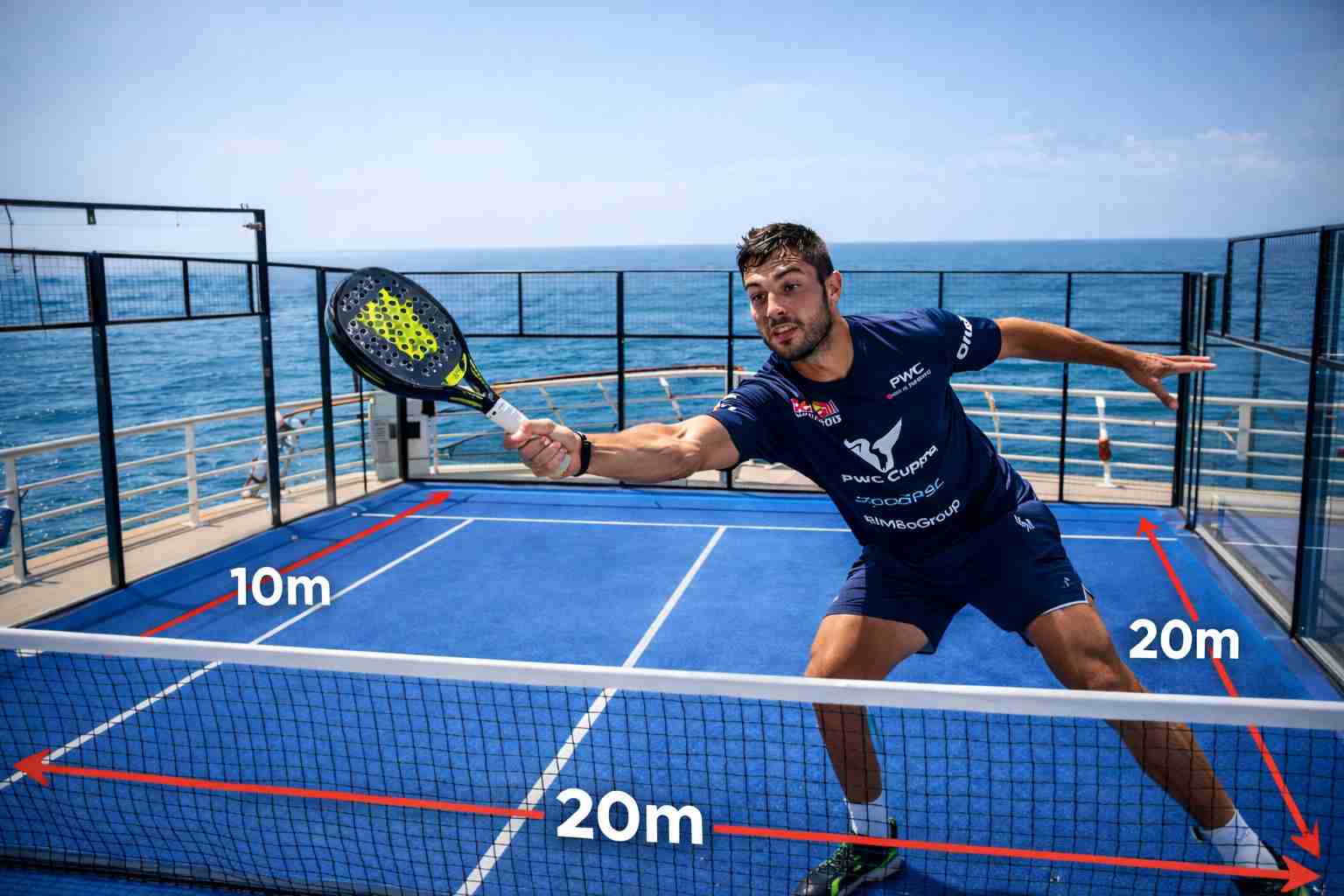
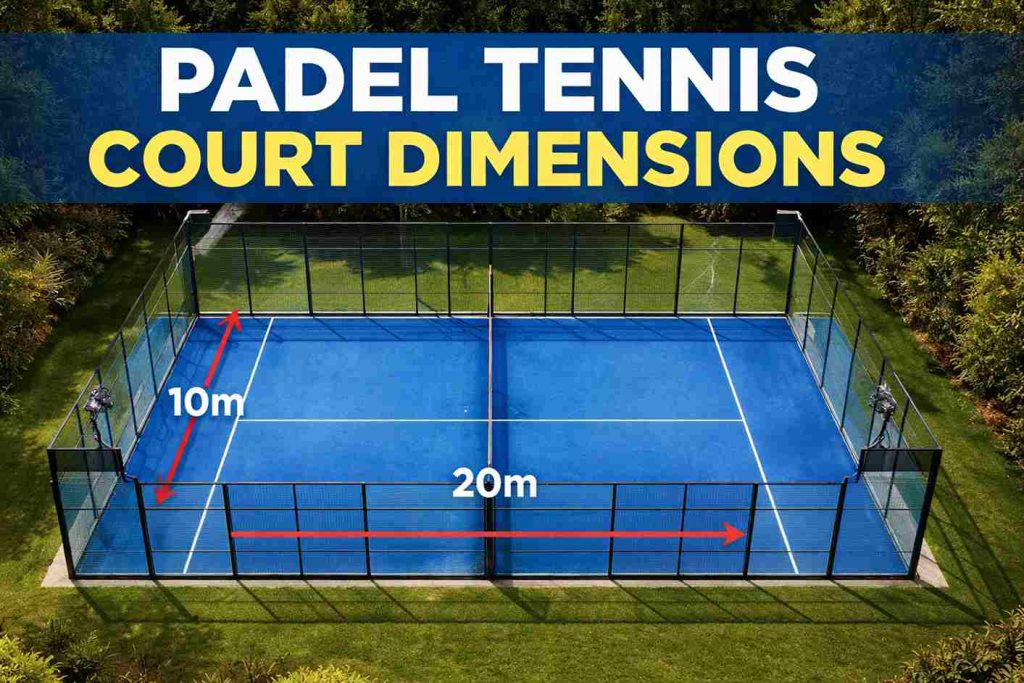
The original court measured 20 meters long by 10 meters wide—a size chosen for practicality rather than formal design. This compact, walled enclosure became the defining characteristic of the sport.
In the mid-1970s, Spanish aristocrat Alfonso de Hohenlohe discovered padel during a visit to Mexico and introduced it to Europe, first at his Marbella Club in Spain.
He made improvements such as replacing some solid walls with wire mesh to improve visibility for spectators and players. These early modifications helped the sport spread quickly across Spain and Argentina.
By the 1980s and 1990s, padel courts evolved further. Concrete surfaces gave way to synthetic turf for better ball control and player comfort. Wall materials shifted from opaque concrete to transparent tempered glass, allowing better viewing and consistent rebounds.
The International Padel Federation (FIP), established in 1991, formalized the rules, standardizing the interior playing area at 20 meters by 10 meters with a 0.5% construction tolerance.
Over the following decades, additional refinements included precise wall heights (4 meters at the back, 3–4 meters on the sides in a stepped configuration), net specifications, line markings, and safety clearances. By the late 1990s, sharp corners were eliminated, and mesh hole sizes were standardized for uniform bounce behavior.
In recent years, padel has experienced explosive global growth, reaching over 25 million players across more than 110 countries. The 2026 FIP regulations maintain the classic 20 m × 10 m dimensions while introducing updates such as enhanced minimum lighting levels, ceiling height recommendations for indoor facilities, and professional scoring options like the golden point system.
These changes support padel’s potential inclusion in major international events without altering the fundamental court size that has defined the sport since its inception.
Understanding Padel Tennis Court Dimensions
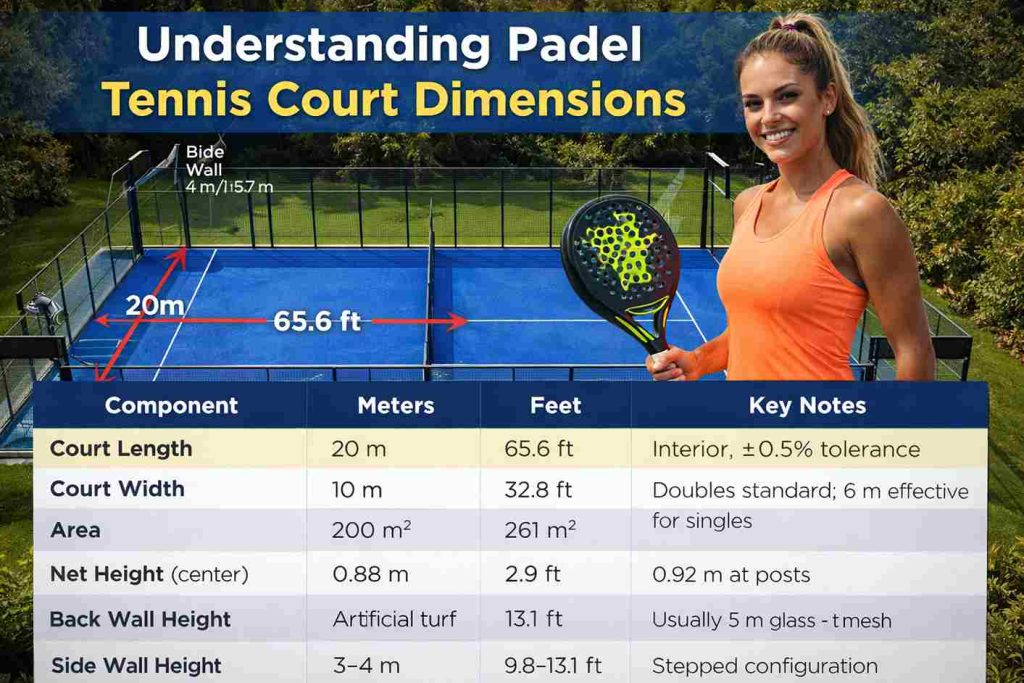
The official padel tennis court is a rectangular enclosed area with precise measurements designed to balance accessibility, strategy, and safety.
Standard Dimensions
- Length: 20 meters (interior measurement)
- Width: 10 meters (interior measurement)
- Tolerance: ±0.5% (up to approximately 10 cm variation allowed for construction)
- Total playable area: 200 square meters
In Feet
- Length: approximately 65.6 feet
- Width: approximately 32.8 feet
- Total playable area: approximately 2,153 square feet
The Padel Tennis Court Dimensions is divided into two equal 10 m × 10 m halves by a central net. Service lines are placed 6.95 meters from the net on each side, and a central service line runs perpendicular to divide each service box. All court lines are 5 cm wide, typically painted white or black for maximum visibility against the surface.
Height Requirements
- Minimum free height (ceiling clearance): 6 meters throughout the entire court area
- Recommended height for new indoor facilities: 8 meters
- No obstructions (lights, beams, etc.) allowed within the 6-meter minimum zone
Net Specifications
- Length: 10 meters (spanning the full width)
- Height at center: 0.88 meters (with 0.5 cm tolerance)
- Height at posts: 0.92 meters
- Posts: maximum 1.05 meters tall, with rounded edges for safety
Enclosure Details The defining feature of padel is its surrounding walls and mesh:
- Back walls (ends): typically 4 meters high (3 meters of glass + 1 meter of mesh)
- Side walls: 3–4 meters high in a stepped configuration
- Materials: 12 mm tempered safety glass for solid sections; electro-welded metallic mesh (wire thickness 2–4 mm, diagonal hole size 5–7.08 cm) for upper sections and sides
Variations
- Singles play: uses the same 20 m × 10 m court, but effective width is reduced to 6 meters using inner service line markings, creating a 120 m² playing area
- Mini/junior courts: often 10 m × 5 m or similar smaller sizes with lower nets (around 0.80 m) and softer balls for training and youth development (not used in official adult competition)
Safety and Additional Space
- Perimeter clearance: minimum 2 meters around the court
- Distance between adjacent courts: minimum 4 meters
- Doors: at least 1.2 meters wide for easy access
These padel tennis court dimensions create a unique environment where wall rebounds are integral to gameplay, distinguishing padel from open-court racket sports.
Padel Court Size vs Tennis Court: A Detailed Comparison
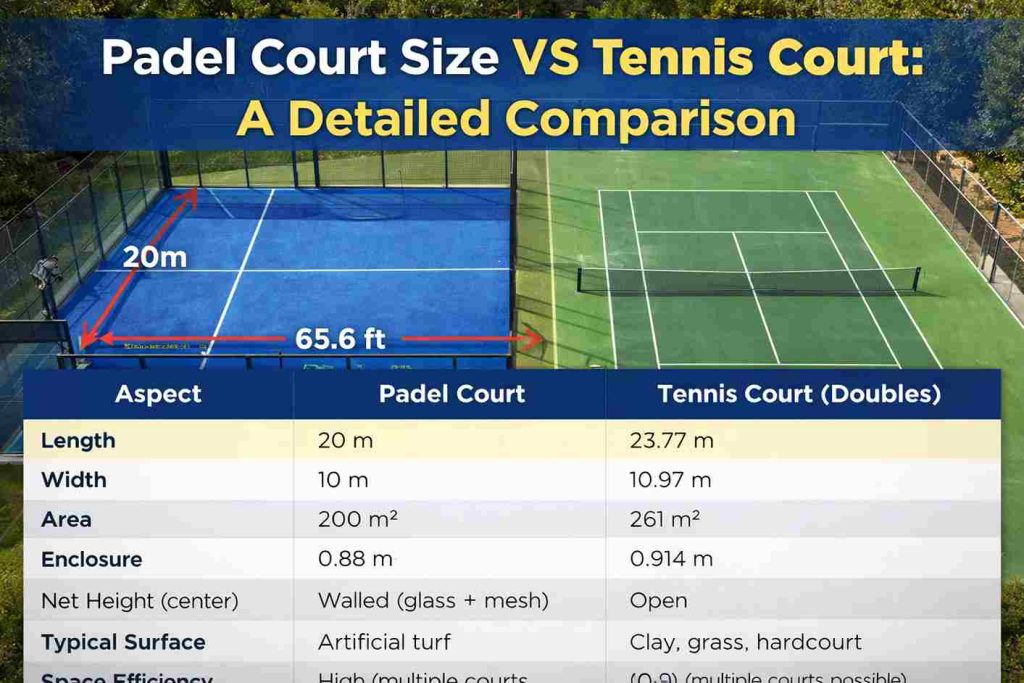
Comparing padel court size vs tennis court highlights why padel has become so popular in space-constrained environments.
- Padel Court
- Dimensions: 20 m × 10 m
- Area: 200 m²
- Enclosed with walls and mesh
- Net height: 0.88–0.92 m
- Tennis Court (Doubles)
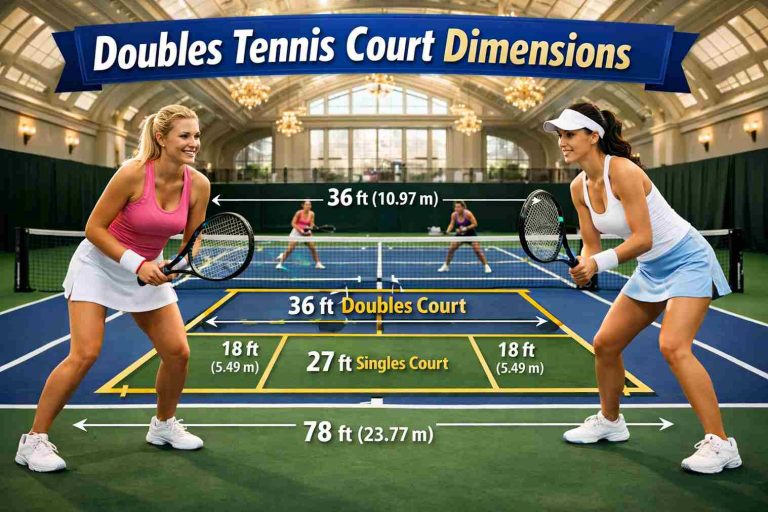
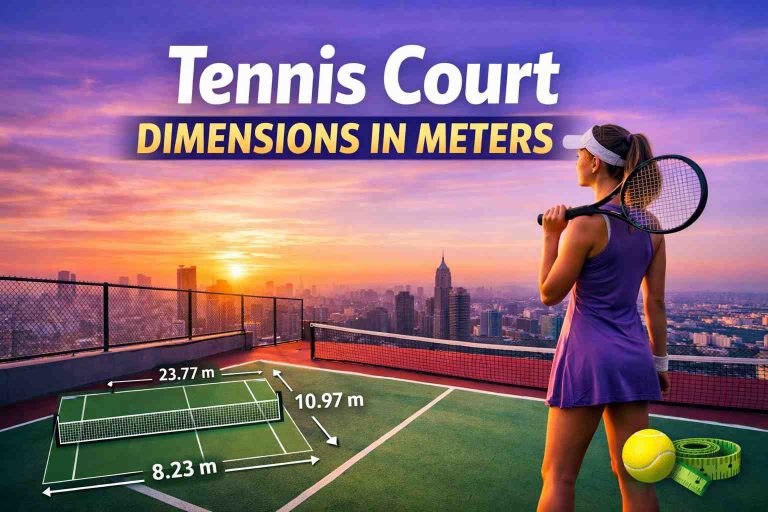
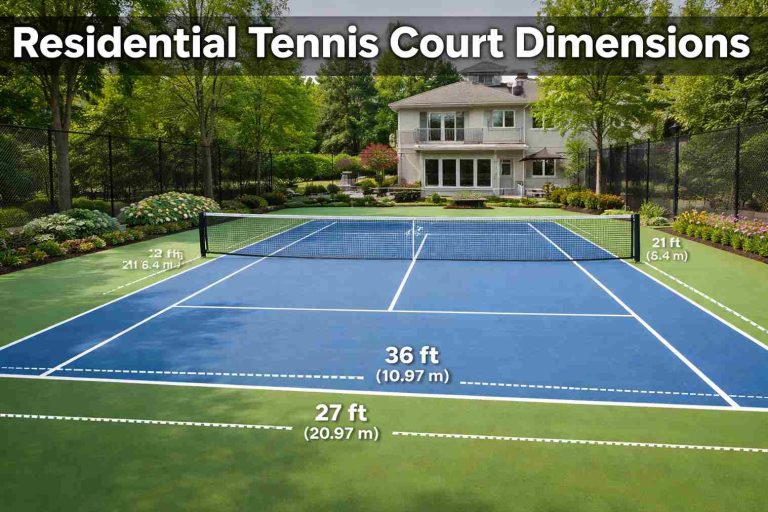
- Dimensions: 23.77 m × 10.97 m
- Area: 261 m²
- Open layout, no walls
- Net height: 0.914 m at center
Padel’s court is approximately 23% smaller in total area than a doubles tennis court and roughly one-third the size when considering the full required space (including run-off areas in tennis). This compactness allows three or more padel courts to be installed in the footprint of a single tennis court, making padel highly attractive for clubs, resorts, and urban facilities.
Gameplay differences are significant:
- Padel’s walls enable rebounds, leading to longer rallies, defensive play, and strategic use of angles
- Tennis relies entirely on groundstrokes, volleys, and baseline power without wall assistance
- Padel surfaces are almost always artificial turf for consistent, cushioned bounce
- Tennis offers clay, grass, or hardcourt options, each affecting speed and spin
Economically, padel courts are generally less expensive to build and maintain due to their smaller size and enclosed design, which reduces weather-related wear. The comparison between padel court dimensions vs tennis court explains much of padel’s rapid growth in regions where land is limited.
Step-by-Step Guide to Building a Padel Court
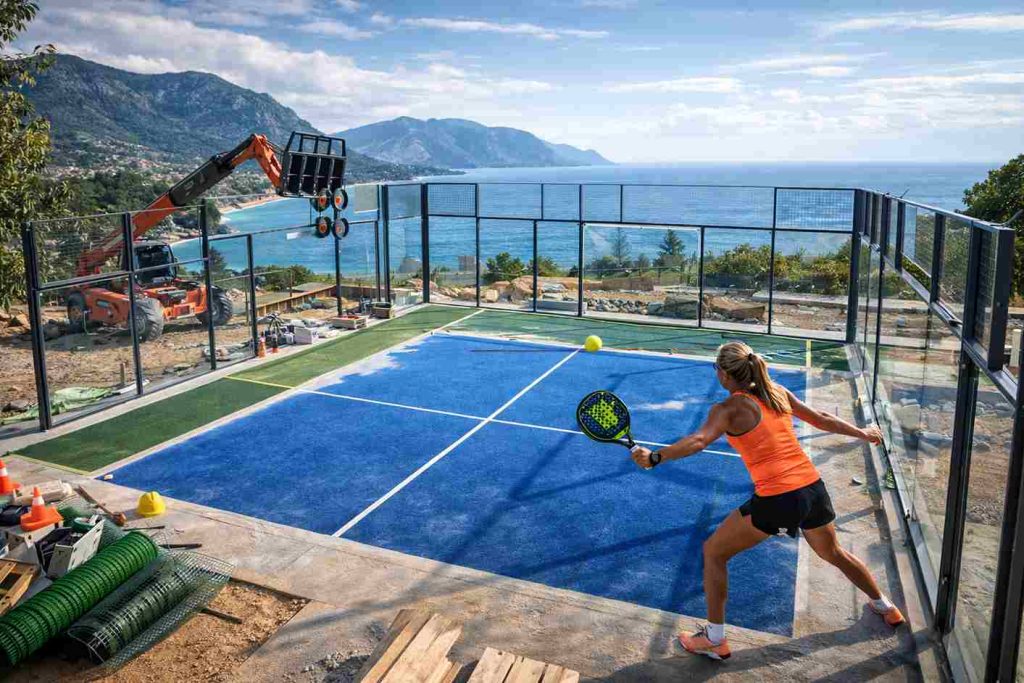
Constructing a court that meets official padel tennis court dimensions involves careful planning and adherence to FIP standards.
- Site Assessment and Planning Select a flat area of at least 25 m × 15 m (including safety clearances). Verify local zoning regulations and obtain necessary permits. Prepare a budget typically ranging from $50,000 to $100,000+ depending on materials and location.
- Foundation Work Excavate to approximately 150 mm depth. Install a free-draining sub-base of compacted stone or gravel. Pour a reinforced concrete slab (minimum 150 mm thick) with proper slope (0.5–1%) for drainage.
- Structural Framework Erect a galvanized steel frame with posts spaced correctly to achieve the 20 m × 10 m interior dimensions. Install back walls using 12 mm tempered safety glass (3 m high) topped with 1 m metallic mesh. Side walls follow a stepped 3–4 m height pattern with mesh sections.
- Surface Installation Lay a shock-absorbing pad followed by high-quality artificial turf (monofilament or fibrillated preferred). Mark court lines precisely (5 cm wide) at 6.95 m service distance and central divisions.
- Net and Accessories Install net posts (maximum 1.05 m tall) and stretch a regulation net to 0.88 m center height. Add access doors (minimum 1.2 m wide) and ensure all edges are rounded for safety.
- Lighting and Finishing Install LED lighting meeting minimum 500 lux standards. For indoor courts, confirm ceiling clearance of at least 6 m (ideally 8 m). Perform final testing for bounce consistency and wall alignment.
- Inspection and Certification Have the court inspected by a qualified professional to ensure compliance with current FIP standards.
Following these steps ensures your court meets all padel tennis court dimensions and specifications for both recreational and competitive use.
Fact Guide: Key Facts on Padel Tennis Court Dimensions
- Standard size: 20 m × 10 m (65.6 ft × 32.8 ft)
- Singles effective width: 6 m
- Mini/junior size (non-official): often 10 m × 5 m
- Minimum ceiling height: 6 m (8 m recommended for new builds)
- Net height: 0.88 m center, 0.92 m at posts
- Back wall height: 4 m typical
- Side wall height: 3–4 m stepped
- Construction tolerance: ±0.5%
- Playable area: 200 m²
- Required perimeter clearance: 2 m
- Minimum distance between courts: 4 m
Latest Data on Padel Tennis Court Dimensions
As of 2026, the FIP continues to uphold the 20 m × 10 m standard dimensions with no changes to length, width, or enclosure heights. Recent updates focus on improved lighting requirements, enhanced safety glass specifications, and optional professional scoring systems (such as the golden point at deuce), but the physical court layout remains consistent.
Global padel court installations have grown dramatically, with many tennis facilities converting courts to padel due to the space efficiency and increasing player demand.
Conclusion
Padel tennis court dimensions—20 meters long by 10 meters wide, enclosed by glass and mesh walls—define a sport that is both compact and strategically deep. This carefully standardized size, unchanged in its core measurements for decades, allows padel to thrive in urban environments, community centers, resorts, and private homes where larger courts would be impractical.
The enclosed design creates longer rallies, encourages teamwork in doubles, and reduces the physical demands compared to open-court sports, making padel accessible to players of all ages and skill levels.
From its origins as a practical solution to limited space in 1960s Mexico to its current status as one of the world’s fastest-growing sports, padel has maintained dimensional consistency while adapting to modern needs.
Whether you’re comparing padel court size in meters to tennis, exploring single padel court dimensions, or planning to build your own facility, understanding these specifications is key to appreciating and participating in the sport.
The combination of a modest footprint, rebound-capable walls, and precise regulations ensures fair, enjoyable, and consistent play worldwide. As padel continues its rapid expansion—with millions of new players and facilities emerging each year—the 20 m × 10 m court remains at the heart of its success, promising an exciting future for this dynamic and inclusive racket sport.
Frequently Asked Questions

Jordan Blake
Jordan Blake is a racket-sports author with hands-on experience and a strong command of both tennis and pickleball. With a foundation built through years on the tennis court and a successful transition into competitive pickleball, Jordan brings practical insight, strategic clarity, and real-world understanding to every article.
Drawing on personal play, match analysis, and court-level observation, Jordan specializes in breaking down technique, tactics, and the mental aspects of both sports in a clear, data-informed, and accessible way. His dual-sport perspective helps readers understand how skills transfer between games—and where each sport demands its own distinct mastery.