Junior Tennis Court Dimensions: Mini, 60-Foot & Youth Courts Explained
Junior tennis court dimensions are essential for introducing young players to the sport in a way that’s fun, safe, and developmentally appropriate.
Unlike standard adult courts, which can overwhelm beginners with their size, junior tennis court dimensions are scaled down to match children’s physical capabilities, allowing them to rally, strategize, and build confidence from an early age.
This article delves deep into junior tennis court dimensions, exploring their history, specifications, benefits, and more. Whether you’re a parent setting up a backyard court, a coach planning youth programs or simply curious about youth tennis court dimensions.
We’ll cover everything you need to know, including related aspects like red ball tennis court dimensions, orange ball tennis court dimensions, and mini tennis court dimensions.
With tennis participation in the USA reaching new heights—25.7 million players in 2024, including significant growth among youth under 25—understanding junior tennis court dimensions is more relevant than ever.
By adapting courts to kids’ sizes, programs like the USTA’s Net Generation have boosted engagement, making tennis accessible and enjoyable for millions.
The History of Junior Tennis Court Dimensions
The evolution of junior tennis court dimensions reflects a broader shift in youth sports toward age-appropriate scaling.
Tennis, originating in the late 19th century as “lawn tennis,” initially featured courts designed for adults—78 feet long and 27 feet wide for singles, expanding to 36 feet for doubles.
These dimensions were based on croquet grounds and remained unchanged for over a century.
Junior tennis, however, didn’t always have tailored dimensions. Early youth programs in the 1910s through the USTA focused on full-sized courts, which often frustrated young players unable to cover the space or sustain rallies.
It wasn’t until the late 20th century that organizations recognized the need for modifications. The National Junior Tennis and Learning network, founded in 1969, emphasized accessibility for underserved youth but still used standard courts.
A pivotal change came in the 2010s with the USTA’s “10 and Under Tennis” initiative, launched around 2012. Inspired by other youth sports like Little League Baseball,
which scales fields, the USTA introduced smaller courts, shorter racquets, and low-compression balls (red, orange, green) to make the game “kid-sized.”
This was only the fifth major rule change in tennis history, allowing for 36-foot and 60-foot courts. The International Tennis Federation (ITF) soon adopted similar guidelines globally, standardizing junior tennis court dimensions to promote skill development and retention.
By the mid-2010s, programs like QuickStart Tennis (now Net Generation) had courts as small as 36×18 feet for ages 5-8, expanding to 60×21 feet for 9-10-year-olds. This shift addressed high dropout rates—previously, many kids quit by age 10 due to frustration on full courts.
Today, in 2026, these dimensions remain the standard, with ongoing refinements based on participation data showing youth growth driving overall tennis surges. For instance, junior core players (playing 10+ times/year) reached 3.7 million in 2024, up from pre-pandemic levels.
This history underscores how junior tennis court dimensions have transformed the sport, making it more inclusive and aligning with modern child development principles.
Standard Tennis Court Dimensions vs. Junior Variations
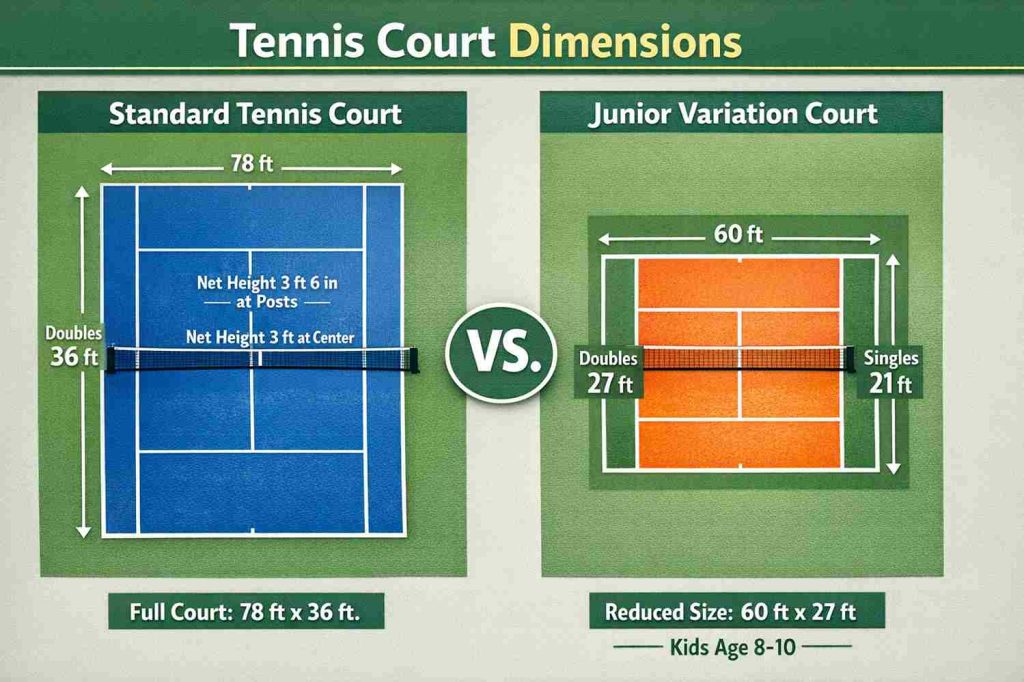
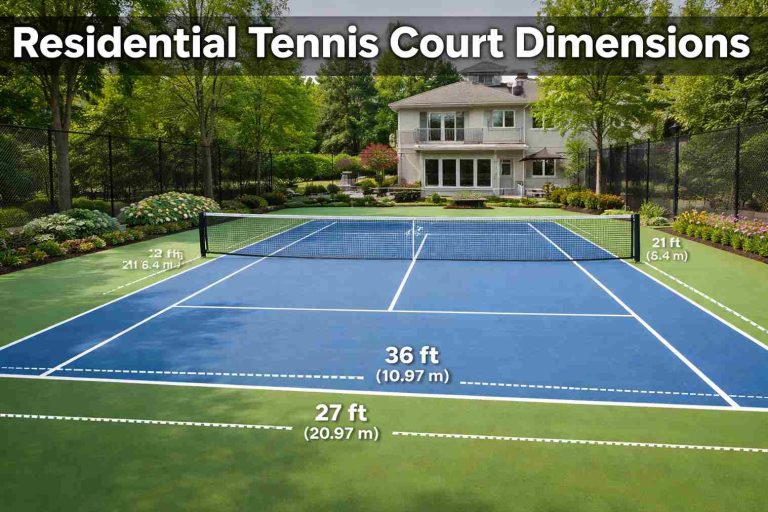
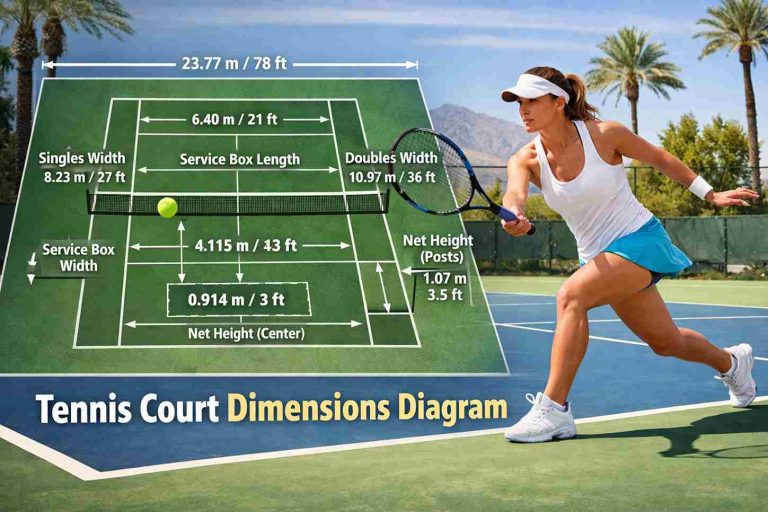
To appreciate junior tennis court dimensions, it’s helpful to compare them to standard courts. Official regulations for adult tennis specify a rectangle 78 feet (23.77 meters) long and 27 feet (8.23 meters) wide for singles, widening to 36 feet (10.97 meters) for doubles.
The net height is 3 feet (0.914 meters) at the center, with posts at 3.5 feet (1.07 meters). Lines are 2 inches (5 cm) wide, and recommended run-back areas add at least 21 feet behind baselines and 12 feet beside sidelines.
Junior tennis court dimensions, however, scale this down for progression. The USTA’s PlayTracker system categorizes by ball type: red for ages 5-8 (36-foot courts), orange for 9-10 (60-foot), and green for 11+ (full size with modified balls). This phased approach ensures kids master fundamentals before transitioning.
Here’s a comparison table:
These junior tennis court dimensions allow for blended lines on full courts, using 1.5-inch wide contrasting colors for easy adaptation. For mini tennis court size in meters, the red stage is about 11×5.5 m, while in feet it’s 36×18—perfect for driveways or gyms.
Detailed Breakdown of Junior Tennis Court Dimensions
Junior tennis court dimensions vary by age and skill, ensuring progressive learning. Let’s explore key variations, incorporating related keywords like half court tennis court dimensions, 10 and under tennis court dimensions, and more.
Red Ball Tennis Court Dimensions (Ages 5-8)
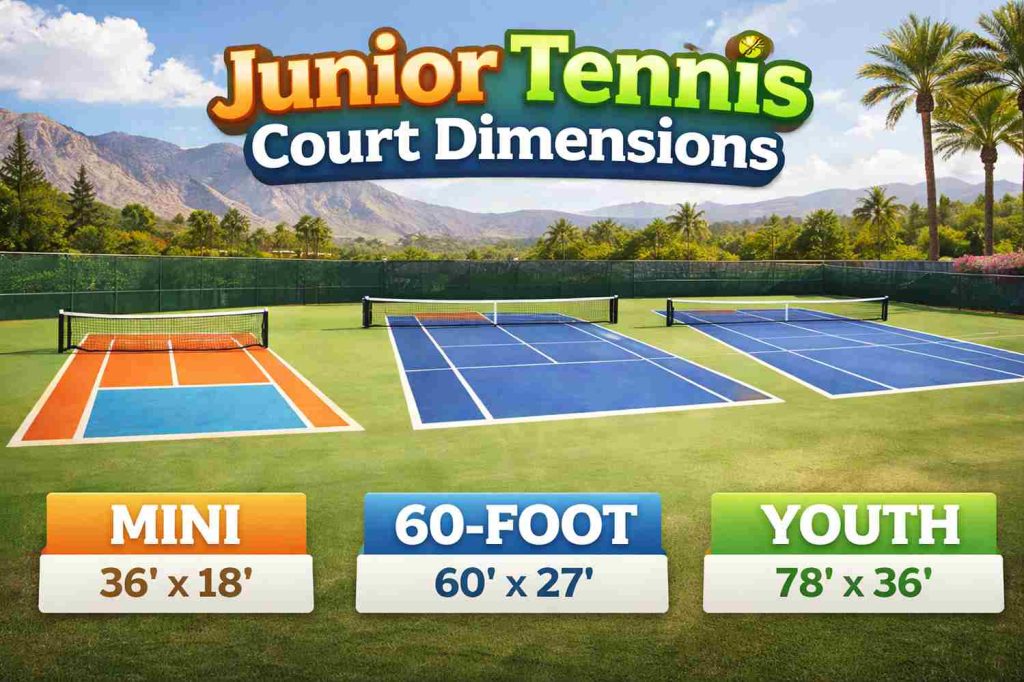
Red ball tennis court dimensions are the smallest, designed for beginners. The court is 36 feet long by 18 feet wide (10.97 m x 5.49 m), with a net at 2.75-3 feet.
This mini tennis court size in feet allows kids to hit over the net easily, using low-bounce red balls (foam or felt) and 19-23 inch racquets. Benefits include longer rallies and better technique development. Mini tennis court dimensions in meters (11×5.5 m) fit small spaces, making it ideal for schools.
Orange Ball Tennis Court Dimensions (Ages 9-10)
For 10 and under tennis court dimensions, orange ball setups use 60-foot courts: 60 ft x 21 ft for singles (18.29 m x 6.40 m) or 60 ft x 27 ft for doubles (18.29 m x 8.23 m).
Net height remains 3 feet, with orange low-compression balls and 23-25 inch racquets. This 60 foot tennis court dimensions bridge to full size, teaching positioning and strategy.
Green Ball and Youth Tennis Court Dimensions (Ages 11+)
Youth tennis court dimensions transition to full 78×27 ft, but with green dot balls for reduced bounce. This helps tweens refine skills without the full intensity of yellow balls.
Half Court Tennis Court Dimensions
Half court setups, often 39 ft x 13.5 ft, are used for drills or space-limited areas, halving standard dimensions for focused practice.
These specifications ensure junior tennis court dimensions meet kids’ needs, reducing injury risk and boosting enjoyment.
Latest Data and Statistics on Junior Tennis Participation
As of 2026, junior tennis is booming in the USA. The 2025 USTA Participation Report (based on 2024 data) shows 25.7 million total players, up 8% from 2023, with youth under 25 driving 45% of growth.
Junior players (6-17) totaled around 6.9 million, with core juniors at 3.7 million. Retention hit 79%, and first-time juniors remained strong at 4.5 million overall beginners.
High school participation reached a record 8.26 million in 2024-25, with tennis at over 363,000 boys and girls combined. Diversity is increasing: Black/African American youth participation grew 26%, Hispanic 15.4%.
Programs using proper junior tennis court dimensions have fueled this, with Net Generation registering millions since 2017.
ITF’s 2026 junior regulations emphasize these dimensions in tournaments, with no major changes but added focus on round-robin formats for engagement. Globally, participation initiatives aim to grow the base.
Step-by-Step Guide to Building a Junior Tennis Court
Building a junior tennis court can be rewarding. Here’s a detailed guide, focusing on a 60-foot orange ball court, adaptable for smaller sizes.
- Plan and Assess Location: Choose a flat area at least 80×40 feet including run-offs. Check sunlight (north-south orientation best), soil drainage, and permits. Budget: $10,000-$30,000 for basic asphalt.
- Design the Layout: Mark dimensions—60×21 ft for singles. Use official guidelines for blended lines if on a full court. Select surface: asphalt for durability, or modular tiles for temporary setups.
- Prepare the Ground: Excavate 6-12 inches, level, and compact sub-base with gravel for drainage. Install edging to contain materials.
- Build the Base: Pour 4-6 inches of asphalt or concrete, curing for 2 weeks. For kid-friendly, add cushion layers.
- Apply Surface and Lines: Coat with acrylic resurfacer, then color (e.g., green/red). Mark lines: 1.5 inches wide, using tape for precision.
- Install Net and Accessories: Set posts 3 feet outside lines, hang net at 3 feet center. Add windscreens, benches.
- Test and Maintain: Flood test for drainage, then play! Annual resurfacing keeps it safe.
This guide ensures your junior tennis court dimensions are accurate and long-lasting.
Key Facts About Junior Tennis Court Dimensions
Here are essential facts to guide your understanding:
- Scalability: Junior tennis court dimensions use blended lines, allowing one court for multiple ages—saving space and costs.
- Net Adjustments: Lower nets (2.75 ft for red) reduce frustration, with portable options for versatility.
- Ball Types: Red balls bounce 75% lower than yellow, matching mini tennis court size in feet for better control.
- Safety Benefits: Smaller youth tennis court dimensions cut injury risk by 50%, by reducing overreaching.
- Global Standards: Tolerances allow ±1% variance, ensuring consistency in tournaments.
- Conversion Tips: Add junior lines to existing courts for $500-$2,000.
These facts highlight why proper junior tennis court dimensions are crucial for development.
Conclusion
In summary, junior tennis court dimensions represent a thoughtful evolution in the sport, designed to foster lifelong passion among young players.
From the compact 36×18 foot red ball setups to the transitional 60-foot orange courts and beyond, these scaled dimensions ensure that children can engage meaningfully without the intimidation of adult-sized play areas.
By incorporating elements like lower nets, specialized balls, and blended lines, organizations like the USTA and ITF have made tennis more accessible, leading to unprecedented participation growth.
As we’ve seen, with 25.7 million Americans playing in 2024—a 46% increase since 2019—and youth segments powering much of that surge, the emphasis on proper junior tennis court dimensions is paying dividends.
Retention rates at 79%, diverse demographic gains, and record core players underscore how these adaptations not only build skills but also community and health benefits.
Looking ahead to 2026 and beyond, the stability in regulations suggests these dimensions will remain foundational, with potential enhancements in digital tools for court planning or inclusive programs for underserved areas.
For parents, coaches, and facilities, investing in accurate junior tennis court dimensions isn’t just about measurements—it’s about creating environments where kids thrive, reducing dropout rates, and nurturing the next generation of champions.
Whether building a backyard mini court or advocating for school programs, remember that the right size sparks joy and progress. As tennis continues to grow, embracing these dimensions will keep the sport vibrant, inclusive, and fun for all ages.
Ultimately, junior tennis court dimensions symbolize a commitment to child-centered sports, proving that scaling down can lead to scaling up participation and love for the game.