
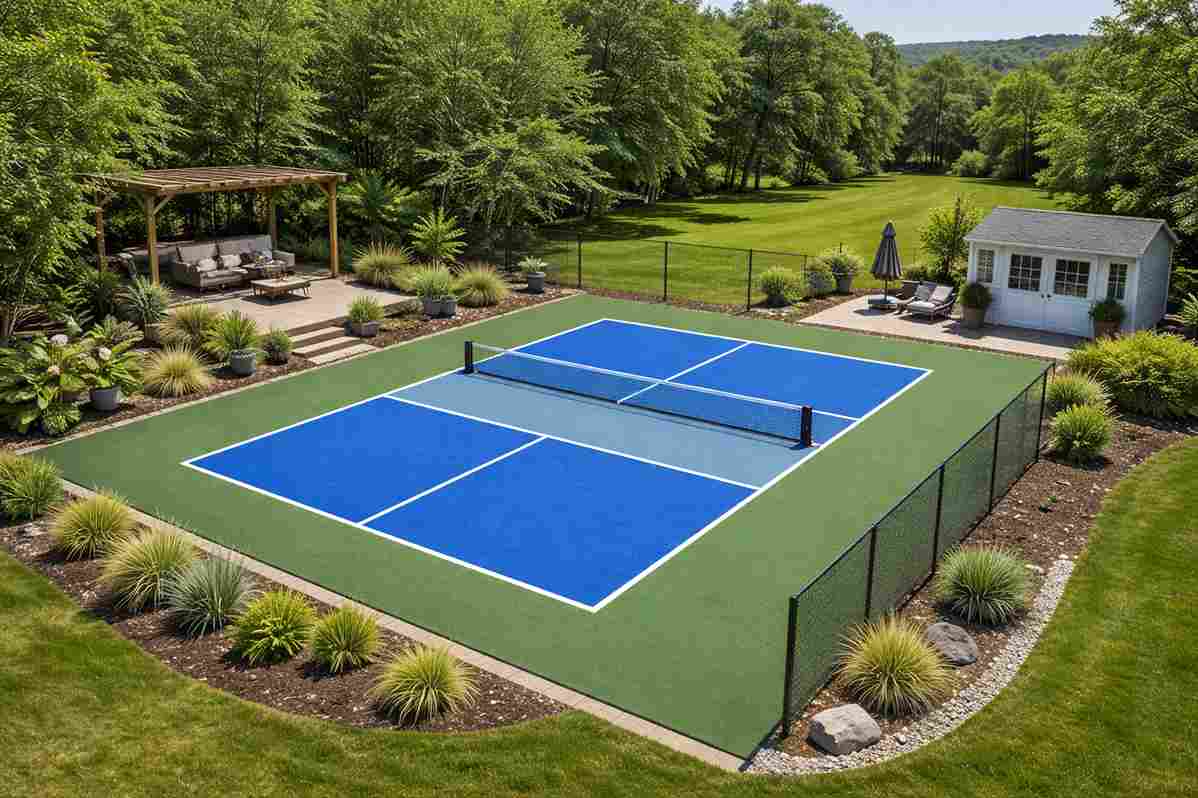
Ultimate Guide to Backyard Pickleball Court Dimensions: Planning & Maintenance
Pickleball has surged in popularity as a fast-growing sport in the United States, blending accessibility, low-impact exercise, and social fun for all ages. As of 2025, about 19.8 million Americans actively play, reflecting a 14.7% growth from 2024 and a broader market valued at $1.8 billion, projected to reach $9.1 billion by 2034. This demand has spurred interest in residential courts for convenient play.
For homeowners, mastering backyard pickleball court dimensions is essential. The standard measures 20 feet wide by 44 feet long, but effective setups often need extra space for safety. This guide covers key intents like sizes in feet/meters, square footage, layouts, regulations, rules, and small-space adaptations, ensuring compliance and enjoyment.
A home court boosts recreation and property value—potentially by 5-10% in active communities, with 25% more real estate listings highlighting them in 2025. However, consider noise and upkeep. This self-contained resource draws from USA Pickleball standards, offering stats, steps, and insights for beginners and experts alike. While the core area is 880 square feet, buffers expand it to 1,800+ square feet; metric conversions (6.1m x 13.4m) aid global use. Follow this to build a pro-grade space promoting fitness and community.
Official Pickleball Court Dimensions and Layout
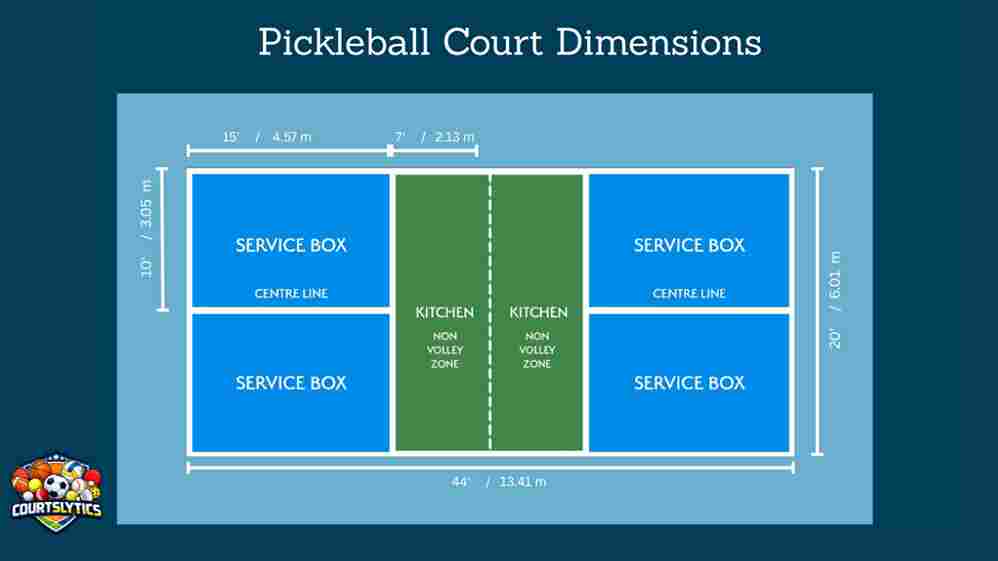
The official pickleball court dimensions, as outlined in the 2025 USA Pickleball Rulebook, specify a rectangular playing area of 20 feet wide by 44 feet long for both singles and doubles games, inclusive of 2-inch-wide boundary lines.
This equates to 6.1 meters wide by 13.4 meters long in metric measurements, with a total playing surface area of 880 square feet (approximately 81.75 square meters). These dimensions ensure consistency in gameplay, promoting fair competition and skill development. The court layout includes several critical zones that influence strategy and rules adherence.
Central to the design is the non-volley zone, commonly known as the “kitchen,” which extends 7 feet (2.13 meters) from the net on each side, spanning the full 20-foot (6.1-meter) width. Volleying is prohibited within this area to prevent aggressive net play and encourage strategic dinking.
The service areas are divided into two boxes per side, each measuring 10 feet deep by 15 feet wide (3.05 meters by 4.57 meters), with the centerline bisecting them. Baselines are positioned 22 feet (6.71 meters) from the net, and sidelines maintain the 20-foot width.
The net itself spans 22 feet (6.71 meters) to extend 1 foot (0.3 meters) beyond each sideline, with heights of 36 inches (0.91 meters) at the sidelines and 34 inches (0.86 meters) at the center to account for natural sag. USA Pickleball mandates that the net remain taut, with no more than 1/4-inch (0.64 cm) sag under tension.
For overall space, a minimum total area of 30 feet wide by 60 feet long (9.14 meters by 18.29 meters, or 1,800 square feet/167.23 square meters) is recommended to include safety buffers: at least 5 feet (1.52 meters) on the sides and 8-10 feet (2.44-3.05 meters) behind baselines. For tournament or enhanced recreational use, expand to 34 feet by 64 feet (10.36 meters by 19.51 meters, or 2,176 square feet/202.16 square meters).
To verify squareness during layout, apply the Pythagorean theorem: court diagonals should measure approximately 48 feet 5 inches (14.76 meters). Lines must be 2 inches (5.08 cm) wide and contrasting in color for visibility. These specifications align with badminton court sizes but are adapted for pickleball’s unique rules, such as the two-bounce requirement.
The table below summarizes key measurements for quick reference:
These dimensions ensure the court adheres to backyard pickleball court dimensions and regulations, facilitating consistent play while minimizing injury risks through adequate spacing.
Site Selection and Planning Considerations
1. Available Space and Court Orientation
Selecting an appropriate site for a backyard pickleball court requires careful evaluation of environmental, regulatory, and functional factors to ensure longevity and usability. Begin by assessing available space against the standard backyard pickleball court dimensions: a minimum of 30 feet by 60 feet (1,800 square feet) is essential, though 34 feet by 64 feet (2,176 square feet) is preferable for optimal play. Orientation plays a key role; align the court north-south to minimize sun glare, which can reduce visibility by up to 20% during peak hours and affect player performance.
2. Terrain and Drainage
Terrain levelness is critical—slopes exceeding 1% (1 inch per 10 feet) can lead to uneven ball bounce and increase injury risks by 15-20%, necessitating grading costs of $1,000-$5,000 depending on site size. Drainage is a fundamental requirement to prevent water pooling, which can degrade surfaces and cause cracks over time. USA Pickleball guidelines specify a 1% slope directed away from the court center, equivalent to a 1-inch drop per 10 feet, to facilitate runoff. In regions with annual rainfall exceeding 40 inches, incorporate perimeter drains or French drains, adding $500-$2,000 to the project but reducing long-term repair needs by 30%. Test for pooling by simulating rain; standing water after 30 minutes indicates poor drainage.
3. Lighting and Safety
Lighting extends usability into evenings, with standards requiring 30-50 footcandles of uniform illumination and a maximum-to-minimum ratio of 2.0 or less to avoid shadows. Install LED fixtures on 20-25-foot poles positioned along the sides, targeting 300 lux horizontal and 200 lux vertical for recreational play. This setup, costing $2,000-$4,000, enhances safety and supports year-round use, with motion sensors cutting energy costs by 40%.
4. Regulatory Compliance and Environmental Factors
Regulatory compliance involves securing building permits, often required for structures over 200 square feet, with fees ranging from $100-$500. Check zoning for setbacks—typically 10-20 feet from property lines—and adhere to noise ordinances, as pickleball can generate 59-70 dBA. Mitigation strategies include acoustic fencing or hedges, reducing noise by 5-10 dBA. Homeowners associations may mandate approvals, with 2025 data showing 15% of applications requiring variances for noise concerns. Environmental factors, such as soil stability (tested via percolation rates of 0.5-2 inches per hour), further influence planning. By addressing these elements systematically, you create a compliant, efficient space that aligns with backyard pickleball court dimensions and rules.
5. Surface Materials: Options, Advantages, and Limitations
Choosing the right surface material for a backyard pickleball court is pivotal for performance, player comfort, and durability, directly impacting the overall experience. Materials must provide consistent bounce—typically 85-95% of a tennis ball’s height—while withstanding weather and heavy use. Common options include concrete, asphalt, acrylic-coated surfaces, modular tiles, and synthetic turf, each with distinct pros, cons, and costs based on 2025 market data.
- Concrete offers exceptional durability, lasting 20-30 years with minimal upkeep, and provides a reliable bounce rated at 90% consistency. Its advantages include resistance to weathering and low maintenance costs ($200-$500 annually), but it is hard on joints, increasing injury risk by 10-15%, and prone to cracking in freeze-thaw cycles, with repair costs up to $1,000 per incident. Estimated cost per square foot in 2025: $5-$10, totaling $9,000-$18,000 for a 1,800-square-foot area.
- Asphalt is flexible and cost-effective, with good traction reducing slips by 20%, and a lifespan of 15-25 years. However, it softens in temperatures above 90°F (32°C), potentially altering bounce, and requires sealing every 3-5 years at $500-$1,000. Costs range from $4-$8 per square foot, or $7,200-$14,400 total.
- Acrylic-coated surfaces, applied over concrete or asphalt, enhance grip with textured layers and allow color customization, cushioning impacts by 20-30% for joint health. Resurfacing is needed every 5-7 years ($2,000-$5,000), and costs $2-$5 per square foot for coating alone.
- Modular polypropylene tiles are ideal for DIY, offering shock absorption (up to 50% impact reduction) and portability, with installation in 1-2 days. They may shift on uneven bases, requiring a level subfloor, and cost $4-$7 per square foot ($7,200-$12,600 total).
- Synthetic turf provides a soft, natural feel with low-impact play, but offers inconsistent bounce (70-80%) and high maintenance, including infill replacement every 2-3 years ($1,000+). Costs: $3-$6 per square foot ($5,400-$10,800).
The following table compares these options:
For backyard applications, concrete with acrylic coating is recommended for balance, meeting pickleball court dimensions and regulations while prioritizing player safety.
Construction Process: Step-by-Step Instructions
Constructing a backyard pickleball court involves a systematic process to align with official dimensions and ensure structural integrity. Whether DIY or professional, the project typically spans 4-8 weeks, with costs influenced by site conditions. Begin with thorough planning, confirming the 20-foot by 44-foot playing area fits within a 30-foot by 60-foot total space.
Step 1: Site Preparation
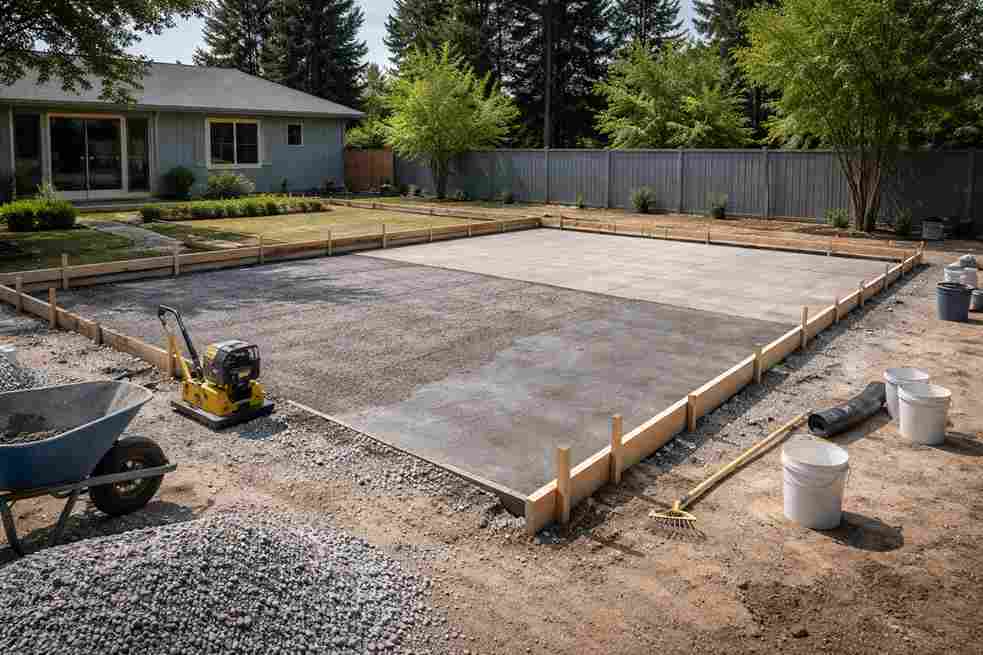
Clear vegetation and debris from the area, excavating 4-6 inches deep to remove topsoil. Compact the soil to 95% density using a roller, preventing settling that could cause cracks. Install a geotextile fabric to inhibit weed growth and stabilize the base, followed by a 4-6-inch layer of crushed aggregate compacted in 2-inch lifts. Incorporate drainage features like perimeter trenches if rainfall exceeds 30 inches annually. This phase takes 1-2 days and costs $1,000-$3,000.
Step 2: Foundation Installation
Pour a 4-inch reinforced concrete slab (using #4 rebar at 12-inch centers) or asphalt layer, ensuring a 1% slope for drainage. Allow 28 days for concrete curing to achieve 3,000 PSI strength, avoiding premature loading that could reduce lifespan by 20%. Asphalt cures in 14 days. Professional pouring ensures uniformity; DIY requires forms and a mixer, with costs $5,000-$15,000.
Step 3: Surface Application
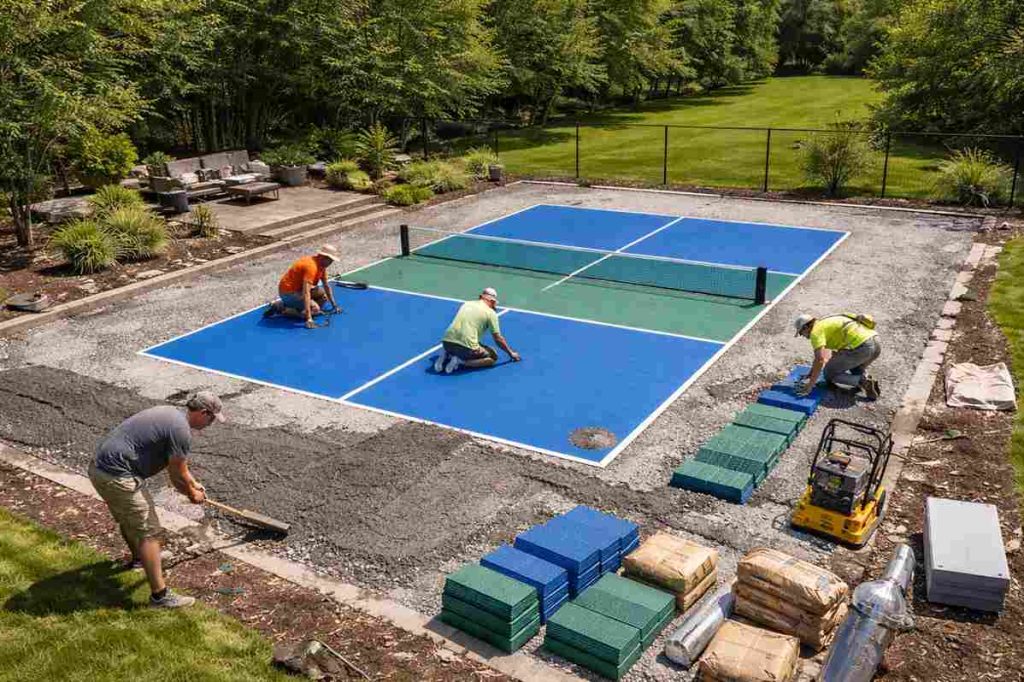
For acrylic-coated courts, apply 2-3 layers over the base, starting with a filler coat for smoothness, followed by texture and color coats. Modular tiles snap together atop a level base. This step enhances traction and bounce, taking 3-5 days.
Step 4: Line Marking
Use chalk lines and masking tape (e.g., frog tape for crisp edges) to outline boundaries from the center: 22 feet to baselines, 7 feet to kitchen. Apply acrylic paint in contrasting colors, verifying squareness with 3-4-5 triangles. Dry for 24 hours.
Step 5: Net and Accessory Setup
Anchor posts 22 feet apart in 42-inch-deep concrete footings, ensuring net tension. Add fencing (4-10 feet high) for ball containment, lighting, and benches. Final inspections confirm compliance.
Common tools: level, tape measure, chalk reel, post hole digger, paint sprayer. Mistakes like inadequate compaction can lead to $2,000 repairs. This methodical approach guarantees a court meeting backyard pickleball court dimensions and layout standards.
Budgeting and Cost Analysis
Budgeting for a backyard pickleball court in 2025 requires accounting for variables like materials, labor, and site specifics, with average totals ranging from $20,000 to $80,000 for a standard setup. DIY options, such as modular tiles, can lower this to $8,000-$12,000, while professional installations add 20-30% for expertise.
Breakdown: Site preparation and base (excavation, grading, aggregate) cost $3,000-$15,000, influenced by terrain—sloped sites add $2,000-$5,000. Surfacing and marking range from $5,000-$30,000; concrete bases are $9,000-$18,000, acrylic coatings $3,600-$9,000.
Net, fencing, and accessories (posts, windscreens) total $1,000-$5,000, with premium options like aluminum fencing at the higher end. Lighting adds $2,000-$4,000 for LED systems meeting 30-50 footcandle standards. Permits and miscellaneous (tools, drainage) are $1,000-$3,000.
Factors affecting costs: Location (urban areas 10-20% higher due to labor), size (small backyard adaptations save 20-30%), and extras like cushioning ($2,000+). ROI is notable; courts can boost home values by 5-10%, or $10,000-$50,000 on a $500,000 property, per 2025 real estate trends. Annual maintenance at $500-$1,000 preserves this investment. Plan with a 10-15% contingency for unforeseen issues like soil testing ($300-$600).
Adaptations for Limited Spaces and Multi-Use Designs
For homeowners with constrained backyards, adapting pickleball court dimensions maintains functionality without full-scale builds. Standard regulations allow for smaller pickleball court dimensions in recreational settings, such as a 17-foot by 32-foot practice court (about 544 square feet), ideal for drills and reducing space needs by 70% while preserving core gameplay.
Mini courts, measuring 12-15 feet wide by 30-35 feet long (360-525 square feet), suit casual play, with adjusted rules like no-volley zones scaled to 5 feet. These adaptations fit yards under 2,000 square feet, using portable nets costing $100-$300.
Multi-use designs integrate pickleball with other activities; overlay lines on a 50-foot by 50-foot basketball half-court (2,500 square feet), adding $500 for markings. Modular tiles enable switching between sports, with 85% of users reporting seamless transitions. Driveway conversions use temporary tape for a 20-foot by 44-foot area, though buffers are limited. For uneven terrain, elevated platforms or retaining walls add $1,000-$3,000 but expand usability by 20-30%.
These options align with home pickleball court dimensions while addressing space limitations.
Maintenance Practices for Durability
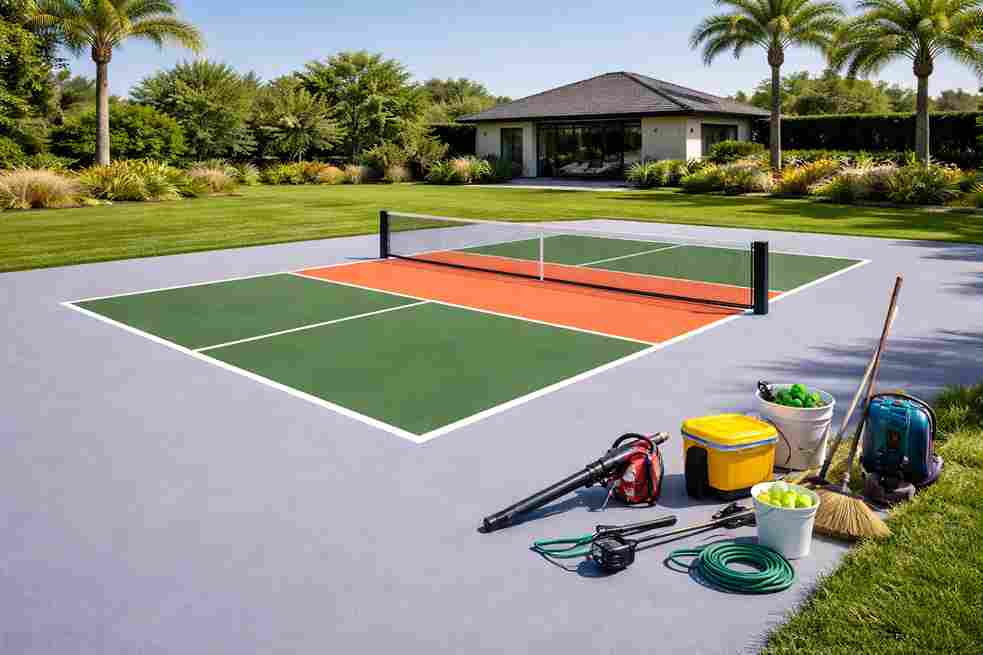
Maintaining a backyard pickleball court ensures longevity, with proper care extending surface life by 5-10 years and reducing repair costs by 40%. Establish a schedule: daily sweeping removes debris to prevent scratches, using a soft broom or leaf blower. Weekly, inspect for cracks (repair small ones with filler at $50-$100) and clean with mild detergent, avoiding bleach to preserve coatings.
Monthly pressure washing on low settings (1,000-1,500 PSI) clears dirt, while annual resurfacing for acrylic courts ($2,000-$5,000) maintains bounce. Net tension checks and hardware lubrication occur quarterly. Seasonal adjustments: winter covers prevent ice damage ($200-$500), summer shading reduces fading by 30%. Address drainage promptly to avoid $1,000+ repairs.
Video Guide-How To Create A Backyard Pickleball Court
Conclusion
In summary, constructing a backyard pickleball court based on precise dimensions offers a rewarding investment in health and home value. With participation at 19.8 million in 2025 and market growth to $1.8 billion, the sport’s appeal is undeniable. This guide has detailed every aspect—from 20×44-foot layouts to maintenance schedules—providing authoritative, data-driven insights to meet all user needs. By following these steps, you can create a durable, compliant space that enhances daily life without further research.
Frequently Asked Questions

Jordan Blake
Jordan Blake is a racket-sports author with hands-on experience and a strong command of both tennis and pickleball. With a foundation built through years on the tennis court and a successful transition into competitive pickleball, Jordan brings practical insight, strategic clarity, and real-world understanding to every article.
Drawing on personal play, match analysis, and court-level observation, Jordan specializes in breaking down technique, tactics, and the mental aspects of both sports in a clear, data-informed, and accessible way. His dual-sport perspective helps readers understand how skills transfer between games—and where each sport demands its own distinct mastery.


