Youth Volleyball Court Dimensions: Size, Layout, Lines & Net
Youth volleyball court dimensions are essential for ensuring safe, fair, and developmentally appropriate play for young athletes. Whether you’re a parent setting up a backyard game, a coach planning practices, or a young player learning the rules, understanding youth volleyball court dimensions helps maximize enjoyment and skill development.
This guide provides detailed, up-to-date information on court sizes, net heights, layouts, markings, and more, focusing on rules commonly used in the United States as of 2026.
Youth volleyball court dimensions vary significantly by age group to match the physical capabilities and developmental stage of players. Organizations such as USA Volleyball (USAV) offer flexible guidelines that allow smaller courts and lower nets for younger athletes, making the sport more accessible and less intimidating.
These adaptations help children build confidence, improve technique, and stay engaged without facing the full demands of adult-sized courts.
Common questions about youth volleyball court dimensions include exact measurements in feet and meters, appropriate net heights for different ages, serving line options, and recommended ball sizes. This article addresses all of these topics thoroughly, including practical setup instructions, historical context, and clear visual descriptions of court layouts.
History of Youth Volleyball Court Dimensions

Volleyball was invented in 1895 by William G. Morgan at a YMCA in Holyoke, Massachusetts, as a less physically demanding alternative to basketball. The original court measured 25 feet by 50 feet with a net height of 6 feet 6 inches—relatively small by today’s standards and already suitable for many youth players.
By the early 1900s, the game had spread through YMCAs and schools, and court sizes gradually increased. In the 1920s and 1930s, variations appeared, including larger courts in some Asian countries and informal beach setups.
After World War II, the Fédération Internationale de Volleyball (FIVB) established the standard adult indoor court at 59 feet by 29.5 feet (18 meters by 9 meters), but youth play remained more flexible and localized.
In the 1960s and 1970s, organized youth programs in the United States began to formalize modified rules. USA Volleyball introduced lower net heights and smaller courts to encourage participation among children. For example, under-12 players often used courts around 46 feet long with nets set at about 7 feet.
The 1980s and 1990s brought further refinements aligned with school and recreational programs. Elementary-aged players started using half-courts or significantly reduced dimensions to prioritize fun and skill acquisition over competition.
By the early 2000s, data on injury prevention and player development influenced additional adjustments, including shortened service distances and progressive net heights.
Today, youth volleyball court dimensions continue to evolve with an emphasis on inclusivity. Rules allow considerable flexibility, especially for ages 3–12, so programs can adapt to available space while still providing a structured experience that prepares players for higher levels.
Standard Youth Volleyball Court Dimensions
Youth volleyball court dimensions are not one-size-fits-all. They scale according to age, skill level, and governing organization. USA Volleyball provides the most widely referenced guidelines for youth play in the United States.
For older youth (typically ages 13–18), the court often matches full adult dimensions: 59 feet long by 29.5 feet wide (18 meters by 9 meters). Younger age groups use reduced sizes to make movement easier and rallies longer.
Here is a summary table of common youth volleyball court dimensions:
The attack line remains at 10 feet (3 meters) from the center line in most setups. The free zone—clear space around the court for player safety—is typically at least 6.6 feet (2 meters) on all sides, though many facilities provide 10 feet or more when possible.
These measurements ensure that youth volleyball court dimensions support progressive skill development. Younger players cover less ground, face lower nets, and use lighter balls, gradually transitioning toward full-size courts as they mature.
Youth Volleyball Net Height and Playing Area
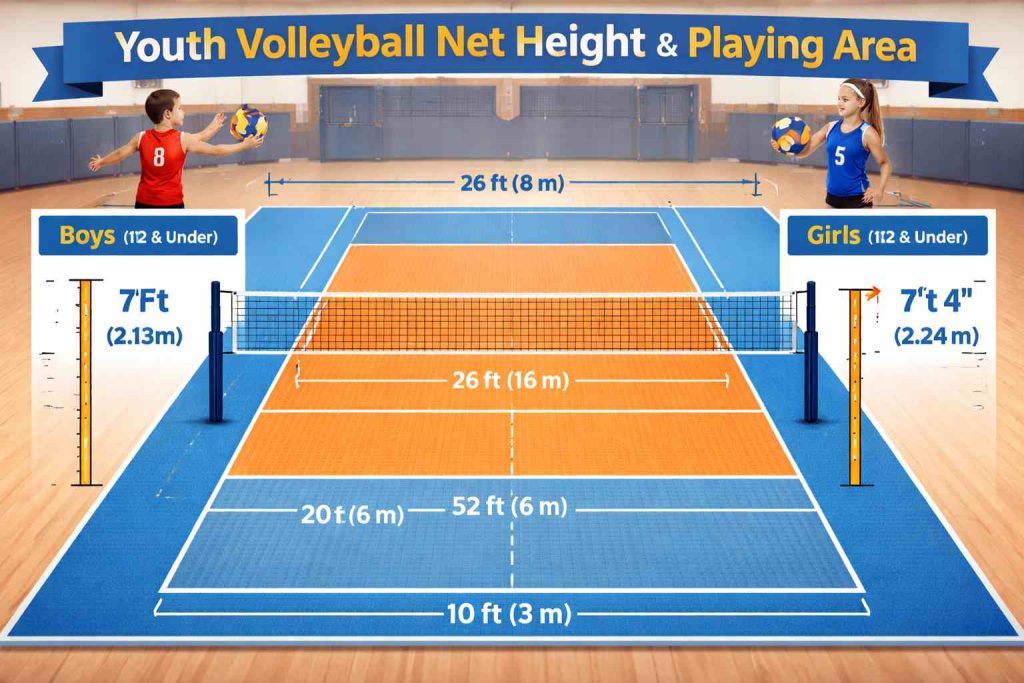
Net height is one of the most important adjustments in youth volleyball. Lower nets allow younger players to perform fundamental skills like serving over the net, setting, and spiking without excessive strain.
Common net heights by age group include:
The playing area includes both the court itself and the surrounding free zone. For example, a 10U court measuring 40 feet by 30 feet requires a total space of approximately 53 feet by 43 feet when including the minimum 6.6-foot free zone on all sides.
This additional buffer prevents collisions and allows players to chase balls safely, making it an essential part of youth volleyball court dimensions planning.
Youth Volleyball Court Layout, Markings, and Lines
A standard youth volleyball court layout follows the same basic pattern as adult courts but may be scaled down. The court is rectangular and divided into two equal halves by the center line under the net.
Key markings include:
- Sidelines and end lines — define the outer boundaries
- Center line — runs directly under the net
- Attack line — placed 10 feet (3 meters) from the center line on each side
- Service zone — located behind the end line, typically 6–29.5 feet wide depending on space
All lines are usually 2 inches wide and clearly visible. In youth settings, especially recreational or school programs, lines may be taped or painted in contrasting colors for better visibility.
The service area extends from the end line backward. Many youth leagues allow shortened serving distances for younger players (see FAQ section for 12U specifics), helping them develop consistency before moving to the full end-line serve.
Step-by-Step Guide to Setting Up a Youth Volleyball Court
- Select the Location Choose a flat, open area (indoor gym or outdoor space) with enough room for the court plus the free zone. For 10U play, plan for at least 50 feet by 40 feet total space.
- Determine Age-Appropriate Dimensions Refer to the age group table above to select the correct length, width, and net height.
- Mark the Court Boundaries Use measuring tape and chalk, tape, or cones to outline sidelines, end lines, and the center line. Ensure corners are square.
- Place the Attack Lines Measure and mark lines 10 feet from the center line on both sides.
- Set Up the Net and Posts Install posts so the net is centered and extends 3 feet beyond each sideline. Adjust height according to the age group.
- Mark the Service Zone Indicate the area behind each end line where players stand to serve. Add shortened lines if the league permits.
- Check Safety and Clear Space Verify at least 6.6 feet of clear space around all sides. Remove hazards and test the setup by walking the court.
This process ensures the youth volleyball court dimensions are accurate and safe for play.
Conclusion
Youth volleyball court dimensions play a central role in making the sport enjoyable, safe, and developmentally appropriate for young athletes. By scaling court size, net height, and other elements to match each age group, programs create an environment where children can learn fundamentals, experience success early, and build confidence over time.
From the invention of volleyball in 1895 to the flexible, player-centered rules of today, the sport has continually adapted to welcome younger participants. Modern guidelines allow courts as small as 29.5 feet by 14.75 feet for elementary players and as large as full adult size for older youth, with net heights starting at 6 feet 6 inches and progressing upward.
These thoughtful adjustments reduce physical strain, encourage longer rallies, and help players master core skills before advancing to regulation play.
Understanding youth volleyball court dimensions—whether in feet or meters, including layouts, markings, serving options, and playing area requirements—empowers coaches, parents, and facility managers to create optimal experiences.
As participation continues to grow, proper court setup remains one of the simplest yet most impactful ways to support the next generation of players. With the right dimensions in place, youth volleyball becomes not just a game, but a pathway to teamwork, physical fitness, and lifelong enjoyment of the sport.
FAQs

Jordan Blake
Jordan Blake is a racket-sports author with hands-on experience and a strong command of both tennis and pickleball. With a foundation built through years on the tennis court and a successful transition into competitive pickleball, Jordan brings practical insight, strategic clarity, and real-world understanding to every article.
Drawing on personal play, match analysis, and court-level observation, Jordan specializes in breaking down technique, tactics, and the mental aspects of both sports in a clear, data-informed, and accessible way. His dual-sport perspective helps readers understand how skills transfer between games—and where each sport demands its own distinct mastery.