
Indoor Volleyball Court Dimensions: Size, Net Height & Layout
Understanding indoor volleyball court dimensions is essential for players, coaches, facility managers, and enthusiasts alike. Whether you’re planning to build a new court, coaching a team, or simply curious about the sport’s technical aspects, knowing the precise measurements ensures fair play, safety, and compliance with official rules.
The focus keyword, indoor volleyball court dimensions, encapsulates the core of this article, where we’ll delve into every detail, from standard sizes to variations across levels. This guide addresses user intent by providing actionable insights and practical advice.
Searches on this topic often reveal a need for clarity on dimensions of an indoor volleyball court, volleyball court dimensions indoor, and related queries like volleyball court size in meter or feet.
Volleyball, as a dynamic indoor sport, relies heavily on standardized court layouts to maintain consistency worldwide.
The Fédération Internationale de Volleyball (FIVB), the global governing body, sets the benchmark for indoor volleyball court dimensions, which are adopted by organizations like USA Volleyball (USAV), the National Collegiate Athletic Association (NCAA), and the National Federation of State High School Associations (NFHS).
These rules ensure that indoor volleyball courts dimensions in meters are uniformly 18m by 9m, translating to volleyball court size in feet as approximately 59 feet by 29.5 feet.
In this comprehensive article, we’ll cover the history of indoor volleyball court dimensions, official standards with tables, step-by-step setup guides, a fact guide, and more. We’ll incorporate related keywords such as volleyball court dimensions in feet, volleyball court size net height, and volleyball court diagram with measurements to fulfill comprehensive search intents.
History of Indoor Volleyball Court Dimensions
The evolution of indoor volleyball court dimensions reflects the sport’s growth from a recreational activity to a global Olympic discipline. Volleyball was invented in 1895 by William G. Morgan, a YMCA physical education director in Holyoke, Massachusetts.
Originally called “Mintonette,” it was designed as a less strenuous alternative to basketball. The initial indoor volleyball court dimensions were modest: a 25 feet by 50 feet rectangle, roughly half the size of today’s standard. This early setup allowed for unlimited players, with a net height of about 6 feet 6 inches, emphasizing leisure over competition.
By 1912, as the sport spread internationally, the United States Volleyball Association (now USA Volleyball) formalized rules, expanding the court to 35 feet by 60 feet. This change accommodated more players and faster gameplay.
In 1916, the court was adjusted to 30 feet by 60 feet, closer to modern dimensions of indoor volleyball court. The net height was raised to 7 feet 6 inches for men, promoting jumping and spiking. These shifts in volleyball indoor court dimensions were driven by the need for balance between offense and defense.
The FIVB’s formation in 1947 standardized indoor volleyball court dimensions globally. By 1952, the court was set at 18 meters by 9 meters (59 feet by 29.5 feet), a size that has remained unchanged.
This metric system adoption facilitated international play, with volleyball debuting at the 1964 Tokyo Olympics. Net heights were finalized: 2.43 meters for men and 2.24 meters for women, reflecting physiological differences.
In the 1970s and 1980s, refinements focused on safety and precision. The attack line, 3 meters from the center, was introduced to restrict back-row attacks, enhancing strategy. Free zones expanded to a minimum of 3 meters for player safety. High school volleyball court dimensions under NFHS were aligned, often rounded to 60 feet by 30 feet for practicality in U.S. gyms.
The 1990s saw beach volleyball diverge, with smaller 16m by 8m courts, highlighting the unique indoor volleyball courts dimensions in meters. Recent evolutions include technological integrations, like LED line markings, but core indoor volleyball court dimensions remain steadfast.
This history underscores how indoor volleyball court dimensions have evolved to support the sport’s athleticism, from Morgan’s humble beginnings to today’s professional arenas. Understanding this progression helps appreciate why precise volleyball court size in cm (1800cm by 900cm) is crucial for fair competition.
Official Indoor Volleyball Court Dimensions
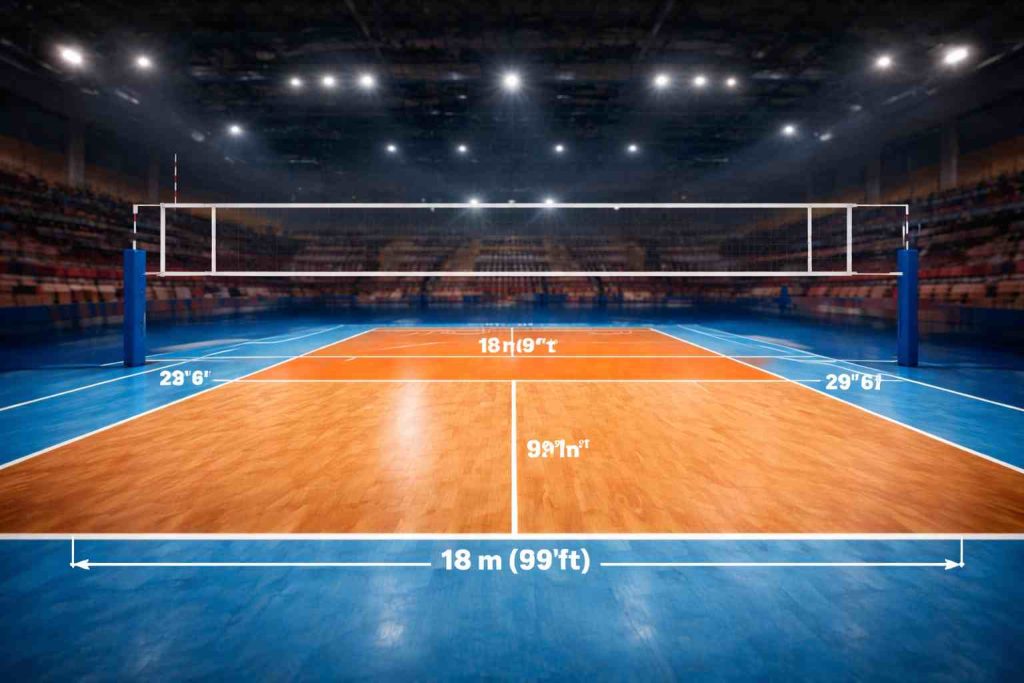
At the heart of any discussion on indoor volleyball court dimensions are the official standards set by the FIVB. The playing court is a rectangle measuring exactly 18 meters in length and 9 meters in width. This translates to volleyball court dimensions in feet as 59 feet by 29 feet 6 inches. The court is divided into two equal halves by a center line, each side being 9m by 9m.
Key elements include the free zone, which surrounds the court and must be at least 3 meters wide on all sides for recreational and national play. For international events, this extends to 5 meters on the sides and 6.5 meters behind the end lines.
The free playing space above the court requires a minimum ceiling height of 7 meters, with 12.5 meters recommended for FIVB World competitions to accommodate high spikes and serves.
The attack lines are positioned 3 meters back from the center line on each side, defining the front zone where back-row players cannot attack above the net. Lines are 5 cm wide and must contrast with the floor color. The service zone extends 9 meters wide behind each end line, with a depth reaching the end of the free zone.
Net specifications are integral to indoor volleyball court dimensions. The net height is 2.43 meters for men’s games and 2.24 meters for women’s, measured at the center. It spans 9.5 to 10 meters long and 1 meter high, with antennae extending 1.8 meters above to mark the crossing space.
Here’s a detailed table summarizing the standard volleyball court dimensions:
These dimensions ensure safety and fairness, with the total playable area (including free zone) ranging from 400 to 750 square meters. For volleyball court size in cm, the court is 1800 cm by 900 cm. Official volleyball court dimensions also mandate a flat, uniform surface, with lighting at least 300 lux and temperature above 10°C.
Variations in Indoor Volleyball Court Dimensions
While FIVB sets the international volleyball court dimensions, variations exist across levels to suit different age groups and competitions.
For high school volleyball court dimensions under NFHS, the court is often listed as 60 feet by 30 feet, a slight rounding from the standard 59 ft by 29.5 ft. This accommodates existing gymnasiums, with a minimum 6-foot clearance around the court. Net heights remain standard, but free zones can be as little as 6 feet if space is limited.
NCAA volleyball court dimensions mirror FIVB exactly: 18m by 9m, with 2.43m/2.24m net heights. However, for collegiate facilities, a 25-foot ceiling is required. Free zones are at least 10 feet, emphasizing player safety in high-level play.
USA Volleyball follows FIVB but allows flexibility for grassroots levels, such as a 2-meter free zone minimum. Youth variations adjust net heights: for under-12s, it might be lowered to 2.1m for boys and 2.0m for girls, though court size stays standard.
Beach volleyball contrasts sharply, with courts at 16m by 8m, no attack lines, and sand surfaces. This highlights why indoor volleyball court dimensions are larger, supporting six players per side versus two in beach.
These variations ensure accessibility, but core indoor volleyball court dimensions remain consistent for professional play.
Volleyball Court Diagram with Measurements
Visualizing indoor volleyball court dimensions is key to understanding layout. A standard diagram shows the rectangular court with labeled lines: side lines, end lines, center line, and attack lines. The net bisects the court, with antennae at the edges.
This diagram illustrates volleyball court diagram with measurements, including the 3m attack lines and free zones. For PDF needs, volleyball court size in meter pdf or feet pdf are available from FIVB sources.
These visuals clarify dimension of volleyball court, aiding in planning.
Step-by-Step Guide to Setting Up an Indoor Volleyball Court
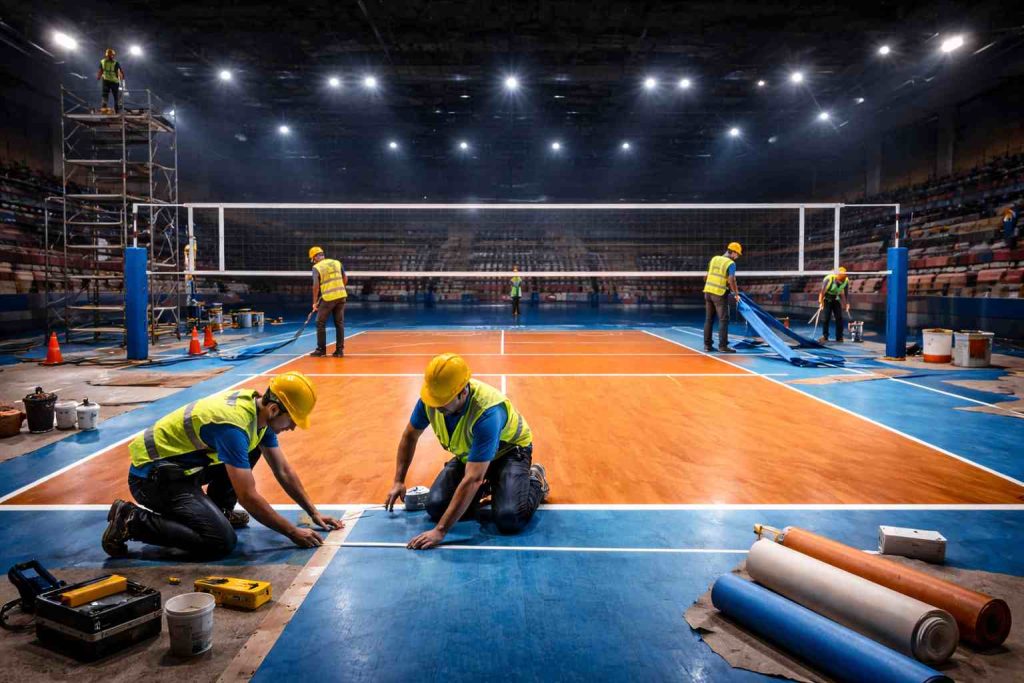
Setting up indoor volleyball court dimensions requires precision. Here’s a step-by-step guide:
- Select the Location: Choose a flat indoor space with at least 24m by 15m total area (including 3m free zones). Ensure ceiling height is 7m+.
- Measure the Court: Use a tape measure to mark 18m length and 9m width. Start from one corner, marking side lines (18m) and end lines (9m).
- Draw Boundary Lines: Use court tape or paint for 5cm-wide lines. Ensure they are inside the dimensions.
- Add Center and Attack Lines: Draw the center line at 9m from each end. Place attack lines 3m from center on both sides.
- Install the Net System: Position posts 0.5-1m outside side lines, 2.55m high. Stretch the net to 2.43m/2.24m height, attaching antennae.
- Mark Service and Other Zones: Extend service zones behind end lines. Designate substitution and libero zones.
- Check Safety and Lighting: Verify free zones are clear, surface is non-slip, and lighting is adequate.
- Test and Adjust: Walk the court, measure again, and play a test rally.
This guide ensures accurate volleyball court size in feet or meters.
Fact Guide: Essential Facts on Indoor Volleyball Court Dimensions
This fact guide compiles key trivia and details:
- The standard volleyball court size in meter is 18x9m, equaling 162 square meters of playing area.
- Volleyball court size net height varies by gender but must not vary more than 2cm across the court.
- In cm, the court is 1800x900cm, with lines at 5cm wide.
- Official volleyball court dimensions include a minimum 300 lux lighting for visibility.
- High school variations round to 60×30 feet, but international sticks to precise metrics.
- The free zone prevents injuries, expanding for pro play.
These facts fill gaps in basic searches like volleyball dimensions of court.
Conclusion
In summary, indoor volleyball court dimensions form the foundation of this exhilarating sport, ensuring consistency from local gyms to Olympic arenas. We’ve explored the standard 18m by 9m court, net heights of 2.43m for men and 2.24m for women, and essential zones that define gameplay.
By incorporating history—from Morgan’s 1895 invention to FIVB’s modern standards—this guide addresses the evolution that shaped today’s dimensions. Variations across high school, NCAA, and international levels highlight adaptability, while the step-by-step setup and fact guide provide practical value for anyone involved in volleyball.
This article fulfills user intent by answering queries like dimensions of indoor volleyball court or volleyball court size in feet, with tables and diagrams. Whether you’re a player optimizing strategy or a builder ensuring compliance, mastering indoor volleyball court dimensions enhances appreciation and performance.
As volleyball continues to grow, these measurements remain timeless, promoting safety, fairness, and excitement. For further resources, consult official FIVB documents or local associations—stay active and enjoy the game!
Frequently Asked Questions

Jordan Blake
Jordan Blake is a racket-sports author with hands-on experience and a strong command of both tennis and pickleball. With a foundation built through years on the tennis court and a successful transition into competitive pickleball, Jordan brings practical insight, strategic clarity, and real-world understanding to every article.
Drawing on personal play, match analysis, and court-level observation, Jordan specializes in breaking down technique, tactics, and the mental aspects of both sports in a clear, data-informed, and accessible way. His dual-sport perspective helps readers understand how skills transfer between games—and where each sport demands its own distinct mastery.