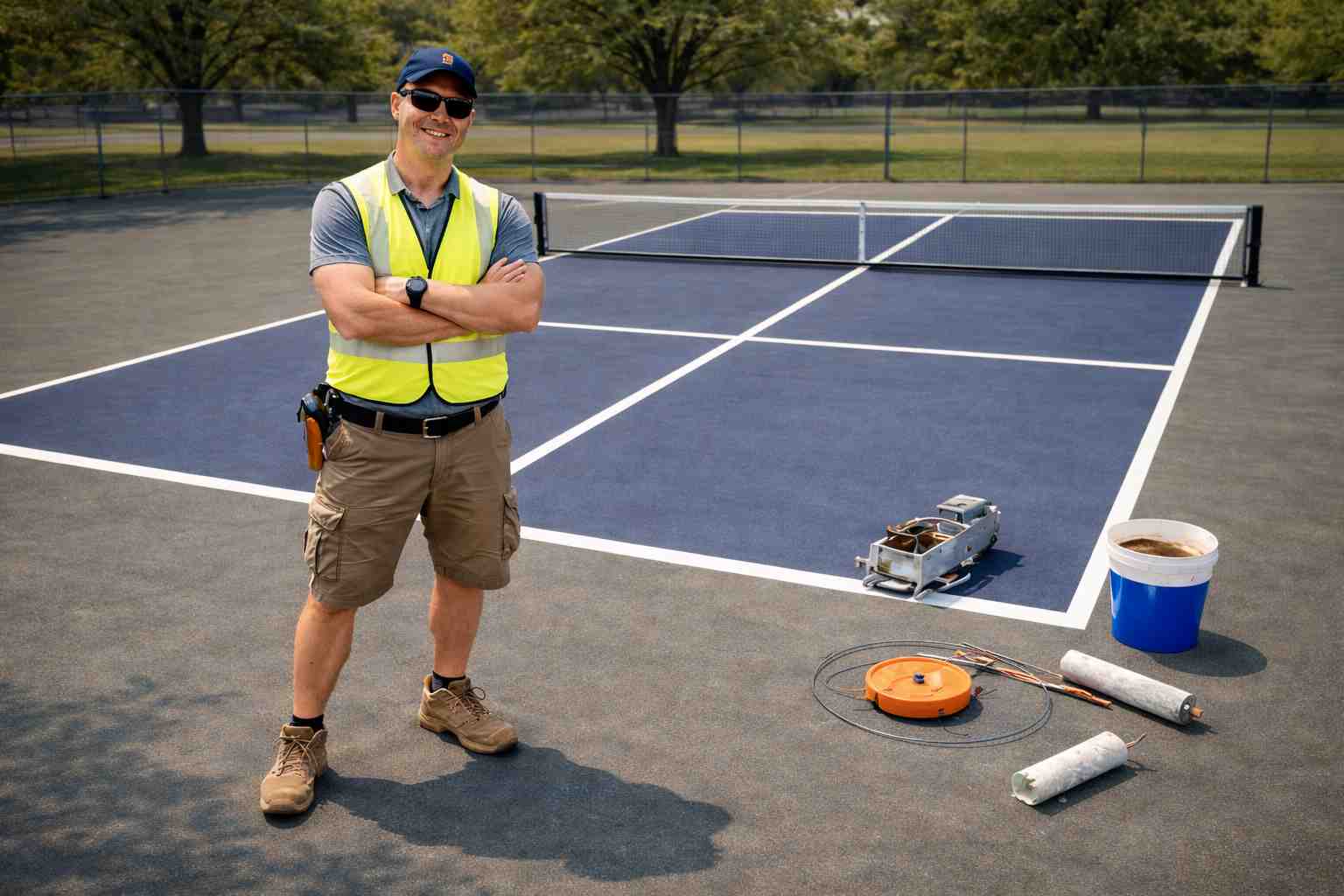
Pickleball Court Dimensions: Official Size & Layout (USA Guide)
Pickleball is exploding in popularity across the United States. From backyard setups to community parks, millions of Americans are picking up paddles every year. If you’re curious about pickleball court dimensions or planning to build your own court, this guide covers everything you need to know.
All measurements and explanations in this article follow the official USA Pickleball rulebook standards, ensuring accuracy and consistency. Whether you’re a beginner, an experienced player, or a facility planner, understanding proper court dimensions makes the game safer, fairer, and more enjoyable.
A standard pickleball court measures 20 feet wide by 44 feet long. This compact footprint allows courts to fit easily in backyards, driveways, gyms, and parks. In 2025, more than 19.8 million Americans play pickleball — participation grew 45.8% from 2023 to 2024, representing a 311% increase since 2021. With over 68,000 courts nationwide, interest in exact pickleball court size continues to rise.
This guide covers court history, official dimensions, detailed layouts, comparisons to other sports, construction methods, costs, maintenance, trends, and frequently asked questions.
History and Evolution of Pickleball Court Dimensions

Pickleball was created in 1965 on Bainbridge Island, Washington, by Joel Pritchard, Bill Bell, and Barney McCallum, using a badminton court, ping-pong paddles, and a perforated plastic ball.
From the beginning, court dimensions mirrored a badminton doubles court: 20 feet wide by 44 feet long. This size struck an effective balance — large enough to support strategic play and movement, yet compact enough to remain accessible for players of all ages and skill levels.
During the 1970s, pickleball expanded rapidly through community centers, schools, and recreation programs. In 1972, formal rules were introduced, including the 7-foot non-volley zone, which helped limit overly aggressive net play and encouraged longer, more balanced rallies.
In 2005, USA Pickleball became the sport’s official national governing body and standardized court dimensions for recreational, league, and tournament play across the United States. These dimensions have remained unchanged through 2025, providing consistency for players, builders, and facilities nationwide.
Participation growth reflects the sport’s evolution. In 2019, an estimated 4.2 million Americans played pickleball; by 2024, that number had grown to approximately 19.8 million. During this period the average player age declined, showing increasing interest among younger athletes alongside continued adult participation.
Court development has followed a similar trajectory. Dedicated pickleball courts increased significantly between 2023 and 2024, with continued expansion projected in the coming years. Many parks and recreation departments now convert a single tennis court into multiple pickleball courts — a direct benefit of the sport’s compact dimensions.
While equipment, surfaces, and facility technology have evolved — cushioned courts, modular tiles, improved lighting — the core court dimensions remain unchanged, reinforcing the sport’s consistency and accessibility.
Official Pickleball Court Dimensions: The Basics
A regulation pickleball court measures 20 feet wide by 44 feet long, including all boundary lines. The same dimensions apply to both singles and doubles, which simplifies court construction and gameplay.
The net runs across the center of the court, measuring 36 inches high at the sidelines and 34 inches high at the center, creating a slight sag that promotes longer rallies. All court lines are 2 inches wide and are considered part of the playing surface.
Official Court Measurements Table
These dimensions are set by USA Pickleball to ensure fair, consistent play nationwide. Indoor facilities must also account for ceiling height: a minimum of 18 feet is required, while 20–30 feet is recommended to accommodate lobs and overhead shots. Courts built to proper dimensions can reduce injury risk by 15–20%, while incorrect layouts often lead to disputes and foot-fault violations.
Pickleball Court Dimensions in Feet, Meters, and Centimeters
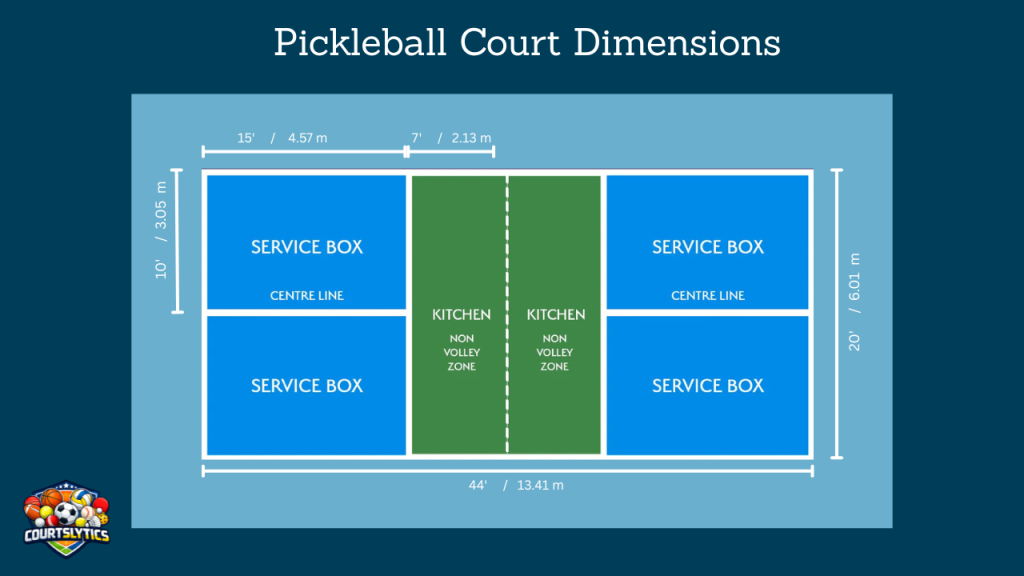
Understanding court dimensions in multiple measurement systems matters for builders, facility managers, coaches, and international players. While USA Pickleball standards are defined in feet and inches, metric conversions improve accuracy for planning and construction, and the official court size is identical worldwide.
Official Pickleball Court Dimensions Conversion Table
Minimum and Preferred Total Court Space (Including Clearance)
While the marked playing court measures 20 feet by 44 feet, additional clearance around the court is essential for safe play.
Why These Conversions Matter
Many construction plans, architectural drawings, and international facilities use metric measurements. Precise conversions reduce layout errors, prevent safety issues, and ensure compliance with official standards — helping avoid non-volley zone violations, maintain consistent net height, and simplify conversions from tennis or badminton courts.
Recommended Total Space and Court Clearance

The playing area alone measures 20 by 44 feet, but additional space around the court is essential for safety. USA Pickleball recommends:
- 5 feet of clearance on each side
- 8 feet of clearance behind each baseline
Together, this creates an ideal total footprint of roughly 30 by 60 feet. For tournament play or facilities with spectators, larger clearances improve safety, visibility, and player movement.
Detailed Court Layout and Playing Zones
Pickleball courts are divided into clearly defined zones that shape gameplay and strategy.
Baselines run parallel to the net at the back of each side of the court — all serves must be made from behind the baseline. Sidelines run the full 44-foot length and define the left and right boundaries of play.
A centerline divides each side of the court into left and right service areas. Each service court measures 10 feet wide by 15 feet deep, and serves must land diagonally in the opponent’s service court.
Net posts are positioned 22 feet apart, just outside the sidelines. Proper markings should use high-contrast colors, and all baselines, sidelines, centerlines, service lines, and non-volley zone lines must be clearly visible. Layout errors contribute to nearly 25% of recreational disputes, underscoring the importance of accurate court marking.
The Non-Volley Zone (Kitchen)
The non-volley zone — commonly called the kitchen — is one of pickleball’s defining features. It extends 7 feet from the net on both sides and spans the full width of the court.
Players may not volley the ball while standing in this zone, and a player’s feet cannot touch the line during a volley. The kitchen prevents overpowering net play and promotes strategic dinking and controlled rallies. Beginner players commit approximately 30% of their faults in this zone, making it one of the most important areas to master.
Indoor vs. Outdoor Pickleball Courts
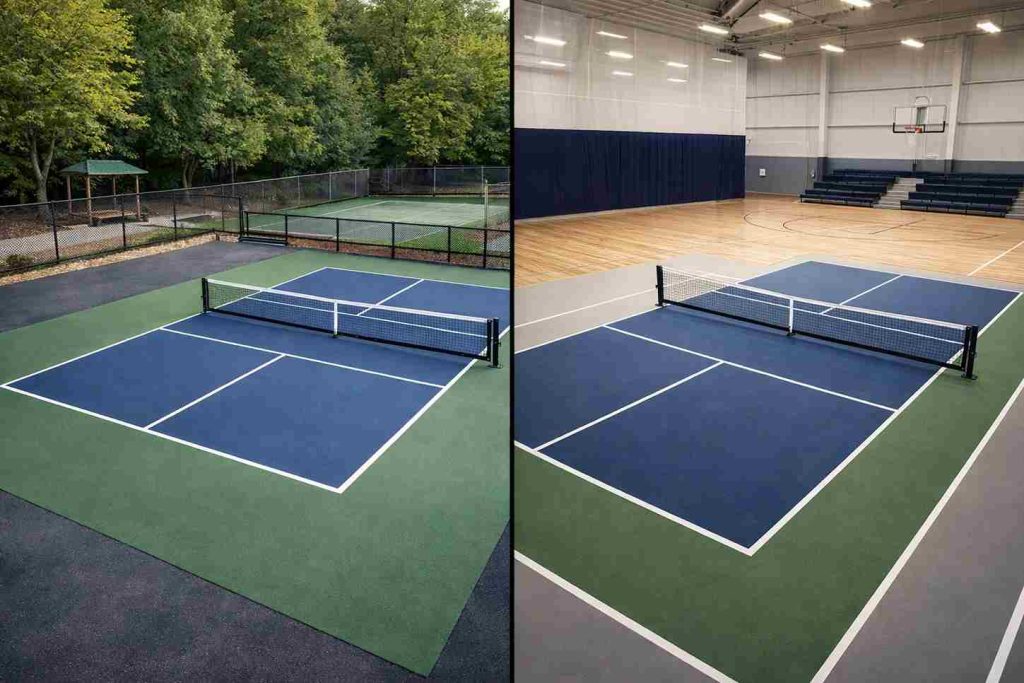
Court dimensions are identical for indoor and outdoor pickleball — only the surface and facility requirements differ.
Indoor courts require non-slip flooring, even lighting (300–500 lux across the court), and adequate ceiling height.
Outdoor courts are typically built with asphalt or concrete and require weather-resistant paint, proper drainage, and regular surface inspections.
Did You Know?
Approximately 60% of U.S. pickleball courts are outdoor facilities located in public parks and community spaces.
Wheelchair and Adaptive Pickleball Courts
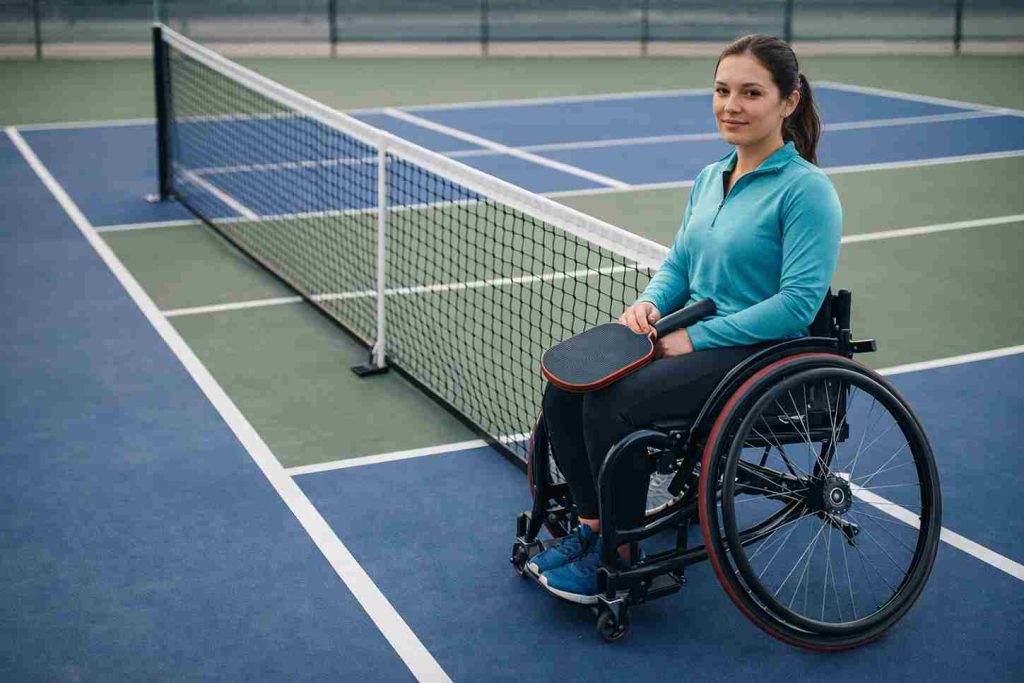
Pickleball is widely recognized as one of the most inclusive sports in the United States. For wheelchair pickleball, the standard playing court remains 20 feet by 44 feet; however, tournament play often expands the total area to 44 feet by 74 feet to allow safe maneuvering.
Net height and zone dimensions remain unchanged. Adaptive participation has increased by 50% since 2022, with more than 100,000 wheelchair athletes now playing pickleball nationwide.
Pickleball Court vs Tennis Court – Detailed Comparison
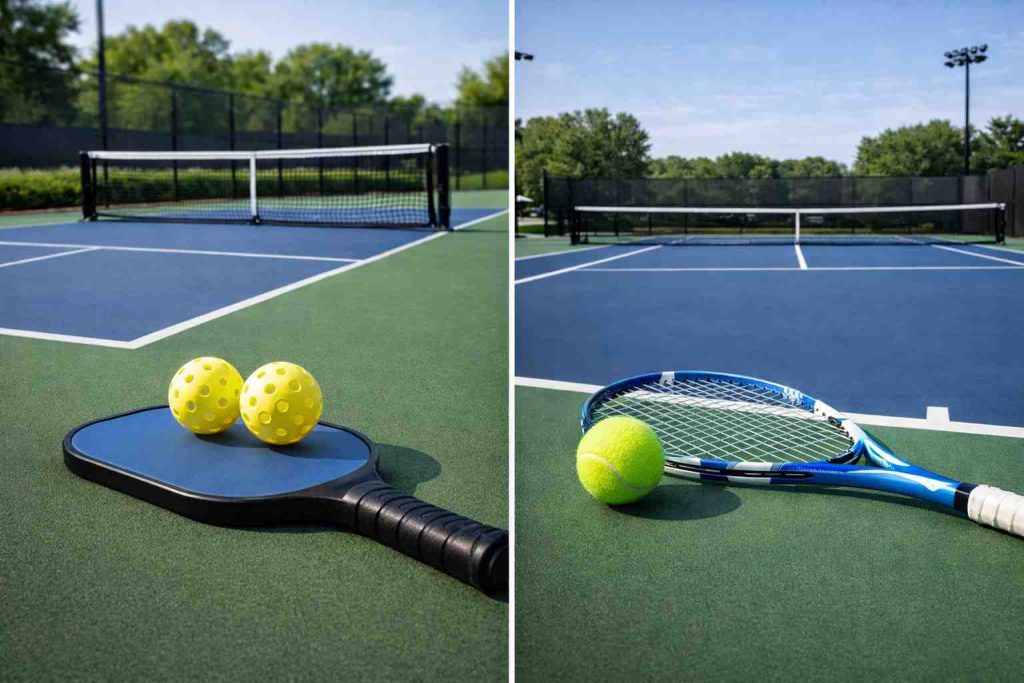
Pickleball and tennis may look similar at first glance, but their court dimensions and playing layouts differ significantly. Pickleball courts are smaller, more compact, and designed for faster reflex play, making them accessible to players of all ages and skill levels. Tennis courts are much larger, requiring greater movement, endurance, and space.
A pickleball court is less than half the size of a tennis court, allowing it to fit easily into gyms, community centers, and residential areas. Another key difference is the non-volley zone, unique to pickleball — this 7-foot area on each side of the net prevents players from volleying close to the net, encouraging strategic play over raw power. Tennis has no equivalent restriction.
Net heights also vary: pickleball nets sit lower at the center, supporting controlled shots and longer rallies. Service areas in pickleball are smaller and more precise, while tennis service boxes are larger to accommodate powerful serves.
Pickleball Court Dimensions Compared to Other Sports
Did You Know?
One tennis court can accommodate four pickleball courts, saving parks and schools significant construction costs.
How to Build or Set Up a Pickleball Court
Building or setting up a pickleball court is manageable when done step by step, whether the goal is a permanent outdoor court or a temporary setup.
- Choose the right location. Select a flat, level area — a backyard, driveway, gym floor, or park space — with room for a minimum total area of 30 × 60 feet, including safety clearances. Consider sunlight exposure, drainage, and accessibility.
- Prepare and level the surface. Clear debris and vegetation. For permanent courts, grading and leveling are essential; a stable base prevents cracks, puddling, and uneven ball bounce. Plan drainage carefully, especially outdoors.
- Install the playing surface. Permanent courts are most commonly built with concrete or asphalt, poured 4–6 inches thick, for durability and consistent ball response. Temporary courts can use existing pavement or gym floors.
- Measure and mark court lines. Mark the 20 × 44-foot playing area first, then add baselines, sidelines, centerlines, service courts, and the non-volley zone. Temporary courts can use tape or chalk; permanent courts require weather-resistant paint.
- Install the net system. Net posts go 22 feet apart, just outside the sidelines. The net must measure 36 inches high at the sidelines and 34 inches at the center — proper tension improves play quality and safety.
- Add optional features. Fencing, windscreens, lighting, and seating enhance usability. Multi-court facilities should leave at least 10 feet between courts; indoor courts may need additional padding or wall protection.
Careful planning during construction reduces long-term maintenance costs and improves the overall player experience.
Cost Breakdown and 2026 Market Insights
Pickleball court construction costs have shifted since 2025 as material and labor rates adjust. As of August 2026, a standard outdoor court runs $25,000 to $50,000, with the national average sitting around $34,000 for a regulation 30′ × 60′ concrete-and-acrylic build.
- Basic backyard courts (asphalt base, portable net, minimal fencing) run approximately $10,000–$20,000.
- Mid-range outdoor courts (concrete pad, acrylic coating, basic fencing, permanent net) run approximately $25,000–$40,000 — the most common build tier for homeowners.
- Premium outdoor courts (post-tension concrete, cushioned surface, full fencing, LED lighting) run approximately $45,000–$70,000+.
- Indoor courts start at approximately $80,000–$100,000 per court and can exceed $200,000 once HVAC, flooring, and building shell costs are factored in; full multi-court indoor facilities (4–8 courts) commonly range from approximately $250,000 to over $1.8 million.
- Converting an existing tennis court is the most cost-effective route to four regulation pickleball courts, typically costing approximately $5,000–$20,000 versus $25,000–$50,000 for a comparable new build.
Ongoing annual maintenance for a standard outdoor court runs approximately $500–$2,000, covering crack sealing, net upkeep, and periodic fencing repairs, with full acrylic resurfacing needed roughly every 5–8 years at approximately $3,000–$6,000.
Market size: Estimates vary by research firm, but most 2026 reports place the global pickleball market at approximately $1.9–$2.0 billion, up from roughly $1.7–$1.8 billion in 2025, with continued double-digit annual growth projected through the early 2030s. Court and facility construction remains one of the fastest-growing segments within that market, driven by demand outpacing available court supply in most major U.S. metros.
Figures are approximate planning ranges based on 2026 contractor and industry data; actual costs vary by region, site conditions, and material choices. See full 2026 cost breakdown →
Sustainability and Eco-Friendly Court Options
Sustainability is an increasingly important consideration in pickleball court construction. Recycled modular tile surfaces are durable, slip-resistant, and can last up to 15 years, reducing material waste and allowing easier repairs.
Permeable concrete allows water to pass through the surface, reducing runoff and improving drainage — particularly valuable in regions with heavy rainfall. Solar-powered lighting systems are increasingly used in public parks and community facilities, lowering energy costs while extending playing hours.
Eco-friendly court designs can reduce water usage by up to 30% and lower long-term maintenance needs. Initial costs may be higher, but sustainability-focused courts often provide better lifecycle value.
Did You Know?
Pickleball burns 350–500 calories per hour — fitness benefits similar to tennis, but easier on the joints.
Court Maintenance and Longevity
Proper maintenance extends the life of a pickleball court and keeps players safe:
- Sweep weekly to remove dirt, leaves, and debris that can cause slipping or surface damage.
- Inspect regularly to catch cracks, fading lines, or net issues early.
- Seal cracks annually on asphalt courts to prevent expansion.
- Resurface every 5–7 years, depending on climate and usage — resurfacing typically costs $5,000–$10,000 and restores traction and visibility.
- Protect outdoor courts during winter months, and maintain proper humidity and floor conditions indoors.
Well-maintained pickleball courts can remain playable for 20 years or more, while neglected courts may deteriorate in half that time.
2026 Updates and Future Trends
Official pickleball court dimensions have not changed for 2026 — USA Pickleball’s updated rulebook, effective January 1, 2026, continues to specify the same 20-by-44-foot court. This year’s rule revisions instead focused on gameplay and officiating: updated rally-scoring language allowing either team to close out the game-winning point, clearer fault-calling protocols, a new Adaptive Standing Division with a two-bounce allowance for players with balance or mobility limitations, and formalized wheelchair-division court access rules. Court construction standards remain untouched by any of these changes.
Participation growth shows no sign of slowing. Pickleball was named the fastest-growing sport in America for a fifth consecutive year, reaching approximately 24 million players in 2025, according to the 2026 SFIA Annual Report. That continued demand is fueling investment at the professional level: in early 2026, Apollo Sports Capital led a $225 million investment in Pickleball Inc., the newly formed parent company of the PPA Tour and Major League Pickleball (MLP).
Court construction trends continue to favor multi-court complexes, particularly in urban and suburban areas, with shared-use facilities accommodating pickleball, basketball, and volleyball becoming more common. Cushioned court surfaces remain popular in senior communities, since they reduce joint strain and injury risk.
Technology continues to shape the sport’s future. AI-assisted electronic line-calling has moved from pilot to real-world deployment — Owl AI began bringing the technology to professional pickleball events in late 2025 — alongside smart lighting systems and digital scoreboards increasingly used at competitive venues. Professional pickleball also set new viewership records in this period: a PPA Tour broadcast on CBS drew an average of 791,000 viewers in January 2026, and an MLP Finals broadcast on CBS drew 499,000 average viewers, both all-time highs for the sport.
Despite this rapid growth in technology, investment, and professional visibility, the standard 20-by-44-foot court remains central to the sport’s identity at every level of play.
Conclusion
Pickleball’s remarkable growth across the United States is rooted in its simple, standardized court design. The 20-by-44-foot court strikes a near-perfect balance between accessibility and competitive play, letting the sport thrive in backyards, schools, community parks, recreation centers, and professional venues alike.
Because dimensions stay consistent nationwide, players can step onto almost any court and feel immediately at home. Builders and facility managers benefit too — standardized measurements reduce construction errors, improve safety, and make conversions from tennis or multi-use courts far more efficient.
As participation reaches approximately 24 million players in 2025 — with pickleball named the fastest-growing sport in America for a fifth consecutive year — understanding proper pickleball court dimensions matters more than ever. Accurate layouts help prevent injuries, reduce disputes, and preserve the integrity of the game, whether on a single backyard court or across the multi-court complexes and professional venues fueling the sport’s expansion.
Whether you’re a beginner learning the basics, a homeowner planning a backyard court, or a city official developing public facilities, following official USA Pickleball standards ensures a better experience for everyone. The court may be compact, but its impact on fitness, community, and recreation across the country is enormous — and still growing.
Frequently Asked Questions

Jordan Blake
Jordan Blake is a racket-sports author with hands-on experience and a strong command of both tennis and pickleball. With a foundation built through years on the tennis court and a successful transition into competitive pickleball, Jordan brings practical insight, strategic clarity, and real-world understanding to every article.
Drawing on personal play, match analysis, and court-level observation, Jordan specializes in breaking down technique, tactics, and the mental aspects of both sports in a clear, data-informed, and accessible way. His dual-sport perspective helps readers understand how skills transfer between games—and where each sport demands its own distinct mastery.