Tennis Court Dimensions in Meters: Complete Size Guide with Layout & Runoff
Tennis is a sport that demands precision, not just in player technique but also in the playing environment. Understanding tennis court dimensions in meters is essential for players, coaches, builders, and enthusiasts alike.
Whether you’re planning to construct a court in your backyard or simply curious about the standards used in professional tournaments, knowing the exact tennis court dimensions in meters ensures compliance with international rules and optimal gameplay.
This article delves deeply into tennis court dimensions in meters, covering everything from historical evolution to modern specifications, building guides, and more.
We’ll explore related aspects like lawn tennis court dimensions in meters, tennis court dimensions including runoff in meters, tennis court dimensions with fence in meters, and even specifics like tennis court dimensions in meters in the Philippines.
By the end, you’ll have a thorough grasp of why these measurements matter and how they influence the game. The focus on tennis court dimensions in meters stems from the metric system’s global adoption, especially outside the United States where imperial units like feet are more common.
However, even in metric terms, the standards remain consistent, as regulated by the International Tennis Federation (ITF). The court is a rectangle measuring 23.77 meters long, with widths varying for singles and doubles play. This precision ensures fairness across all levels of play, from recreational to Olympic competitions.
In this comprehensive guide, we’ll break down the topic step by step, incorporating historical context, practical guides, and actionable insights for construction, education, or curiosity. Let’s start with the origins to appreciate how tennis court dimensions in meters have evolved.
History of Tennis Court Dimensions
The history of tennis court dimensions is a fascinating journey that mirrors the sport’s transformation from a medieval pastime to a global phenomenon. Tennis, or “real tennis” as it’s sometimes called to distinguish it from modern lawn tennis, originated in 12th-century France as “jeu de paume,” played in monastic cloisters without rackets—players used their palms instead.
Early courts were irregular, often adapted from indoor spaces like castle halls, with no standardized dimensions. These primitive setups were long and narrow, sometimes measuring up to 27 meters wide but varying greatly in length, often exceeding 30 meters to accommodate the game’s evolving rules.
By the 16th century, dedicated indoor courts emerged in Europe, particularly in England and France. These “real tennis” courts featured sloped roofs, galleries for spectators, and unique markings like the “tambour” (a buttress) and “grille” (a window-like target).
Dimensions were somewhat standardized for these indoor venues, typically around 28.5 meters long and 9.1 meters wide, but they included walls and hazards that made play asymmetric—quite different from today’s flat, open courts.
The pivotal shift came in the 19th century with the invention of lawn tennis. In 1873–1874, Major Walter Clopton Wingfield patented “Sphairistikè,” a game played on hourglass-shaped grass courts that were longer at the baselines than at the net, measuring about 18.3 meters long (60 feet) and narrowing from around 9.1 meters (30 feet) at the base to narrower at the net.
This design aimed to make serving more challenging, but it was cumbersome. Just two years later, in 1875, the Marylebone Cricket Club (MCC) revised the rules, adopting a rectangular shape that closely resembles modern tennis court dimensions in meters. The court was set at 23.77 meters (78 feet) long and 8.23 meters (27 feet) wide for singles, expanding to 10.97 meters (36 feet) for doubles.
By the 1880s, the Lawn Tennis Association (LTA) in Britain formalized these measurements, which the newly formed International Lawn Tennis Federation (now ITF) adopted and has maintained since the early 20th century.
This standardization was crucial as tennis spread globally, ensuring consistency in tournaments like Wimbledon, which began in 1877 on grass courts adhering to these specs. Over the decades, minor tweaks occurred—such as net height adjustments to the current 0.914 meters in the center—but the core tennis court dimensions in meters have remained unchanged since the late 19th century.
In the 20th century, the introduction of hard and clay surfaces didn’t alter dimensions but influenced play styles. For instance, the 1970s saw the rise of synthetic surfaces, yet the ITF maintained strict guidelines to preserve the game’s integrity.
The rules confirm no changes to these foundational measurements, emphasizing their enduring relevance. This historical stability underscores why understanding tennis court dimensions in meters is key to appreciating the sport’s heritage.
Standard Tennis Court Dimensions in Meters
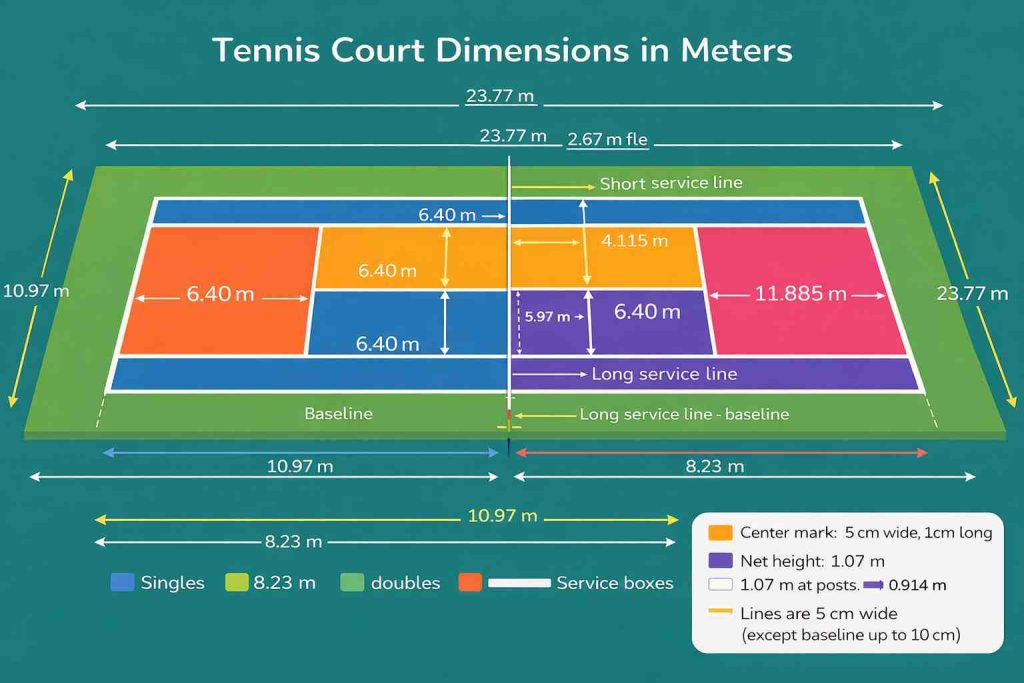
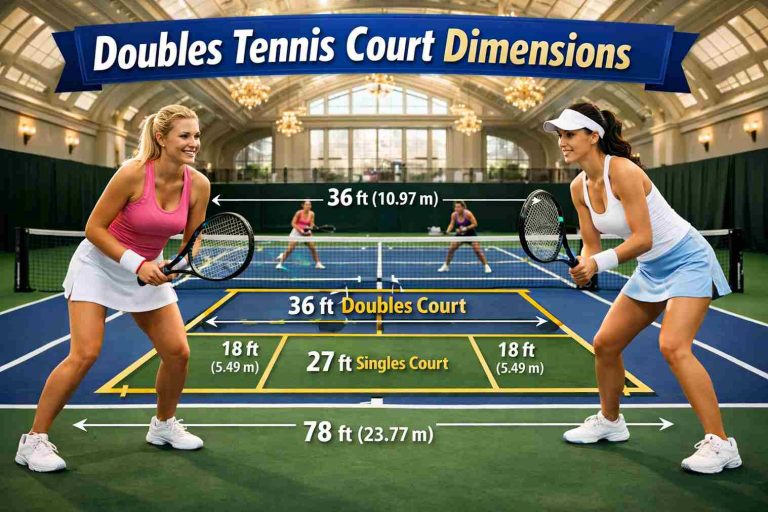
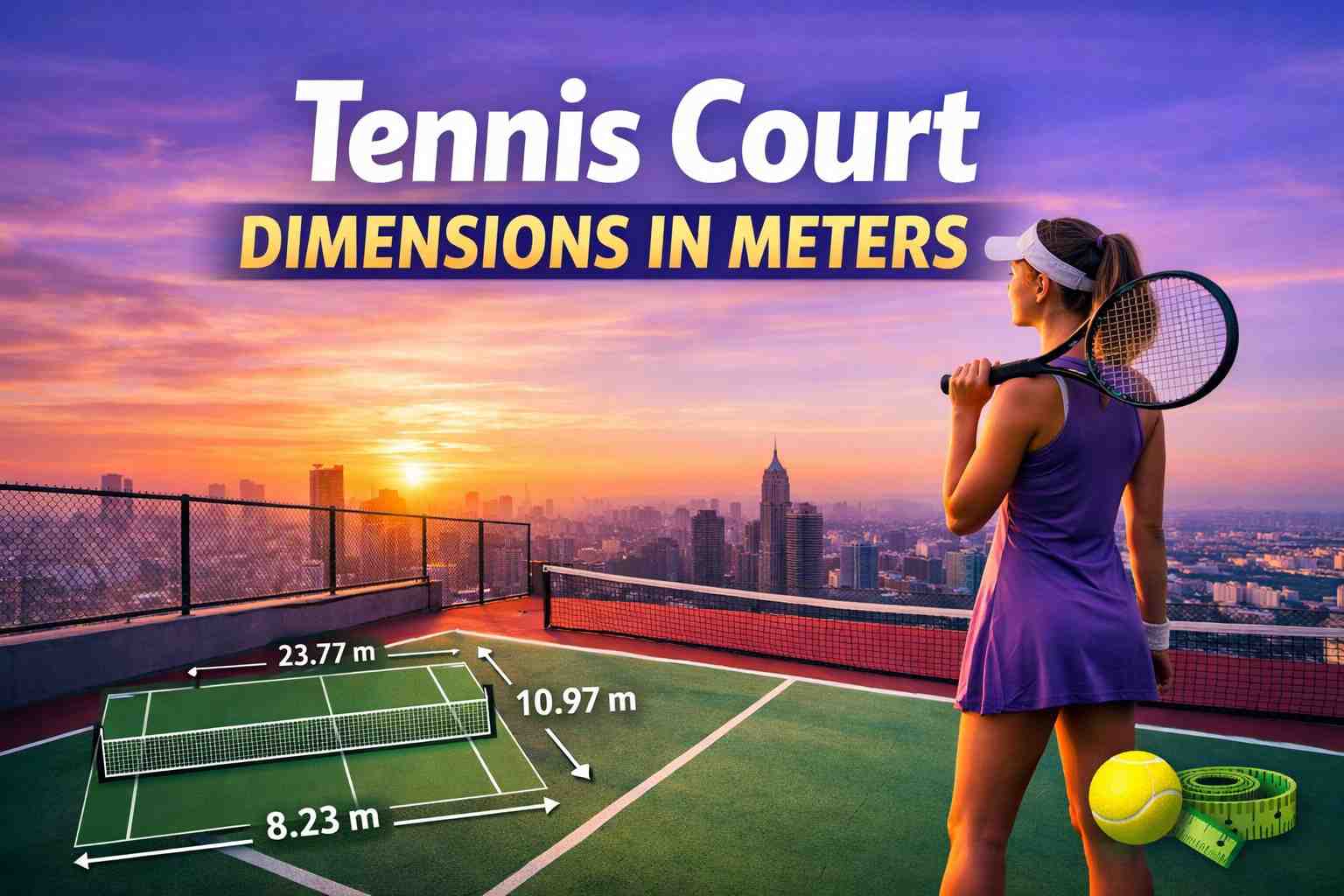
At the heart of any discussion on tennis court dimensions in meters are the standard measurements that define the playing area. A standard court is rectangular, measuring 23.77 meters in length from baseline to baseline. The width varies: for singles matches, it’s 8.23 meters, while for doubles, it expands to 10.97 meters to accommodate the alleys on either side.
The net divides the court into two equal halves, each 11.885 meters long. The net height is 1.07 meters at the posts and dips to 0.914 meters in the center. Service lines are positioned 6.40 meters from the net, creating the service boxes.
The center service line runs perpendicular to the net, dividing each service area into left and right courts. All lines are 5 cm wide, except the baseline, which can be up to 10 cm.
Here’s a detailed table summarizing the key tennis court dimensions in meters:
These tennis court dimensions in meters ensure balanced gameplay, with ample space for volleys, lobs, and groundstrokes. For lawn tennis court dimensions in meters, the specs are identical, as “lawn tennis” refers to the modern game played on grass or other surfaces.
Variations in Tennis Court Dimensions: Runoff, Fence, and Regional Specifics
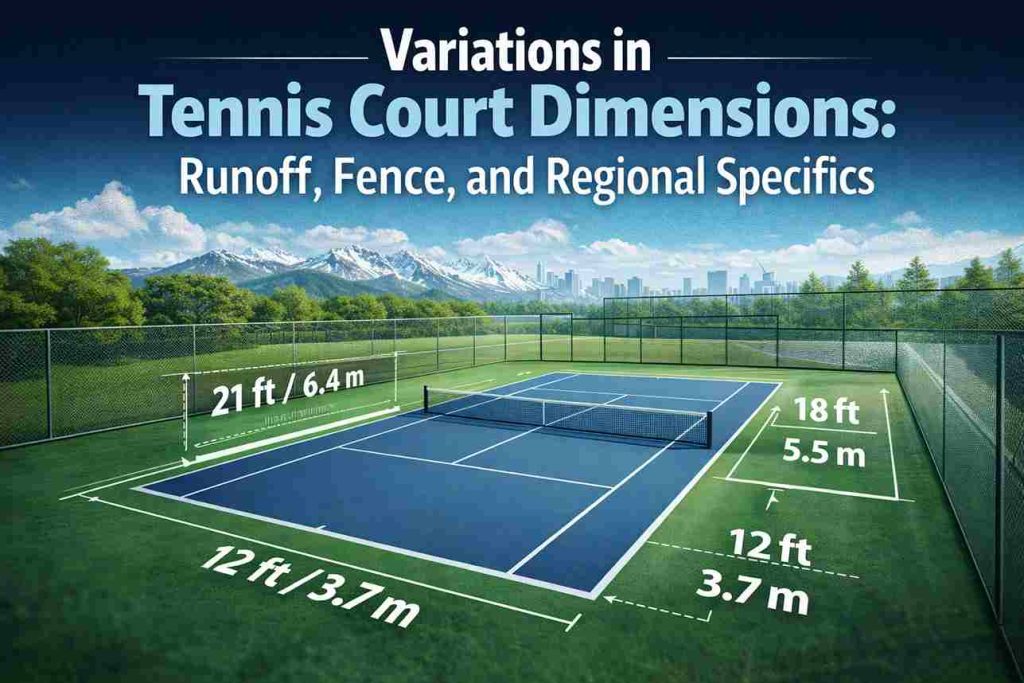
While core playing area dimensions are fixed, variations arise when considering surrounding spaces. Tennis court dimensions including runoff in meters account for safety and spectator areas.
The ITF recommends a minimum runoff of 6.40 meters behind baselines and 3.66 meters on sidelines for international competitions, making the total area about 36.57 meters long and 18.29 meters wide. For recreational courts, this can be reduced to 5.49 meters behind and 3.05 meters on sides.
Tennis court dimensions with fence in meters incorporate enclosures for ball containment. Fences are typically 3.05 to 3.66 meters high, surrounding the runoff area, leading to an overall fenced space of approximately 40 meters long and 20 meters wide. In windy areas, higher fences (up to 4.57 meters) prevent disruptions.
For tennis court dimensions in meters in the Philippines, standards align with ITF guidelines, as the Philippine Tennis Association (PHILTA) adheres to international rules. Local constructions often use the same 23.77 x 8.23 meters for singles, with fences at 36.58 x 18.29 meters including runoff.
However, in urban areas like Manila, space constraints might lead to multi-purpose courts, but dimensions remain standard to allow for competitive play. Recent updates from PHILTA emphasize climate-resilient materials, but measurements are unchanged.
These variations ensure tennis court dimensions in meters adapt to different environments without compromising the game’s essence.
The Four Types of Tennis Courts
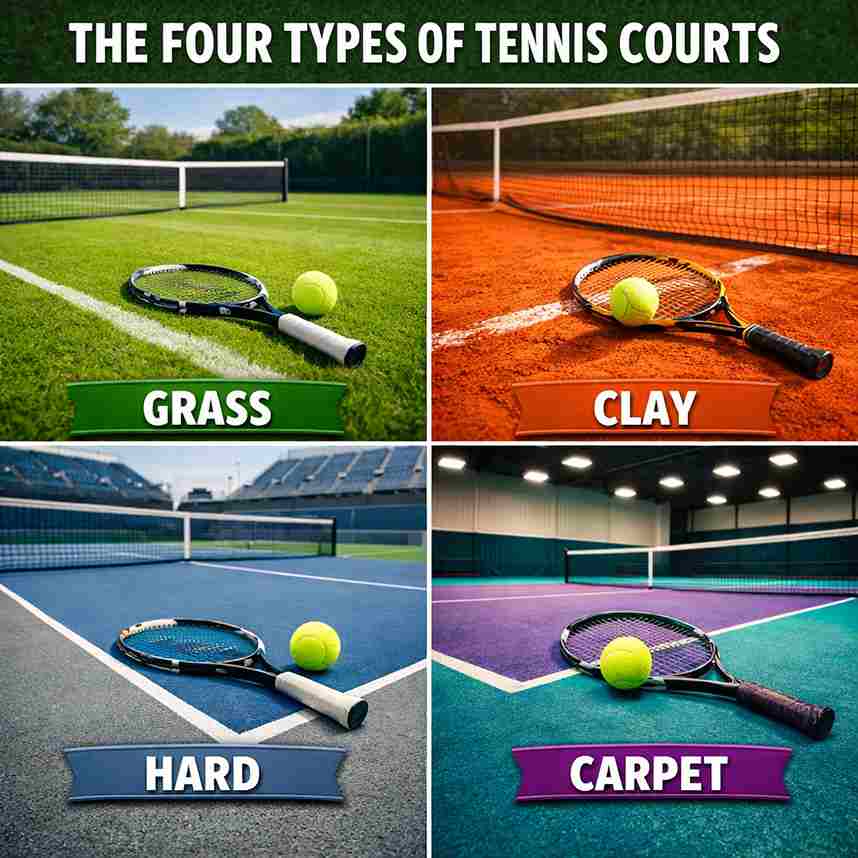
Tennis courts come in four primary types, each affecting ball bounce, speed, and player strategy, though tennis court dimensions in meters remain consistent across all.
- Grass Courts: Traditional surfaces, like those at Wimbledon. Made of natural grass, they offer fast, low bounces. Maintenance is high due to weather sensitivity. Pros: Favor serve-and-volley players. Cons: Slippery when wet.
- Clay Courts: Seen at the French Open, composed of crushed brick or shale. Slower play with high bounces promotes rallies. Pros: Joint-friendly. Cons: Require frequent watering and rolling.
- Hard Courts: Most common, used at the US and Australian Opens. Acrylic-layered concrete or asphalt. Medium pace, consistent bounce. Pros: Durable, low maintenance. Cons: Hard on joints.
- Carpet Courts: Indoor synthetic, like rubberized mats. Fast pace, low bounce. Pros: All-weather. Cons: Less common now, phased out in pros due to injury risks.
Each type influences tactics, but the underlying tennis court dimensions in meters ensure universality.
Step-by-Step Guide to Building a Tennis Court
Building a tennis court requires careful planning to meet tennis court dimensions in meters. Here’s a detailed guide:
- Site Selection and Planning: Choose a flat area at least 36 x 18 meters for runoff. Check zoning laws and soil for drainage. Budget: $50,000–$150,000 depending on surface.
- Excavation and Foundation: Clear the site, excavate to 0.3–0.5 meters depth. Install a gravel base for drainage, compacting layers.
- Base Construction: Pour concrete or asphalt slab, ensuring it’s level within 3 mm tolerance over 3 meters.
- Marking Dimensions: Layout 23.77 m length, 10.97 m width for doubles. Use strings and lasers for accuracy.
- Surface Installation: Apply chosen material—grass seed, clay layers, or acrylic paint. Cure as needed.
- Net and Fence Installation: Erect posts 0.91 m outside lines, hang net at 0.914 m center. Install 3.66 m fences.
- Lighting and Accessories: Add LED lights (500 lux minimum), benches, and windscreens.
- Testing and Certification: Verify dimensions with ITF tools, test bounce and pace.
This process takes 4–6 weeks.
Fact Guide on Tennis Court Dimensions in Meters
Here are key facts:
- The court area for doubles is 260.87 square meters.
- Net posts must be 1.55 cm square or round.
- Junior courts for under-10s are smaller: 18 m x 5.5–8.23 m.
- Wheelchair tennis uses standard dimensions but with two bounces allowed.
- Highest court: Indoor ones require 9 m ceiling clearance.
These facts highlight the precision of tennis court dimensions in meters.
Conclusion
In wrapping up this extensive exploration of tennis court dimensions in meters, it’s clear that these measurements are more than just numbers—they form the foundation of a sport that captivates millions worldwide.
From the standard 23.77 meters length and 8.23 meters singles width to variations including runoff and fences, tennis court dimensions in meters ensure consistency, safety, and excitement in every match.
We’ve traced the history from medieval cloisters to the 1875 standardization, examined the four types of courts (grass, clay, hard, and carpet), and provided practical steps for building your own.
Understanding tennis court dimensions in meters fulfills user intent by empowering builders in places like the Philippines to create compliant spaces, educating players on how dimensions affect strategy, and offering facts for enthusiasts.
Related aspects, such as lawn tennis court dimensions in meters being identical to standards, highlight the sport’s universality. This article provides tables and detailed explanations to make the information clear and actionable. As tennis evolves—perhaps with tech like electronic line calling—these dimensions remain timeless, promoting fair play across generations.
Whether you’re a pro aspiring for Wimbledon or a backyard builder, mastering tennis court dimensions in meters enhances appreciation for the game. With global participation rising, these specs continue to unite players, underscoring tennis’s enduring appeal.
Frequently Asked Questions

Jordan Blake
Jordan Blake is a racket-sports author with hands-on experience and a strong command of both tennis and pickleball. With a foundation built through years on the tennis court and a successful transition into competitive pickleball, Jordan brings practical insight, strategic clarity, and real-world understanding to every article.
Drawing on personal play, match analysis, and court-level observation, Jordan specializes in breaking down technique, tactics, and the mental aspects of both sports in a clear, data-informed, and accessible way. His dual-sport perspective helps readers understand how skills transfer between games—and where each sport demands its own distinct mastery.