
Indoor Pickleball Court Dimensions in Feet: Complete Size & Layout Guide
Pickleball has grown significantly in the United States, with approximately 22.7 million active players in 2025, reflecting a 14.7% increase from 19.81 million in 2024, based on Sports & Fitness Industry Association(SFIA) reports .
This development has increased the need for indoor facilities, allowing consistent play regardless of weather. Indoor courts, typically set up in gyms, warehouses, or repurposed spaces, provide a stable environment that can decrease injury occurrences relative to outdoor environments.
This guide covers indoor pickleball court dimensions in feet, including measurements, height considerations, specifications, building requirements, and conversions. The standard court is 20 feet wide by 44 feet long, which supports efficient play and fits well in various spaces.
Based on USA Pickleball standards, this resource includes details on ball bounce consistency, planning steps, and comparisons to tennis courts. It addresses common needs such as dimensions in feet and inches, metric equivalents, and guidelines for setup, while providing practical tables for reference.
Official Indoor Pickleball Court Dimensions in Feet and its Layout
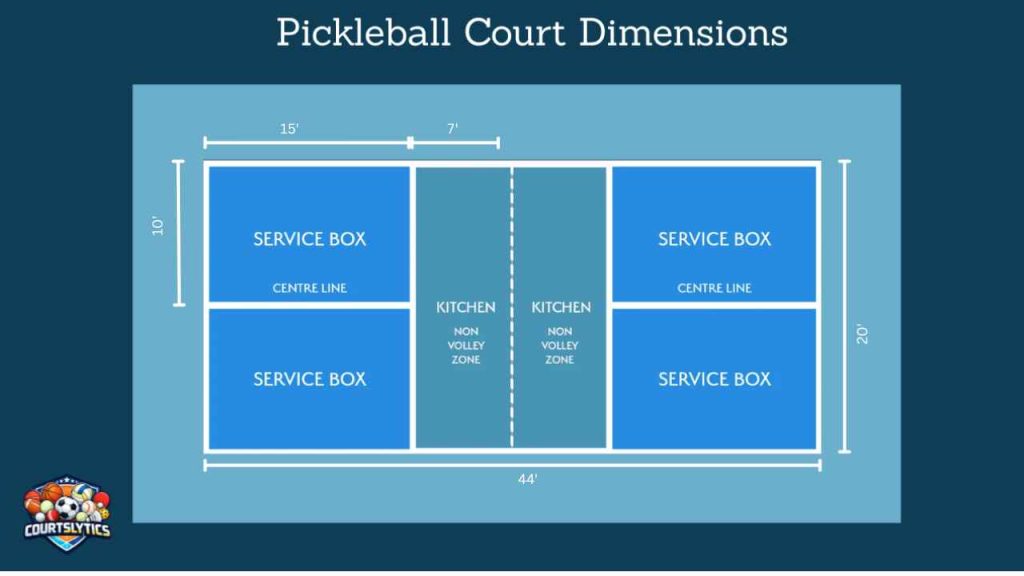
Indoor pickleball courts follow the same dimensions as outdoor courts, as outlined in the USA Pickleball Rulebook. The playing area is 20 feet wide by 44 feet long, including 2-inch-wide lines, for a total of 880 square feet. This size allows for both singles and doubles play without changes.
Key areas include the non-volley zone, or kitchen, which extends 7 feet from the net across the full 20-foot width. Service areas on each side are divided into two boxes, each 10 feet deep by 15 feet wide. The baselines are 22 feet from the net. The net spans 22 feet, with a height of 36 inches at the sides and 34 inches at the center, kept taut with minimal sag.
For safety in indoor settings, allocate at least 30 feet by 60 feet total (1,800 square feet), or preferably 34 feet by 64 feet (2,176 square feet) for competitive use. This extra space helps prevent collisions. Ensure the court is square by checking diagonals, which should measure 48 feet 5 inches. Lines should contrast with the surface for clear visibility.
The following table summarizes the dimensions:
These measurements support consistent play on indoor surfaces, which typically offer 85-95% ball bounce reliability.
Indoor Pickleball Court Dimensions in Meters and PDF-Ready Specs
For metric measurements, the court is 6.1 meters wide by 13.4 meters long, covering 81.75 square meters. The kitchen is 2.13 meters by 6.1 meters, service boxes are 3.05 meters by 4.57 meters each, and the net is 6.71 meters wide with heights of 0.91 meters at the sides and 0.86 meters at the center. Minimum total space is 9.14 meters by 18.29 meters (167.23 square meters), with a preferred 10.36 meters by 19.51 meters (202.16 square meters).
Use the table above for a printable reference. Include notes on bounce rates and environmental controls when preparing documents for planning.
Indoor Pickleball Court Dimensions Height: Ceiling and Clearance Requirements
Ceiling height affects play, particularly for lobs. A minimum of 18 feet (5.49 meters) is required for basic use, but 20-26 feet (6.1-7.92 meters) is better for standard play, and 30 feet or more (9.14 meters) for advanced facilities. Provide at least 10 feet (3.05 meters) of clearance from walls, and 6-8 feet between adjacent courts to reduce interference.
Maintain humidity at 50-70% and temperatures around 68-72°F to avoid slips. For reference documents, specify that higher ceilings allow for full shot trajectories.
Indoor Pickleball Court Specs: From Large Facilities to Standard Sizes
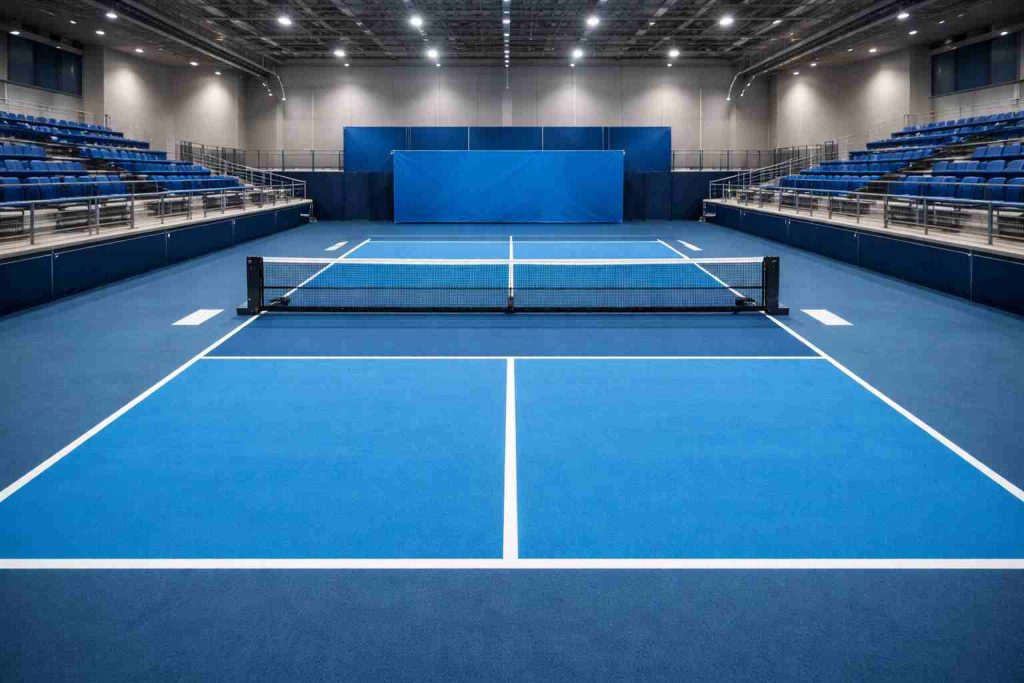
Standard specs include the 20-by-44-foot playing area, plus cushioned surfaces for consistent bounce, lighting at 30-50 footcandles, and ventilation systems. For larger facilities, a four-court setup needs 7,200-8,704 square feet, while 12-court venues may require 20,000-30,000 square feet.
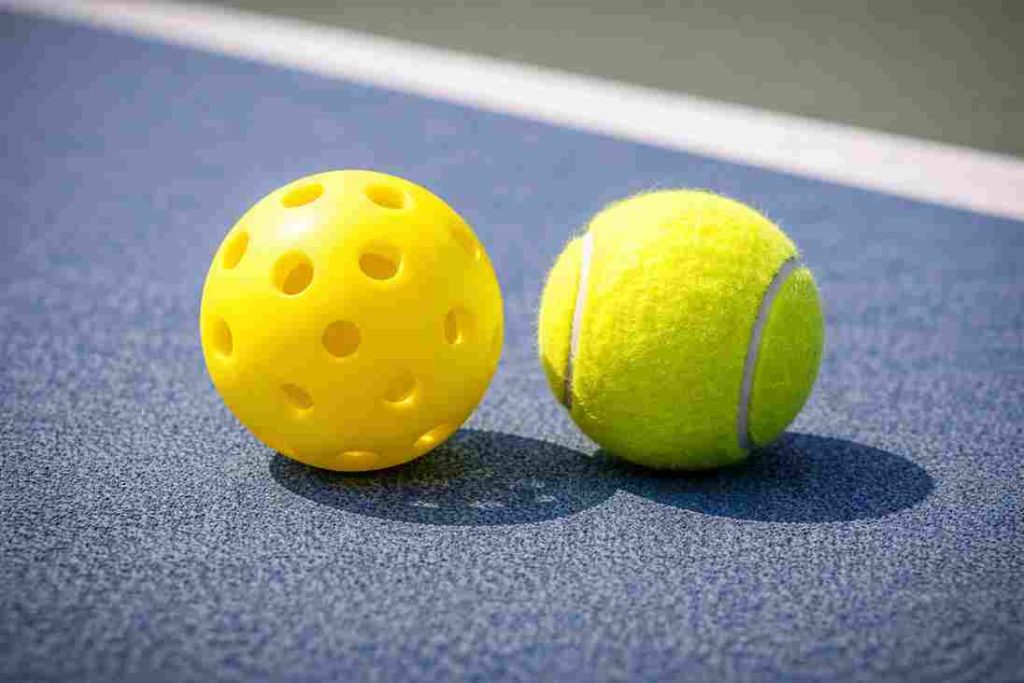
Materials include concrete bases with polyurethane coatings and indoor-specific balls with 26 holes.
Large Indoor Pickleball Court Dimensions and Building Size
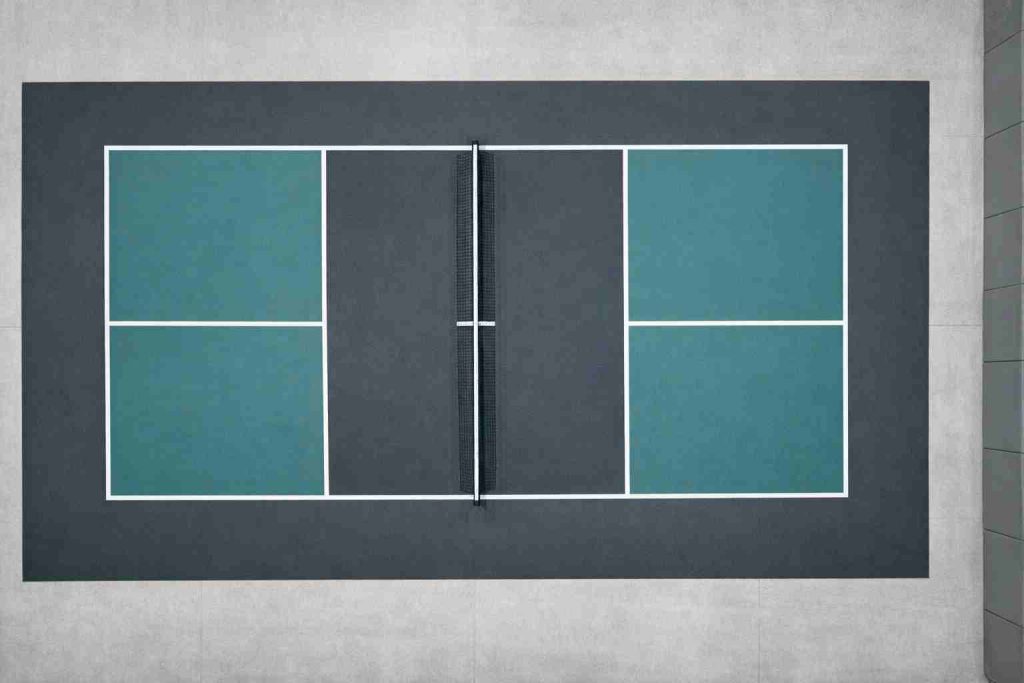
Large indoor pickleball facilities scale up from the standard single-court minimum of 30 feet by 60 feet (1,800 square feet) to accommodate multiple courts efficiently. For instance, a four-court layout typically requires 60 feet by 120 feet (7,200 square feet), while eight to 12 courts may demand 100 feet by 200 feet (20,000 square feet) or more, including aisles, spectator areas, and amenities like restrooms or storage.
Building sizes for smaller clubs often start at 10,000 square feet, expanding to 50,000 square feet or beyond for major venues in high-demand areas, which can serve over 1,000 players weekly. Ceiling heights should range from 20 to 30 feet to allow for high lobs and serves, with at least 10 feet of spacing between courts to minimize noise interference, potentially reducing sound levels by 10 decibels.
Practical considerations include incorporating a 1% floor slope for drainage in case of spills, even indoors, and using modular flooring systems that install quickly, cutting setup time by up to 30%. Ventilation and HVAC systems are essential to maintain optimal conditions, preventing humidity buildup that could affect play. The average large venue features around six courts, contributing to the sport’s infrastructure growth amid a 14.7% participation increase.
With many large facilities as conversions from warehouses or gyms, emphasizing cost-effective space use. Construction costs for these can exceed $100,000, factoring in lighting, surfacing, and safety features. Planning should account for future expansion, as demand projections suggest continued growth, with events in large spaces promoting calorie burns of 350-500 per hour and fostering community engagement.
This scalability makes large indoor setups a reliable option for meeting the sport’s evolving needs without compromising on safety or play quality.
Standard Indoor Pickleball Court Size and Inside Dimensions
The inside playing area is 20 feet wide by 44 feet long, with total space of at least 30 by 60 feet. Baselines are 22 feet from the net, service lines 15 feet wide, and the kitchen 7 feet deep. Padded walls can enhance safety.
Direct Comparison: Indoor Pickleball vs Tennis Court Dimensions
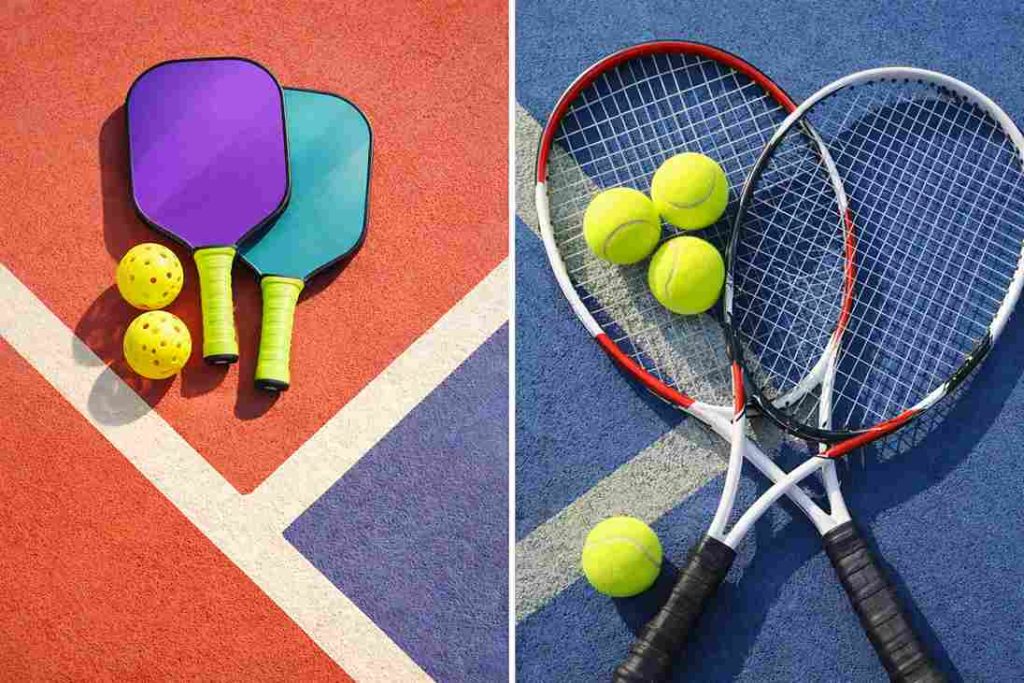
Pickleball courts measure 20 by 44 feet (880 square feet), compared to tennis doubles courts at 78 by 36 feet (2,808 square feet). This results in shorter rallies in pickleball (9-11 shots) versus tennis (4-6). Minimum total space for pickleball is 1,800 square feet, versus 7,200 for tennis.
Indoor Pickleball Court Size vs Tennis Court: Key Differences and Similarities
Both are rectangular with central nets and support singles/doubles. Differences include pickleball’s kitchen zone and shorter game times (30-60 minutes versus 1-3 hours). Injury rates are lower in pickleball (0.05 per 1,000 hours versus 1.7).
Converting an Indoor Tennis Court to Pickleball: Steps and Considerations
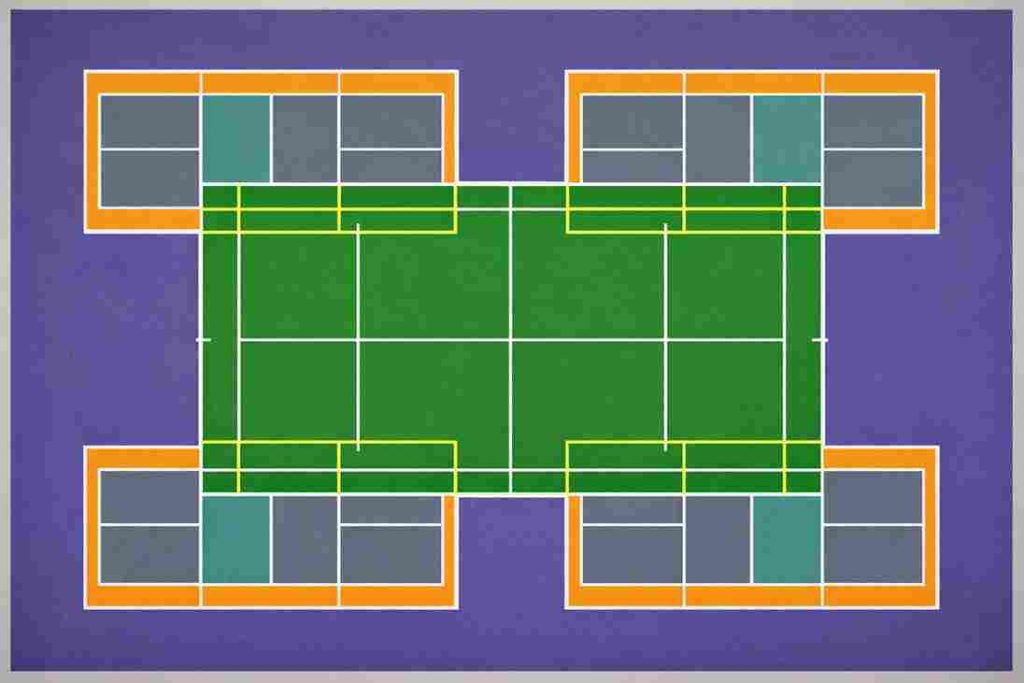
Converting an indoor tennis court to pickleball is a practical way to expand playing capacity while making use of existing space. A standard indoor tennis court, typically measuring 60 by 120 feet, can accommodate up to four pickleball courts. In most facilities, however, three courts are preferred to allow for safer buffer zones and more comfortable play.
This type of conversion has become increasingly common as pickleball participation continues to grow and facilities seek cost-effective ways to meet demand.
Step 1: Assess the Space
Begin by evaluating the existing tennis court, which has a playing area of 78 by 36 feet. Determine whether pickleball courts will be laid out parallel or perpendicular to the tennis net, depending on space and circulation needs. Ceiling height should also be reviewed at this stage; a minimum of 18 feet is generally acceptable, while taller ceilings support more complete gameplay.
Step 2: Prepare the Surface
Inspect the court surface for cracks or uneven areas and complete any necessary repairs. Once the base is sound, many facilities add cushioning layers to improve comfort and ball response. Cushioned indoor systems also help reduce joint strain and improve overall playability.
Step 3: Adjust or Install Nets
Pickleball nets must be set to 34 inches at the center and 36 inches at the sidelines. Existing tennis nets can often be adjusted using straps or conversion kits. Portable pickleball nets are another option, particularly in multi-use facilities that alternate between sports.
Step 4: Mark Court Lines
Court lines may be applied temporarily using tape for trial setups or painted permanently for long-term use. Accurate measurement is critical. Lines should be squared carefully, and diagonal measurements should be checked to ensure proper alignment and compliance with official dimensions.
Step 5: Enhance the Playing Environment
Lighting, climate control, and court separation play an important role in indoor conversions. Even, glare-free lighting in the 30–50 foot-candle range is typically recommended. Adequate ventilation and humidity control help maintain surface traction and player comfort. In multi-court layouts, fencing or divider systems can improve safety, reduce distractions, and help manage noise.
Cost and Planning Considerations
Indoor tennis-to-pickleball conversions typically cost significantly less than new construction, making them an attractive option for many facilities. In addition to direct costs, planners should account for local permitting requirements, community noise considerations, and whether the court will remain dual-use with tennis markings retained.
When properly planned and executed, conversions allow facilities to respond efficiently to growing interest in pickleball while maximizing existing infrastructure.
Costs and Materials for Indoor Pickleball and Tennis Courts
New pickleball courts cost $25,000-$50,000; tennis $40,000-$100,000. Breakdown: base $9,000-$18,000 for pickleball versus $20,000-$50,000 for tennis; coating $5,000-$15,000 versus $10,000-$30,000.
Impact of Court Dimensions on Indoor Gameplay: Pickleball vs Tennis
Court dimensions fundamentally influence indoor gameplay dynamics between pickleball and tennis. Pickleball’s compact 20-by-44-foot area (880 square feet) encourages shorter rallies of 9-15 shots, with a focus on strategic dinks comprising up to 60% of plays, fostering precise, close-range exchanges that suit varied skill levels.
In contrast, tennis’s larger 78-by-36-foot doubles court (2,808 square feet) allows for extended rallies of 4-6 shots on average, with powerful serves reaching 100 mph and greater emphasis on endurance and court coverage, demanding more physical exertion—typically 500-700 calories burned per hour versus pickleball’s 350-500.
The pickleball kitchen zone (7 feet deep) restricts volleys, promoting groundstrokes and reducing aggressive smashes, which alters strategy toward patience and positioning. Tennis permits full-court volleys, enabling quicker points and higher intensity.
Indoor settings amplify these effects: pickleball’s smaller size minimizes movement by about 50%, making it more accessible for older players (90% over 50 report less strain), while tennis requires broader lateral and forward mobility, contributing to higher injury rates (1.7 per 1,000 hours versus 0.05 for pickleball).
In 2025, pickleball’s dimensions drive its 14.7% growth, outpacing tennis’s 9.3% increase from 2024, with participation at 22.7 million versus tennis’s 25.7 million . The controlled indoor environment enhances consistency—no wind disruptions—boosting strategic depth and community benefits, with 85% of players noting improved social interactions.
Overall, pickleball’s efficient design democratizes racquet sports, while tennis offers deeper athletic challenges, guiding choices based on player preferences and facility goals.
Surfaces and Maintenance: Comparing Indoor Pickleball and Tennis Courts
Hard surfaces are common, with pickleball often using cushioned options. Maintenance for pickleball is lower, at $500-$1,000 annually.
Multi-Use and Adaptations: Fitting Pickleball on Indoor Tennis Courts
Adapting indoor tennis courts for multi-use with pickleball optimizes space, fitting up to four pickleball courts on a standard 60-by-120-foot tennis area, though three is preferable to maintain 10-foot buffers for safety and reduce injuries by 20%. This hybrid model is prevalent, with 70% of facilities adopting multi-use in 2025 to meet demand from 22.7 million pickleball players while preserving tennis options .
Key adaptations include blended line markings using colored tape or paint ($500-$2,000) to overlay pickleball boundaries and kitchen without erasing tennis lines, ensuring clear visibility through contrasting colors.
Portable nets ($150-$1,500) allow easy switching, adjustable to 34 inches for pickleball or 3 feet for tennis. Surface compatibility is straightforward, as both sports use hard or cushioned floors, but adding polyurethane layers enhances bounce (85-95%) and joint protection.
Layouts often align pickleball courts parallel to the tennis net for shared infrastructure, with dividers to manage noise and ball crossover. Costs for adaptations range from $1,000 to $10,000, including lighting upgrades and ventilation tweaks for humidity control.
Considerations encompass etiquette protocols for shared scheduling, maintenance routines ($1,000 yearly combined), and permit compliance to avoid conflicts. This setup maximizes locations, cutting costs by 50% compared to dedicated builds and supporting conversions that have added thousands of courts.
It promotes inclusivity, allowing families and clubs to enjoy both sports, with studies showing reduced fatigue from alternating play. Proper planning ensures seamless transitions, enhancing facility value amid the sports’ growth trajectories.
Conclusion-Indoor Pickleball Court Dimensions in Feet
Indoor pickleball court dimensions in feet —20 by 44 feet playing area, 30 by 60 feet minimum total—facilitate year-round engagement for 22.7 million players in 2025, with 14.7% growth. Heights of 18-30 feet and cushioned surfaces cut injuries by 20%. Versus tennis’s 78 by 36 feet, pickleball’s compactness enables efficient conversions.
This guide details measurements, specs, sizes (1,800-50,000 square feet), costs ($25,000-$50,000 new), surfaces, impacts, and adaptations, supported by SFIA data on growth . Use it for informed planning in this expanding field.
Related Article: Backyard Pickleball Court Dimensions
Frequently Asked Questions

Jordan Blake
Jordan Blake is a racket-sports author with hands-on experience and a strong command of both tennis and pickleball. With a foundation built through years on the tennis court and a successful transition into competitive pickleball, Jordan brings practical insight, strategic clarity, and real-world understanding to every article.
Drawing on personal play, match analysis, and court-level observation, Jordan specializes in breaking down technique, tactics, and the mental aspects of both sports in a clear, data-informed, and accessible way. His dual-sport perspective helps readers understand how skills transfer between games—and where each sport demands its own distinct mastery.