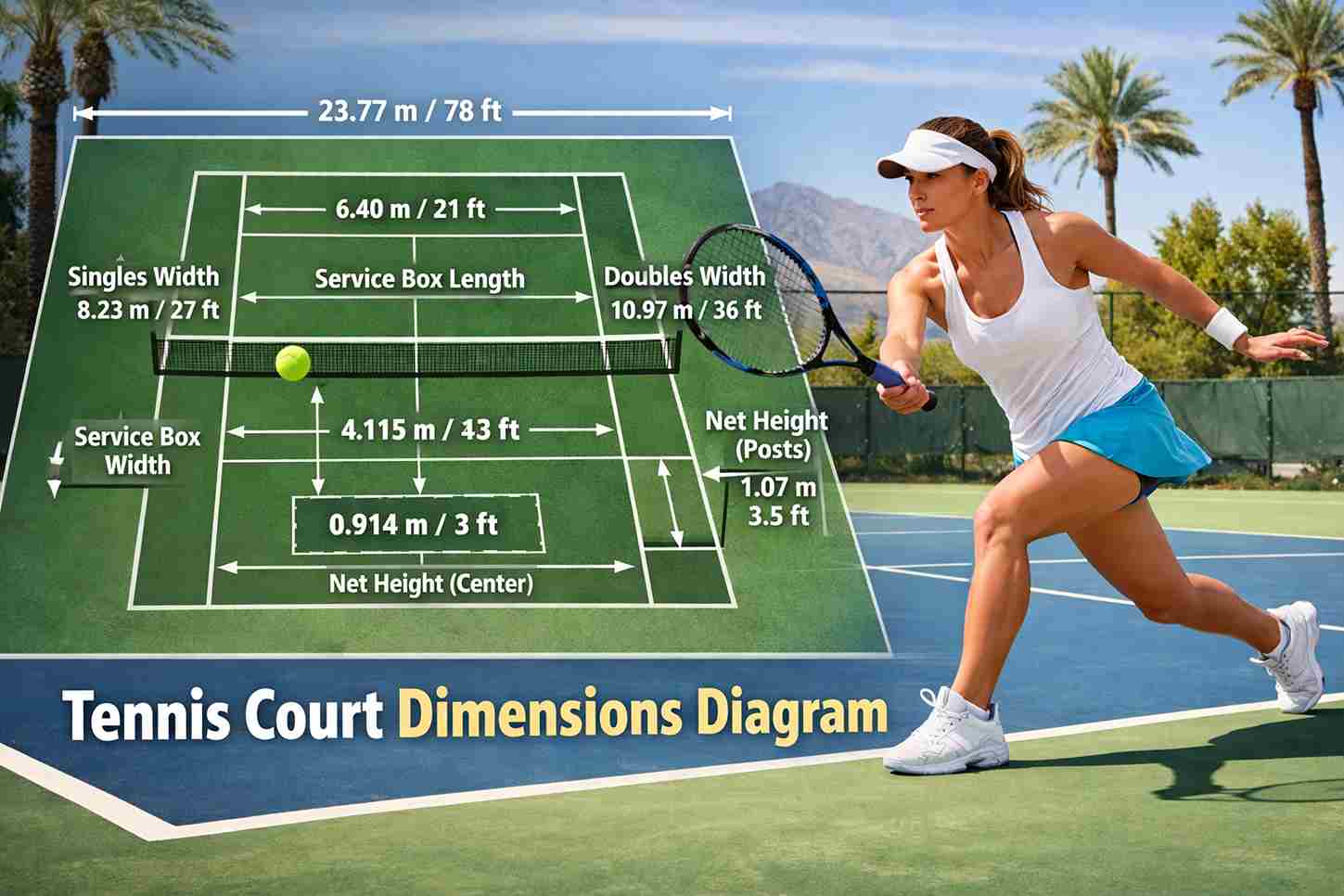
Tennis Court Dimensions Diagram with Lines, Layout & Measurements
When it comes to the sport of tennis, precision is everything. From the swing of the racket to the bounce of the ball, every element plays a crucial role in the game.
At the heart of this precision lies the tennis court dimensions diagram—a visual and informational blueprint that defines the playing field.
Whether you’re a beginner learning the basics, a professional athlete fine-tuning your strategy, or a contractor planning to build a new facility, understanding the tennis court dimensions diagram is essential.
This diagram not only outlines the standard measurements but also ensures fair play, safety, and compliance with international regulations.
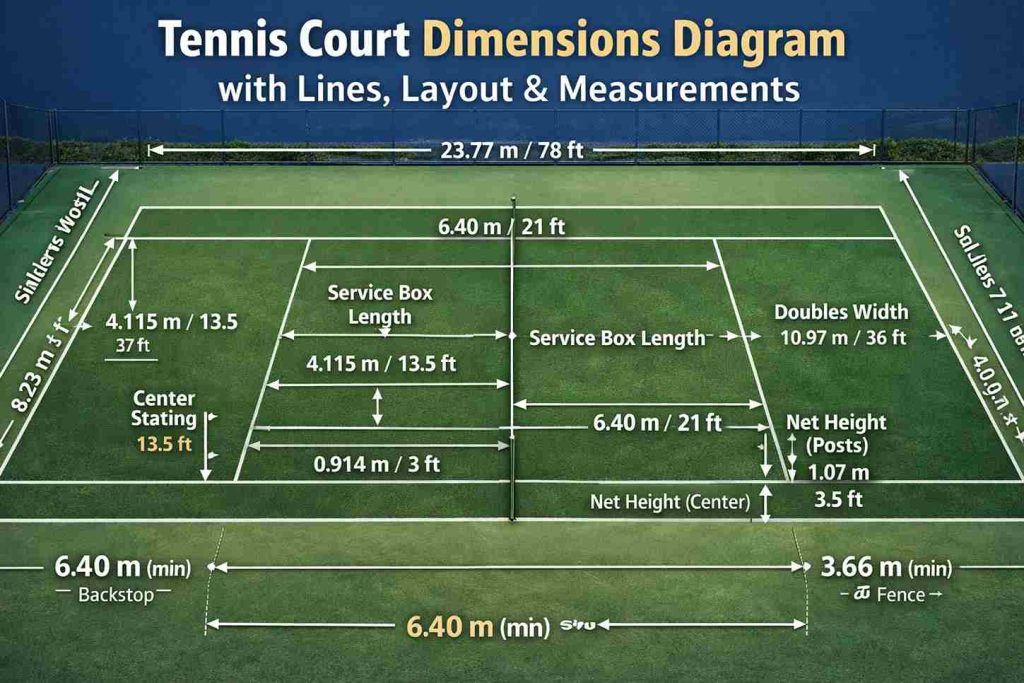
The tennis court dimensions diagram typically includes key elements like the length and width of the court, the positions of the baselines, sidelines, service lines, and the net.
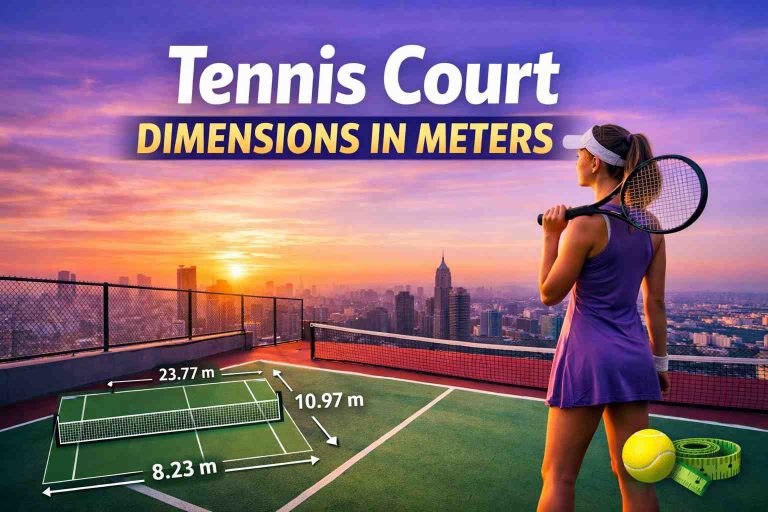
For instance, a diagram of a tennis court with dimensions will show the overall length as 78 feet (23.77 meters) for both singles and doubles, while the width varies: 27 feet (8.23 meters) for singles and 36 feet (10.97 meters) for doubles.
These measurements are standardized by the International Tennis Federation (ITF), ensuring consistency across global tournaments.
Why does the tennis court dimensions diagram matter? For players, it helps in visualizing strategies, such as serving angles or volley positions. For builders, it’s a guide to creating courts that meet official standards, avoiding costly errors.
Even enthusiasts searching for “tennis court diagram with labels” or “tennis court layout diagram” often seek this information to set up backyard games or understand professional matches better.
Related queries like “tennis court line dimensions,” “tennis court size dimensions,” and “measurements of a tennis court” all point to the same core need: accurate, visual representations.
In recent years, with the rise of recreational tennis and home courts, interest in the tennis court dimensions diagram has surged. This guide will delve deep into every aspect, from history to practical applications, filling the user’s intent by providing comprehensive, up-to-date information.
We’ll cover standard tennis court measurements, official dimensions of a tennis court, and even how to address common questions about court sizes in different contexts.
As we explore, remember that the tennis court standard dimensions are not arbitrary—they evolved over time to balance challenge and fairness. Queries like “what is the length and width of a tennis court” or “court tennis court dimensions” highlight common curiosities, which we’ll address thoroughly.
By the end, you’ll have a complete understanding of the tennis court dimensions diagram, empowering you to engage with the sport on a deeper level.
History of Tennis Court Dimensions
The story of the tennis court dimensions diagram begins in the late 19th century, when tennis emerged as a modern sport. Originating from “real tennis” or “court tennis,” which was played indoors on asymmetrical courts, the game we know today—lawn tennis—was patented by Major Walter Clopton Wingfield in 1874.
His initial setup, called “Sphairistikè,” featured an hourglass-shaped court, quite different from today’s rectangular tennis court layout diagram.
By 1877, the All England Croquet and Lawn Tennis Club standardized the court for the first Wimbledon tournament. The tennis court diagram at that time measured 78 feet long and 27 feet wide for singles, with doubles extending to 36 feet—dimensions that have remarkably persisted.
This standardization was crucial as tennis spread globally, preventing regional variations that could unfair the game.
In 1924, the International Lawn Tennis Federation (now ITF) was formed, formalizing the tennis court dimensions diagram. The focus was on metric conversions for international play, setting the length at 23.77 meters and widths at 8.23 meters (singles) and 10.97 meters (doubles).
Over the decades, minor adjustments addressed practical issues, like net height specifications in 1933, mandating 3 feet (0.914 meters) at the center.
Post-World War II, with the Open Era in 1968, courts diversified in surfaces—grass, clay, hard—but dimensions remained constant. The 1980s saw emphasis on runoff areas in the tennis court layout dimensions, recommending 21 feet behind baselines for safety in professional venues.
In the 21st century, sustainability influenced designs. ITF guidelines incorporate eco-friendly materials, but the core tennis court size dimensions stay unchanged.
Searches on “tennis court standard dimensions” reveal ongoing interest in historical evolution, with diagrams often comparing old and new layouts.
This history underscores how the tennis court dimensions diagram has been refined for equity, from Victorian lawns to modern arenas. Understanding this progression helps appreciate why queries like “the dimensions of a tennis court” yield such precise answers today.
Official Tennis Court Dimensions and Diagram
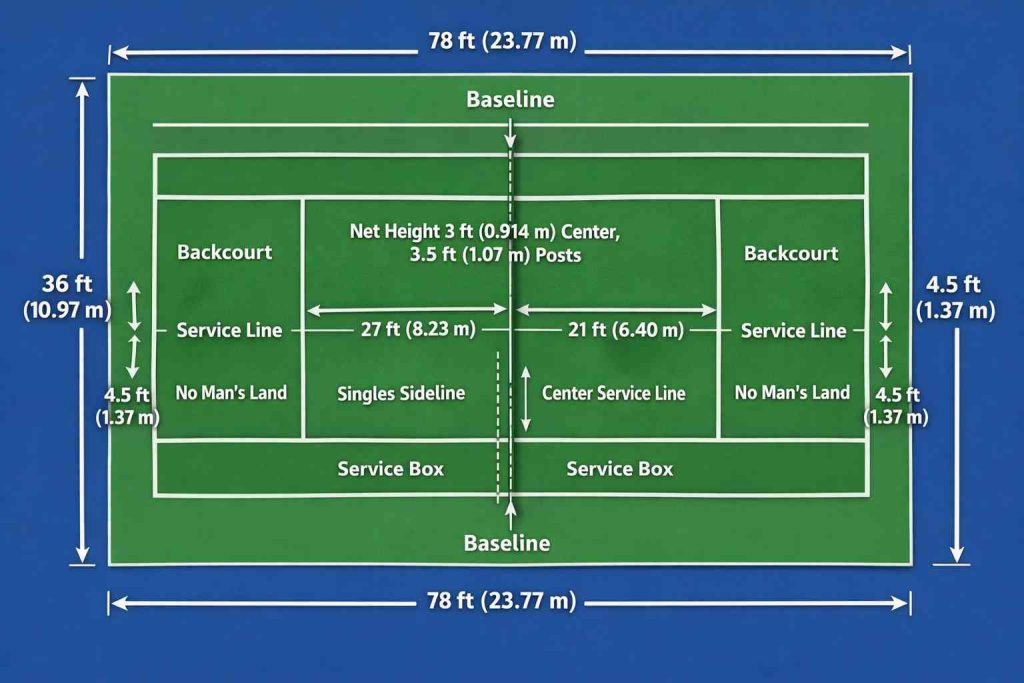
Diving into the core of our topic, the tennis court dimensions diagram provides a detailed visual of the playing area. According to the latest ITF standards, the court is rectangular, with exact measurements ensuring uniformity.
Here’s a breakdown:
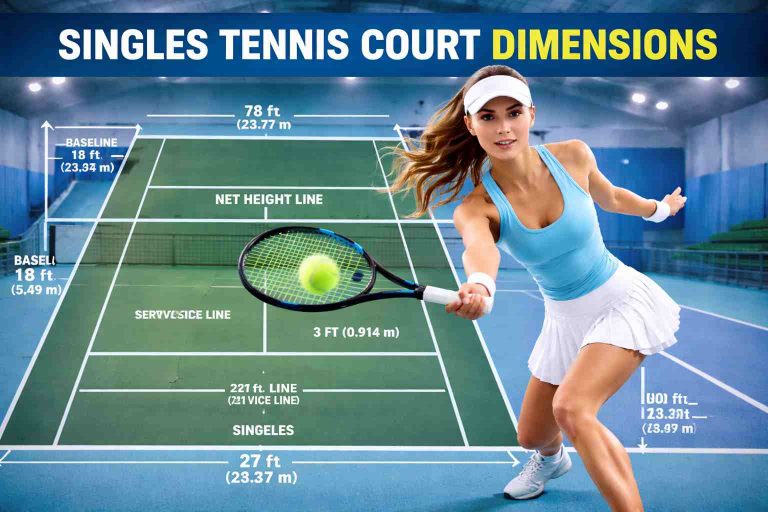
- Overall Length: 78 feet (23.77 meters) from baseline to baseline.
- Singles Width: 27 feet (8.23 meters).
- Doubles Width: 36 feet (10.97 meters).
- Service Line: 21 feet (6.40 meters) from the net.
- Center Service Line: Divides the service boxes, running from the service line to the net.
- Net Height: 3 feet (0.914 meters) at the center, 3.5 feet (1.07 meters) at the posts.
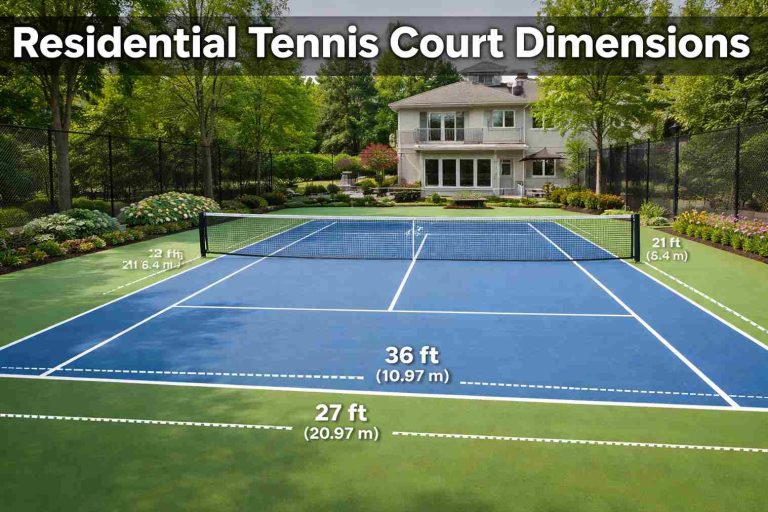
- Runoff Areas: Minimum 21 feet (6.40 meters) behind baselines, 12 feet (3.66 meters) on sides for international play.
A typical diagram of tennis court with dimensions labels these elements clearly. Imagine a top-down view: baselines at each end, sidelines parallel, service lines perpendicular midway, and the net bisecting the court.
To visualize, here’s a table summarizing the tennis court line dimensions:
This tennis court diagram with labels ensures players know exact zones, like the 4.5-foot alleys for doubles. For “official dimensions of a tennis court,” these are ITF-approved, with tolerances of ±10mm for lines.
Variations exist for non-regulation courts, but standard tennis court measurements prioritize these for tournaments. Searches for “tennis court layout dimensions” often lead to printable diagrams, emphasizing accuracy.
Step-by-Step Guide to Laying Out a Tennis Court
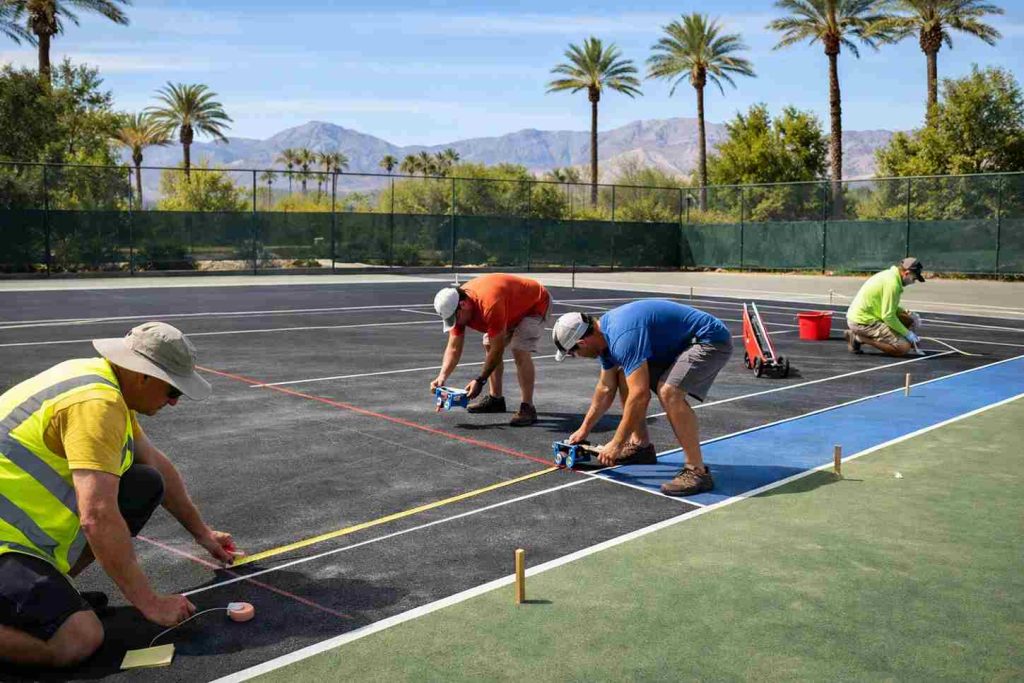
Building a tennis court requires precision, starting with the tennis court dimensions diagram as your blueprint. Here’s a step-by-step guide:
- Site Selection and Preparation Choose a flat area at least 120 feet long by 60 feet wide to accommodate runoff. Clear debris, level the ground, and ensure proper drainage.
- Mark the Baselines Using the diagram of a tennis court with dimensions, stake out 78 feet for length. Use string lines for straightness.
- Set Sidelines For doubles, mark 36 feet wide; add alleys 4.5 feet each side from singles 27 feet.
- Position the Net Posts Place posts 3 feet outside sidelines, 42 feet apart. Install net at 3.5 feet high at posts.
- Draw Service Lines 21 feet from net, parallel to baselines. Center line bisects the court.
- Add Alleys and Hashes Mark doubles alleys and center hash mark.
- Paint Lines Use 2-inch wide lines per ITF standards. For surfaces like clay, use tape or embedded lines.
- Install Fencing and Lighting Ensure 10-12 foot fences around, with lighting for night play.
- Surface Application Apply grass, clay, or hardcourt materials over the layout.
- Final Inspection Verify all tennis court size dimensions match the official tennis court dimensions diagram.
This process addresses “how to layout a tennis court,” ensuring a professional result.
Fact Guide on Tennis Courts
Here are key facts about the tennis court dimensions diagram:
- The court area for doubles is 2,808 square feet, singles 2,106.
- Lines are part of the court except baselines for serves.
- Indoor courts match outdoor dimensions but need higher ceilings (30 feet min).
- Surfaces affect play: Grass fast, clay slow.
- ITF certifies courts for tournaments; updates emphasize LED lighting efficiency.
- Wheelchair tennis uses same dimensions.
- Mini-tennis courts for kids are smaller, e.g., 36 feet long.
These facts enhance understanding of “measurements of a tennis court.”
Latest Data and Trends in Tennis Court Design

ITF data confirms no dimension changes in recent years, but trends include sustainable surfaces like recycled rubber. Interest is rising in smart courts with embedded sensors for line calls. Indoor facilities emphasize ventilation, maintaining standard tennis court measurements.
Conclusion
In wrapping up this extensive exploration of the tennis court dimensions diagram, it’s clear that this fundamental aspect of the sport bridges history, precision, and practicality.
From its origins in the 1870s to the unwavering ITF standards today, the tennis court diagram with labels has remained a cornerstone of fair play.
We’ve covered the official dimensions—78 feet long, 27 feet wide for singles, 36 for doubles—alongside step-by-step guides for layout, fascinating facts, and answers to common questions about court sizes in various settings.
The tennis court layout diagram isn’t just measurements; it’s the canvas for athletic excellence, strategy, and community.
Whether addressing “what is the length and width of a tennis court” or delving into construction, this guide fulfills user intent by offering actionable, up-to-date insights.
As tennis evolves with sustainable trends and technology, the core tennis court size dimensions ensure accessibility for all levels.
Ultimately, mastering the tennis court dimensions diagram empowers players to appreciate the game’s nuances, builders to create enduring spaces, and fans to engage more deeply. In a world where precision matters, this diagram stands as a testament to tennis’s enduring appeal.
Frequently Asked Questions

Jordan Blake
Jordan Blake is a racket-sports author with hands-on experience and a strong command of both tennis and pickleball. With a foundation built through years on the tennis court and a successful transition into competitive pickleball, Jordan brings practical insight, strategic clarity, and real-world understanding to every article.
Drawing on personal play, match analysis, and court-level observation, Jordan specializes in breaking down technique, tactics, and the mental aspects of both sports in a clear, data-informed, and accessible way. His dual-sport perspective helps readers understand how skills transfer between games—and where each sport demands its own distinct mastery.