Residential Tennis Court Dimensions for Home & Backyard Courts
Residential tennis court dimensions form the foundation for creating a functional and enjoyable home sports space.
These dimensions are based on official standards established by the International Tennis Federation (ITF) and adopted universally, including by the United States Tennis Association (USTA).
This guide provides a detailed exploration of residential tennis court dimensions, covering standard measurements, layout specifics, adaptations for home use, historical context, construction steps, and current trends.
With tennis participation continuing to rise globally and in the United States, more homeowners are considering backyard tennis court dimensions to bring the sport directly to their property.
Whether the goal is casual family play, serious training, or multi-sport versatility, understanding residential tennis court dimensions ensures the court is safe, playable, and compliant with best practices.
This article addresses core user needs by explaining exact measurements, including tennis court size in feet, tennis court size in meter, tennis court dimensions including fence, and minimum tennis court dimensions for smaller properties.
Related terms such as home tennis court dimensions, building a tennis court dimensions, usta tennis court dimensions, official tennis court dimensions, regulation tennis court dimensions, indoor tennis court dimensions, and the dimensions of a tennis court are covered naturally throughout.
History of Tennis Court Dimensions
The origins of tennis court dimensions date back centuries. Early forms of the game, such as jeu de paume played in France from the 12th century, used long, narrow indoor courts without standardized measurements.
Players struck the ball with their hands against walls, and court sizes varied widely depending on the available space in monasteries or castles.
The transition to modern lawn tennis began in the 1870s. Major Walter Clopton Wingfield introduced a version in 1874 with an hourglass-shaped court and specific rules, marking a significant shift toward rectangular layouts.
By 1875, the Marylebone Cricket Club standardized the shape to a rectangle, and in 1877 the first Wimbledon tournament used dimensions very close to those we recognize today.
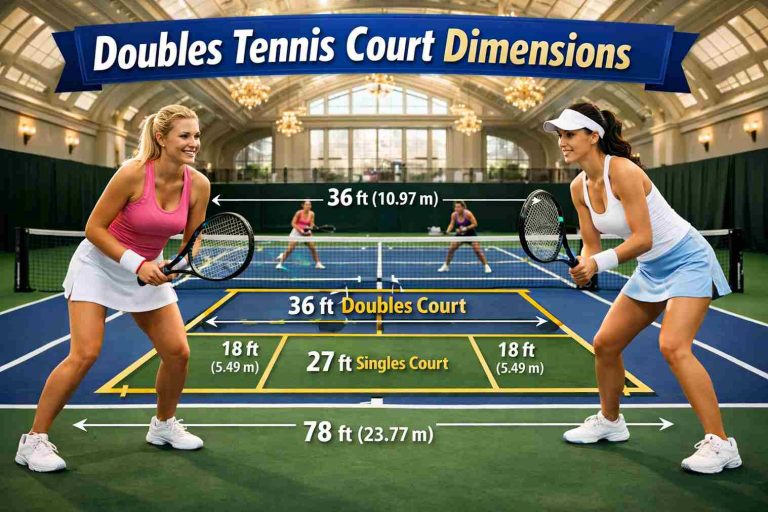
In 1882, the length was set at 78 feet and the singles width at 27 feet, with doubles expanding to 36 feet. These measurements have remained unchanged for over 140 years, providing consistency across recreational, competitive, and residential settings.
The United States adopted these standards shortly after the sport arrived in the 1870s, and the USTA has maintained alignment with international rules ever since.
Today, residential tennis court dimensions continue to follow these historical measurements while incorporating modern adaptations for backyard constraints, climate considerations, and multi-use functionality.
Standard Tennis Court Dimensions and Layout
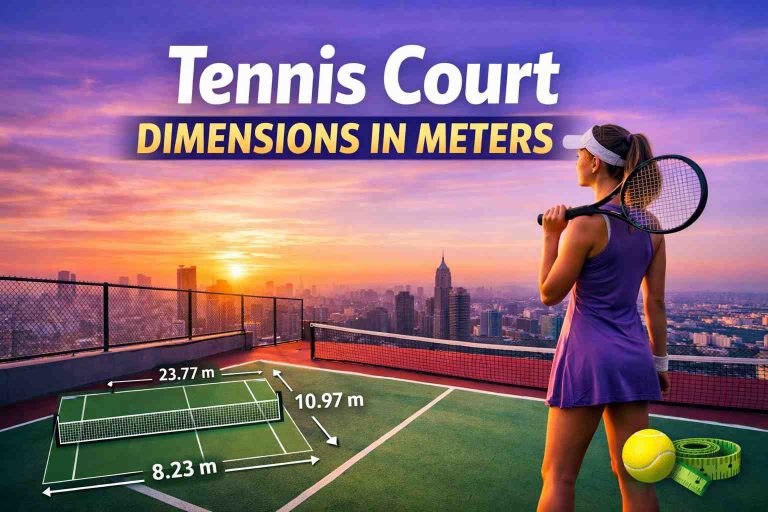
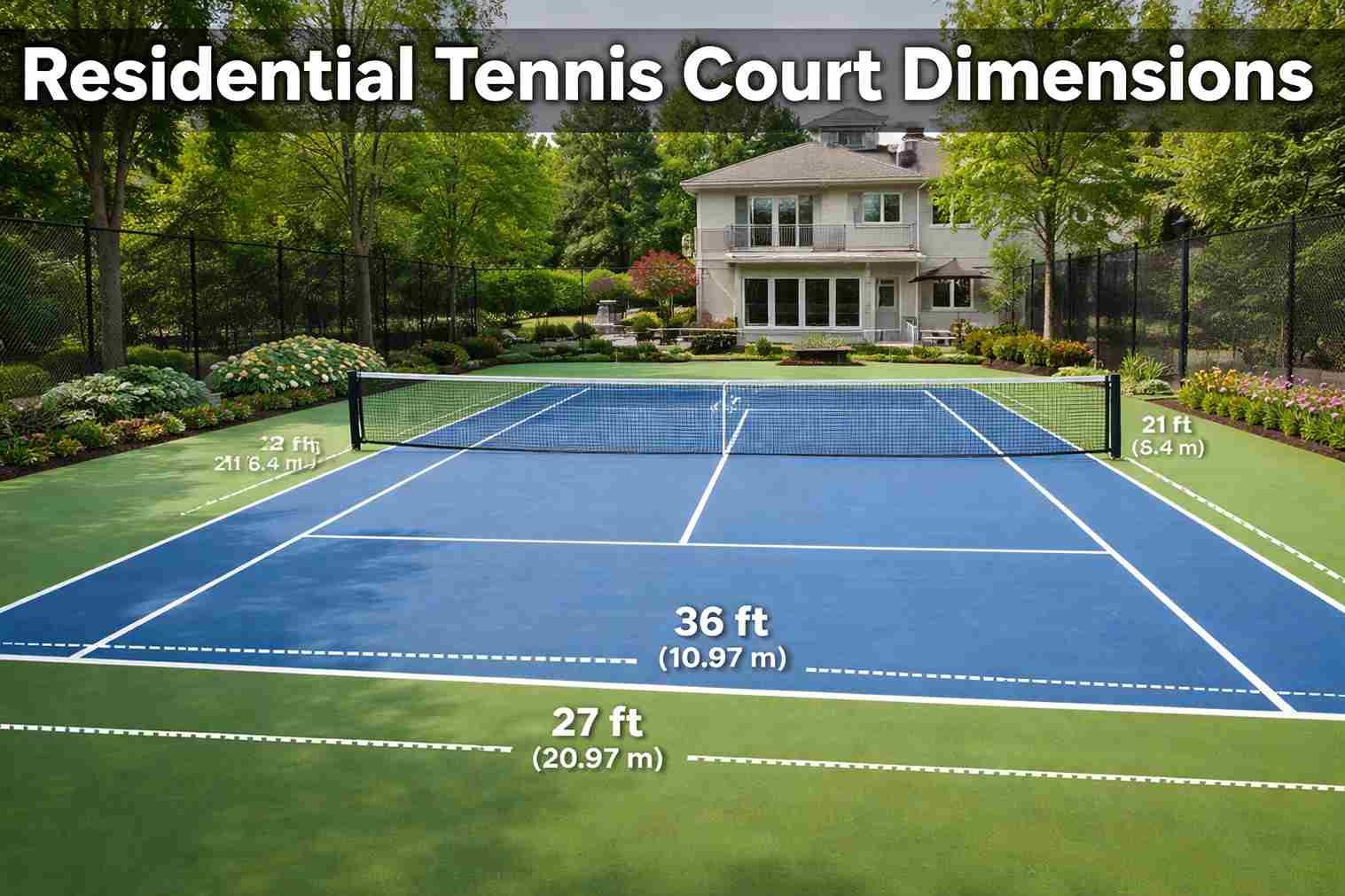
A regulation tennis court is 78 feet (23.77 meters) long and 27 feet (8.23 meters) wide for singles play. For doubles, the width increases to 36 feet (10.97 meters) by including the doubles alleys on each side.
The net divides the court exactly in half, positioned 39 feet from each baseline. The service line is located 21 feet (6.40 meters) from the net on both sides. Each service box measures 21 feet long by 13.5 feet wide. The center service line runs from the net to the service line, splitting each box.
Key measurements include:
For residential tennis court dimensions, the total recommended playing area including runoff is approximately 120 feet long by 60 feet wide. This provides adequate space for player movement, safety, and ball retrieval.
Tennis court dimensions including fence typically add 10 to 12 feet of fencing height around the perimeter. Tennis court dimensions with fence in feet result in an enclosed area of about 140 feet by 80 feet when including clearance outside the fence line.
In meters, tennis court dimensions with fence often measure approximately 42.67 meters by 24.38 meters for the enclosed space.
Line widths are standardized at 1 to 2 inches, except baselines which may be up to 4 inches wide. These precise markings ensure accurate calls during play.
Residential-Specific Considerations
Home tennis court dimensions follow the same core measurements as professional courts but often require adjustments for property size, orientation, and intended use.
Many homeowners opt for the full doubles width of 36 feet to allow versatile play. In space-constrained backyards, some choose narrower configurations, though staying close to official dimensions preserves the authentic feel.
Orientation is critical: courts are ideally aligned north-south to reduce glare from the sun during morning and afternoon play. Proper drainage with a slight slope (typically 1%) prevents water pooling, which is especially important in residential settings exposed to weather.
Fencing is a key element in residential tennis court dimensions. A standard height of 10 feet is common, with some installations using 12 feet for added ball containment. Gates, windbreaks, and privacy screening are frequently incorporated.
Lighting extends usability into evening hours. LED systems with 300–500 lux provide sufficient illumination without excessive energy use.
Surfacing choices for backyard tennis court dimensions include acrylic hard courts (most popular), cushioned systems for joint comfort, artificial clay, or synthetic turf. Each option affects bounce, speed, and maintenance requirements.
Multi-sport markings for pickleball, basketball, or volleyball are increasingly common, maximizing the value of the investment.
Step-by-Step Guide to Building a Residential Tennis Court
- Define Goals and Budget Determine whether the court is for casual recreation, training, or multi-use. Establish a realistic budget, which typically ranges from $50,000 to $400,000 depending on size, surface, fencing, and features.
- Conduct Site Assessment Evaluate the proposed location for flatness, soil stability, drainage, sun exposure, and proximity to trees or structures. A professional surveyor can confirm the site meets minimum residential tennis court dimensions.
- Check Regulations and Obtain Permits Review local zoning laws, building codes, homeowners association rules, and setback requirements. Secure necessary permits before any construction begins.
- Design the Layout Mark out tennis court layout dimensions using stakes and string lines. Ensure accurate placement of baselines, service lines, center line, and net posts according to official measurements.
- Prepare the Site Clear vegetation, excavate to the required depth, and install proper drainage systems. Grade the sub-base to achieve the necessary slope.
- Build the Foundation Install a stable base layer, usually compacted gravel or crushed stone, followed by asphalt or concrete depending on the chosen surface.
- Apply Surfacing Install the selected playing surface, whether acrylic, cushioned hard court, or synthetic material. Ensure even application and proper curing time.
- Install Net, Posts, and Markings Position net posts at the correct height and tension the net to regulation specifications. Paint all lines with precision.
- Add Fencing, Lighting, and Accessories Erect perimeter fencing, install lighting poles and fixtures, and add benches, windscreens, or water stations as desired.
- Final Inspection and Testing Walk the court to check for levelness and surface consistency. Test playability and make any final adjustments.
Following this process helps ensure the finished court meets residential tennis court dimensions standards and provides years of reliable use.
Latest Data and Trends in Residential Tennis Court Construction
The tennis industry continues to expand, with millions of active players driving demand for home facilities. Synthetic and cushioned surfaces remain popular due to lower maintenance and player comfort.
Eco-friendly acrylic coatings with recycled content and permeable bases that reduce water runoff are gaining traction.
Smart technology integration, such as court sensors for shot tracking and app-connected lighting controls, is emerging in higher-end residential projects.
Convertible court designs that allow quick switching between tennis, pickleball, and other sports are especially appealing for smaller properties.
Average construction costs in the United States range from $15,000 to $26,000 for basic resurfacing projects and significantly higher for full new builds, depending on location, materials, and added features.
Conclusion
Residential tennis court dimensions provide the blueprint for turning a backyard into a dedicated space for sport, fitness, and family enjoyment.
The unchanging core measurements—78 feet by 27 feet for singles, expanding to 36 feet for doubles—offer consistency that connects home play to professional standards.
Adding recommended runoff areas, proper fencing, thoughtful orientation, and modern surfacing creates a court that is safe, durable, and versatile.
Homeowners benefit from understanding these dimensions fully, whether planning a full-size regulation court or a more compact version tailored to available space.
Advances in materials, lighting, and multi-sport capabilities make residential installations more practical and appealing than ever before.
A well-designed home tennis court not only supports regular physical activity but also increases property value and creates lasting memories residential tennis court dimensions.
Careful planning, adherence to standard measurements, and attention to local conditions ensure the investment delivers maximum return in both enjoyment and longevity. With the right approach, residential tennis court dimensions become the starting point for a lifetime of play right at home.
Frequently Asked Questions

Jordan Blake
Jordan Blake is a racket-sports author with hands-on experience and a strong command of both tennis and pickleball. With a foundation built through years on the tennis court and a successful transition into competitive pickleball, Jordan brings practical insight, strategic clarity, and real-world understanding to every article.
Drawing on personal play, match analysis, and court-level observation, Jordan specializes in breaking down technique, tactics, and the mental aspects of both sports in a clear, data-informed, and accessible way. His dual-sport perspective helps readers understand how skills transfer between games—and where each sport demands its own distinct mastery.