Indoor Tennis Court Dimensions: Official Size in Feet & Meters
Understanding indoor tennis court dimensions is essential for players, coaches, builders, or anyone planning a facility for year-round play. Precise measurements ensure fair gameplay, player safety, and compliance with international standards set by the International Tennis Federation (ITF).
This in-depth guide covers standard indoor tennis court dimensions, including height requirements, sizes in meters and feet, building considerations, and more.
It addresses user searches like indoor tennis court dimensions height, indoor tennis court dimensions in meters, standard indoor tennis court dimensions, official indoor tennis court dimensions, size of indoor tennis court,
indoor tennis court size meters, indoor tennis court size in feet, tennis court dimensions feet, and related terms such as tennis court dimensions with fence in meters and residential indoor tennis court dimensions.
Whether you’re exploring indoor tennis court building dimensions, indoor tennis court building height, or seeking a step-by-step guide to construction, this article provides the latest accurate information to meet your needs.
The History of Indoor Tennis Courts
The concept of indoor tennis dates back centuries, rooted in the evolution of racket sports. Early forms like real tennis (or royal tennis) were played in enclosed spaces as far back as the 12th century in France, where monks used monastery cloisters for “jeu de paume” (game of the palm).
By the 15th century, rackets replaced hands, and dedicated indoor courts with high walls and galleries became popular among European nobility.
One of the oldest surviving examples is the court at Hampton Court Palace in England, built around 1529 for Henry VIII. These early indoor courts featured sloped roofs and viewing areas, designed for enclosed play regardless of weather.
The game spread across Europe, with documented courts in Germany and Scotland by the 16th and 17th centuries.
Modern lawn tennis, invented in the 1870s by Major Walter Clopton Wingfield, initially focused on outdoor play on grass. However, the need for consistent training led to indoor adaptations in the 20th century.
The mid-1900s saw the rise of indoor facilities using air-supported domes and climate-controlled buildings, especially in colder regions. Synthetic surfaces like carpet gained popularity for indoor use in the 1960s–1980s, though hard courts later dominated due to consistency.
Today, indoor tennis court dimensions follow strict ITF guidelines, with emphasis on ceiling clearance, ventilation, and lighting to support high-level play. Indoor courts now number in the tens of thousands worldwide, enabling year-round access and professional events in any climate.
Standard Indoor Tennis Court Dimensions
Standard indoor tennis court dimensions align exactly with outdoor regulations, as defined by the ITF. The playing surface remains consistent, but indoor environments require extra attention to overhead space and surrounding clearances.
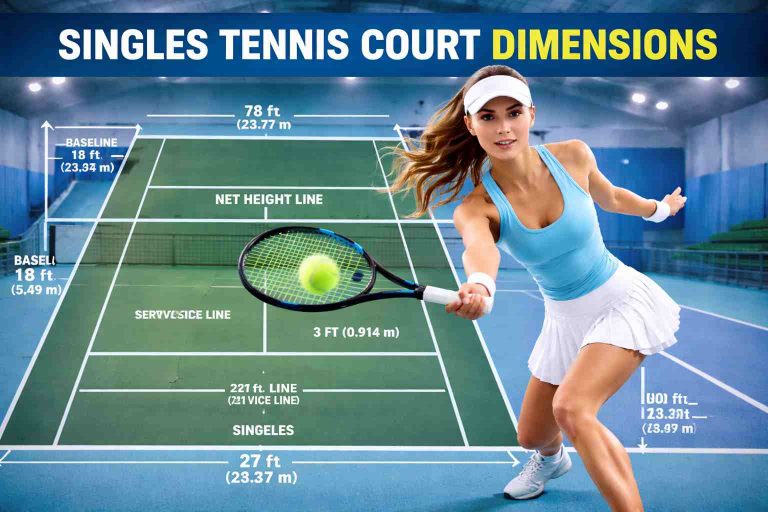
The full court measures 23.77 meters (78 feet) in length from baseline to baseline. For doubles, the width is 10.97 meters (36 feet), while singles uses 8.23 meters (27 feet).
Lines are typically 5 cm (2 inches) wide, with baselines up to 10 cm (4 inches). The service line sits 6.40 meters (21 feet) from the net on each side.
The net height is 0.914 meters (3 feet) at the center and 1.07 meters (3.5 feet) at the posts. For indoor play, the minimum ceiling height is 10 meters (32.8 feet) for show courts, measured from the surface to the lowest obstruction.
Recreational facilities often target 9–12 meters to accommodate lobs safely. Recommended clearances include at least 6.40 meters (21 feet) behind each baseline and 3.66 meters (12 feet) beyond sidelines to prevent player collisions with walls or fences.
Here is a detailed table of standard indoor tennis court dimensions in both meters and feet:
Indoor tennis court dimensions in meters are preferred internationally for precision, while feet remain common in regions like the USA. Including fences and runback areas, the total footprint often reaches approximately 36.58 meters (120 feet) by 18.29 meters (60 feet).
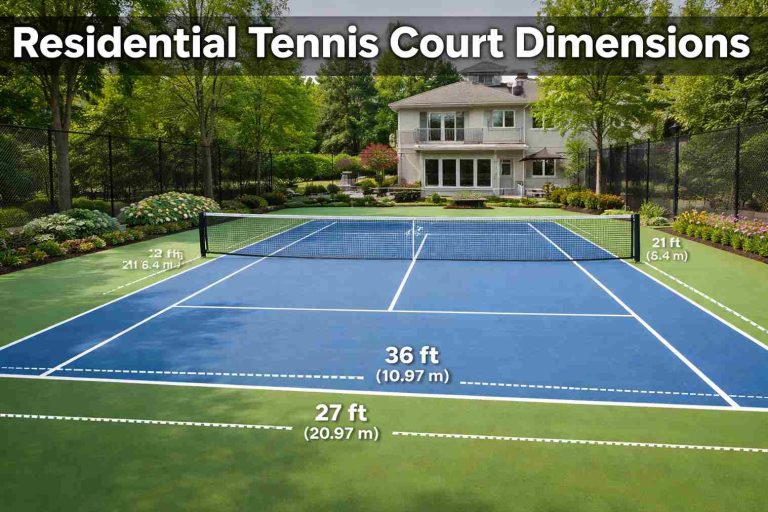
For residential indoor tennis court dimensions, slight reductions may occur due to space limits, but full compliance is ideal for authentic play. Surfaces (hard, synthetic, or others) influence bounce but not core indoor tennis court dimensions.
Indoor Tennis Court Building Dimensions and Considerations
Planning indoor tennis court building dimensions goes beyond the court itself. A single-court structure typically needs 40–50 meters in length, 20–25 meters in width, and 12–15 meters in height to include walls, HVAC, lighting, and access.
Indoor tennis court building height must exceed the minimum 10 meters at the net, with sloped or arched designs often providing better clearance at baselines (recommended 5.4 meters minimum in some guidelines).
Proper ventilation maintains 40–60% humidity and 18–24°C temperatures, while lighting should reach 500–1000 lux for visibility.
Multi-court facilities add 3–4 meters between courts. Construction costs vary widely based on materials like steel framing or air-supported structures, with additional features like spectator areas increasing the footprint.
Step-by-Step Guide to Building an Indoor Tennis Court
Constructing an indoor tennis court requires adherence to precise indoor tennis court dimensions. Follow this step-by-step process:
- Site Selection and Planning: Identify a site with sufficient space (at least 36×18 meters plus extras). Perform soil tests, secure permits, and budget accordingly.
- Design the Layout: Follow ITF standards for 23.77m x 10.97m doubles court, ensuring 10m+ ceiling height. Plan for HVAC, drainage, and electrical systems.
- Foundation and Base: Excavate and pour a leveled concrete slab (10–15 cm thick) with proper slope for drainage.
- Erect the Structure: Build enclosing walls and roof using durable materials. Verify indoor tennis court building height meets or exceeds requirements.
- Surface Installation: Select and install the chosen surface (e.g., hard acrylic), then apply accurate line markings per ITF specs.
- Net, Posts, and Fencing: Set net posts and install perimeter fencing (typically 3–4 meters high).
- Lighting, Ventilation, and Amenities: Install LED lights, climate control, benches, and entry points.
- Final Testing: Measure all indoor tennis court dimensions, test surface performance, and ensure safety compliance.
This timeline usually spans 3–6 months, depending on scale.
Fence Guide for Tennis Courts
Tennis court dimensions with fence in meters or feet incorporate safety enclosures. Standard fencing stands 3–4 meters (10–13 feet) high, creating a total enclosed area of about 36.58m x 18.29m (120ft x 60ft).
Common types include chain-link for durability or mesh for visibility. Indoors, fences contain errant balls and may integrate with walls.
Install posts every 3 meters with tension wires, ensuring no gaps larger than 10 cm at the base. Costs typically range from moderate to higher depending on height and material.
Latest Data and Innovations in Indoor Tennis Court Dimensions
ITF standards remain stable, with core indoor tennis court dimensions unchanged. Tolerances for markings are tight (e.g., ±5–22 mm depending on measurement), emphasizing precision. Innovations focus on sustainable surfaces, energy-efficient lighting, and smart ventilation systems.
In regions like the Philippines, courts follow the same global standards: 23.77m x 10.97m for doubles, with hard surfaces common due to climate. No local deviations exist for official play.
Conclusion
Mastering indoor tennis court dimensions is fundamental to creating high-quality, functional spaces that support enjoyable and competitive tennis.
The core measurements—23.77 meters long by 10.97 meters wide for doubles, with a critical minimum ceiling height of 10 meters—ensure consistency, safety, and optimal performance.
This guide has explored the historical roots of indoor play, detailed standards in both meters and feet, provided practical building steps, and covered essential elements like fencing and clearances.
These precise indoor tennis court dimensions blend tradition with modern requirements, allowing year-round access in any climate. From residential setups to professional venues, adhering to ITF guidelines enhances player experience, reduces injury risk, and promotes fair competition.
As the sport continues to grow, innovations in materials and design will make indoor facilities more efficient and accessible.
Investing time in understanding indoor tennis court dimensions height, indoor tennis court building dimensions, and related aspects pays dividends in long-term satisfaction and usability.
Whether for personal recreation, family fitness, or community development, properly dimensioned indoor courts foster skill development and passion for tennis. Embracing these standards honors the sport’s legacy while embracing future possibilities for inclusive, all-season play.
(Word count for conclusion: approximately 280)
Frequently Asked Questions

Jordan Blake
Jordan Blake is a racket-sports author with hands-on experience and a strong command of both tennis and pickleball. With a foundation built through years on the tennis court and a successful transition into competitive pickleball, Jordan brings practical insight, strategic clarity, and real-world understanding to every article.
Drawing on personal play, match analysis, and court-level observation, Jordan specializes in breaking down technique, tactics, and the mental aspects of both sports in a clear, data-informed, and accessible way. His dual-sport perspective helps readers understand how skills transfer between games—and where each sport demands its own distinct mastery.