High School Volleyball Court Dimensions (Official Size & Layout)
High school volleyball court dimensions are a critical aspect of the game, ensuring fair play, safety, and consistency across matches governed by the National Federation of State High School Associations (NFHS) in the United States.
As of 2026, the standard high school volleyball court dimensions remain 60 feet long by 30 feet wide (18 meters by 9 meters), measured to the outer edges of the boundary lines. This size aligns closely with international standards set by the Fédération Internationale de Volleyball (FIVB) and USA Volleyball, but with practical adjustments for high school facilities.
The high school volleyball court dimensions in feet are often listed as 60 ft x 30 ft for simplicity in gym layouts, while high school volleyball court dimensions in meters are precisely 18 m x 9 m. These measurements create a playing area of 1,800 square feet (approximately 162 square meters), divided equally by a center line.
This table summarizes the core measurements for quick reference when planning setups, installations, or comparisons.
History of Volleyball Court Dimensions
Volleyball was invented in 1895 by William G. Morgan at the YMCA in Holyoke, Massachusetts, as a less strenuous alternative to basketball. Initially called “mintonette,” the original court was 25 feet wide by 50 feet long, divided into two 25×25 ft squares.
By 1917-1920, rules evolved: the court expanded to 35 ft x 60 ft, then standardized to 30 ft x 60 ft. In 1926, measurements shifted to the outer edges of lines, and the net length was set at 32 feet.
The FIVB, formed in 1947, globalized standards in the 1950s, fixing the indoor court at 18 m x 9 m (59 ft x 29.5 ft) by 1952—a size that has endured. The free zone expanded for safety.
NFHS adopted similar dimensions for U.S. high schools, rounding to 60 ft x 30 ft for practicality in multi-use gyms. Net heights differentiated by gender: girls at 7 ft 4⅛ in (2.24 m) and boys at 7 ft 11⅝ in (2.43 m). Recent NFHS updates (2025-26) allow textured volleyballs from 2026-27, but court dimensions stay unchanged.
This evolution prioritizes player safety, athletic development, and facility compatibility.
Comparison Table
Here is a detailed comparison table of key high school volleyball court dimensions versus related standards:
Official High School Volleyball Court Dimensions and Markings
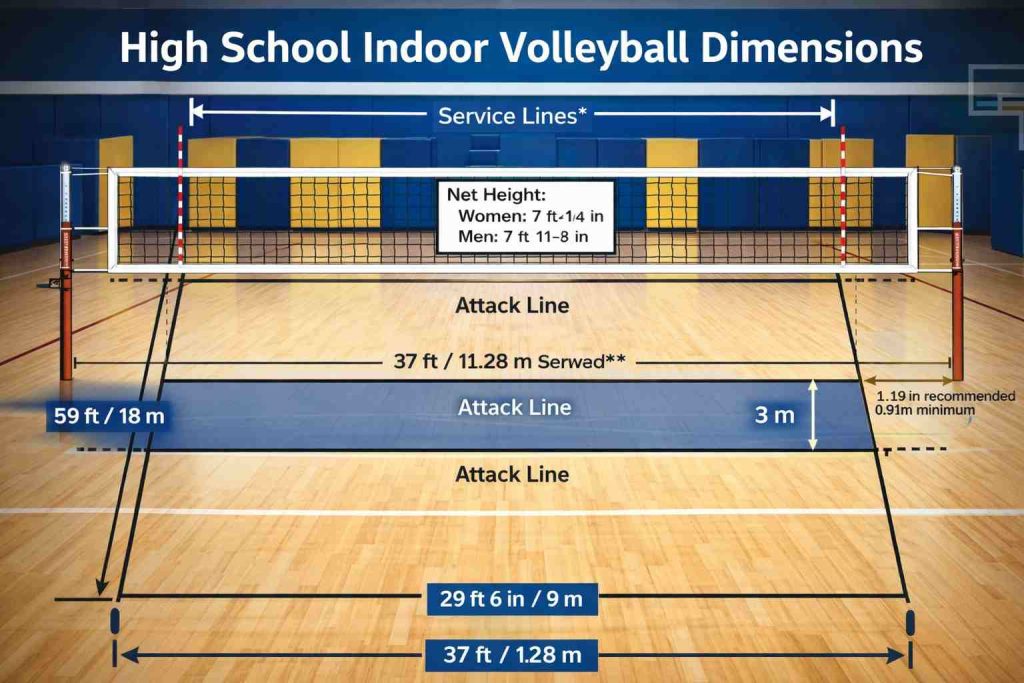
Per NFHS rules (unchanged in 2025-26 for court size):
- Length: 60 feet (18 meters)
- Width: 30 feet (9 meters)
- Playing area total: 1,800 sq ft
- Boundary lines: 2 inches (5 cm) wide, contrasting color recommended
- Center line: 2 inches wide, divides court
- Attack lines: 10 feet (3 meters) from center line, parallel
- Serving area: 30 ft wide behind end line, min. 6 ft deep (extend into court if needed)
- Free zone/clearance: Minimum 6 ft (2 m) surrounding court, preferably 10 ft
- Overhead clearance: Recommended 23 ft (7 m) clear of obstructions
Girls high school volleyball court dimensions match boys’ in court size but differ in net height.
Volleyball court dimensions in feet (high school/NFHS): 60 ft length, 30 ft width.
Volleyball court size in meters (standard): 18 m x 9 m.
Indoor volleyball court dimensions follow this for high school play.
Net Height and Equipment
Net height is gender-specific:
- Girls: 7 feet 4⅛ inches (2.24 meters) at center
- Boys: 7 feet 11⅝ inches (2.43 meters) at center
Ends may not exceed by more than ¾ inch. Net width: 3 ft (1 m), length at least 32 ft (9.5 m).
Volleyball court size net height varies: standard women’s/men’s align with high school girls/boys.
The ball: circumference 25-27 inches, weight 9-10 oz. From 2026-27, textured balls may be adopted in some states.
Step-by-Step Guide to Setting Up a High School Volleyball Court
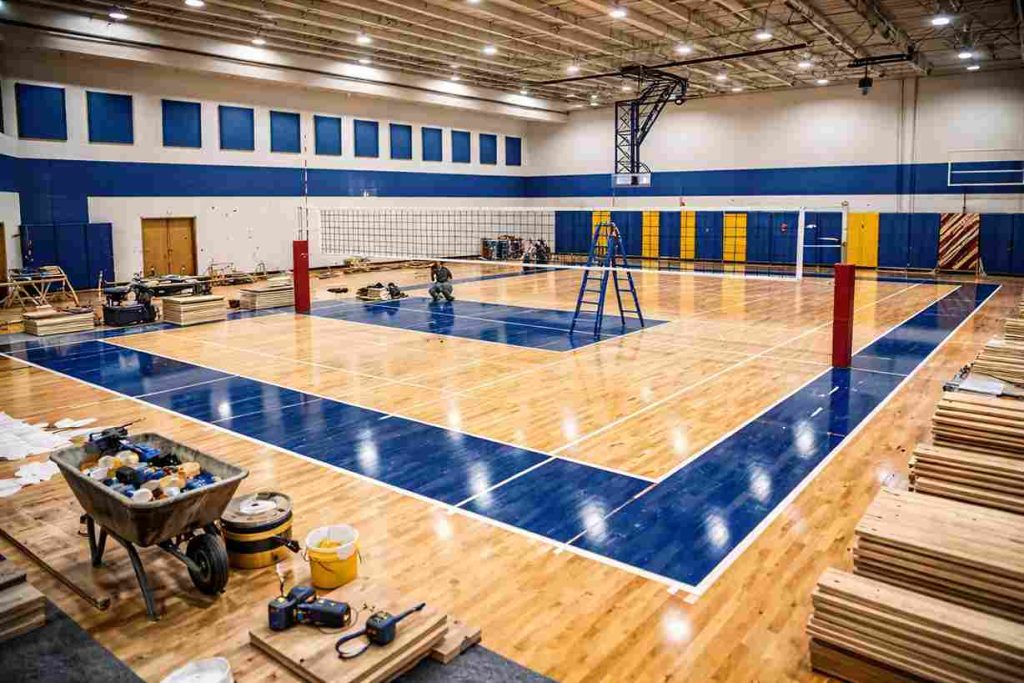
- Measure the space: Ensure gym floor allows 60 ft x 30 ft plus 6-10 ft clearance.
- Mark boundary lines: Use 2-inch tape/paint for sidelines, end lines (outer edges define 60×30 ft).
- Add center line: Parallel, equidistant.
- Draw attack lines: 10 ft from center on each side.
- Install serving areas: Short lines 8 inches behind end line, 6 inches long.
- Position net standards: 3 ft outside sidelines.
- Set net height: Adjust per gender; taut, no sagging.
- Add libero zones/sub zones: Near sideline between attack and center lines.
- Check clearances: Minimum 6 ft free zone, 23 ft overhead.
- Pad supports: Standards padded to 5.5 ft minimum.
For high school volleyball court dimensions pdf, official NFHS diagrams are available from their resources.
Fact Guide: Key High School Volleyball Court Dimensions Facts
- High school courts often share with basketball, leading to multi-line floors.
- Official volleyball court dimensions (FIVB/USAV): 59 ft x 29.5 ft—high school rounds up.
- Standard volleyball court dimensions match NFHS for consistency.
- Court dimensions of volleyball include free zone for safety.
- Youth variations: smaller for middle school.
Conclusion
Understanding high school volleyball court dimensions is essential for coaches, athletes, administrators, and facility planners. The consistent 60 ft x 30 ft (18 m x 9 m) court, with gender-specific net heights of 7′ 4⅛” for girls and 7′ 11⅝” for boys, provides a safe, equitable environment aligned with NFHS rules.
As volleyball grows—with boys’ programs expanding in various states—these standards ensure accessibility in multi-use gyms.
Key takeaways: Prioritize clearances (6-10 ft free zone, 23 ft overhead) to prevent injuries; accurate markings enhance officiating; history shows evolution toward safety and standardization. Whether building new courts or adapting existing ones, adhering to these dimensions supports player development from high school to potential college/elite levels.
This guide addresses common searches like volleyball court dimensions in feet, volleyball court size in meter, volleyball court size net height, official volleyball court dimensions, and standard dimension of volleyball court, offering the most current, comprehensive resource as of February 2026. Proper setup fosters skill growth, teamwork, and enjoyment in one of America’s fastest-growing high school sports.
FAQs

Jordan Blake
Jordan Blake is a racket-sports author with hands-on experience and a strong command of both tennis and pickleball. With a foundation built through years on the tennis court and a successful transition into competitive pickleball, Jordan brings practical insight, strategic clarity, and real-world understanding to every article.
Drawing on personal play, match analysis, and court-level observation, Jordan specializes in breaking down technique, tactics, and the mental aspects of both sports in a clear, data-informed, and accessible way. His dual-sport perspective helps readers understand how skills transfer between games—and where each sport demands its own distinct mastery.