
Volleyball Court Dimensions in Feet – Indoor & Outdoor Size Guide
Volleyball court dimensions in feet are critical for players, coaches, parents, facility designers, and anyone setting up or playing the sport. The standard indoor volleyball court dimensions in feet measure 59 feet long by 29.5 feet wide, with additional surrounding free zones that significantly increase the total required space.
These measurements come from the official Fédération Internationale de Volleyball (FIVB) rules in effect for the 2025–2028 Olympic cycle and remain consistent across most professional, collegiate, and international competitions. Variations exist for beach volleyball, high school play, youth divisions, and recreational setups.
This in-depth guide answers common searches such as volleyball court dimensions in feet, dimensions of a volleyball court in feet, volleyball net height in feet, indoor volleyball court dimensions, outdoor volleyball court dimensions in feet, volleyball court size in square feet, and volleyball court size in feet pdf-style breakdowns.
A Brief History of Volleyball Court Evolution
Volleyball was invented in 1895 by William G. Morgan at the Holyoke YMCA in Massachusetts as a less physically demanding indoor alternative to basketball. The original court was roughly 25 feet by 50 feet with a tennis net stretched across the middle. Early games allowed nine players per side, and the court size quickly grew to better accommodate movement.
By the early 1900s the dimensions had expanded to approximately 35 feet by 60 feet. The name officially changed from “Mintonette” to “volleyball” in 1896 because players volleyed the ball back and forth. In 1916, the Philippines introduced the three-hit rule and set play, influencing modern strategy. The sport spread rapidly through YMCAs and the military during World War I.
The International Volleyball Federation (FIVB) was founded in 1947 and began standardizing rules globally. By the late 1950s the indoor court was fixed at 18 meters long by 9 meters wide—exactly 59 feet by 29.5 feet. Net heights were also standardized: men at 2.43 m (7 ft 11⅜ in) and women at 2.24 m (7 ft 4⅛ in).
Beach volleyball emerged on California beaches in the 1920s, became organized in the 1970s, and joined the Olympics in 1996 with a smaller court of 16 m × 8 m (52.5 ft × 26.3 ft).
These core volleyball court dimensions in feet have remained virtually unchanged for decades because they strike an effective balance between athletic demands, strategic depth, and spectator visibility.
Official Indoor Volleyball Court Dimensions in Feet (FIVB 2025–2028)
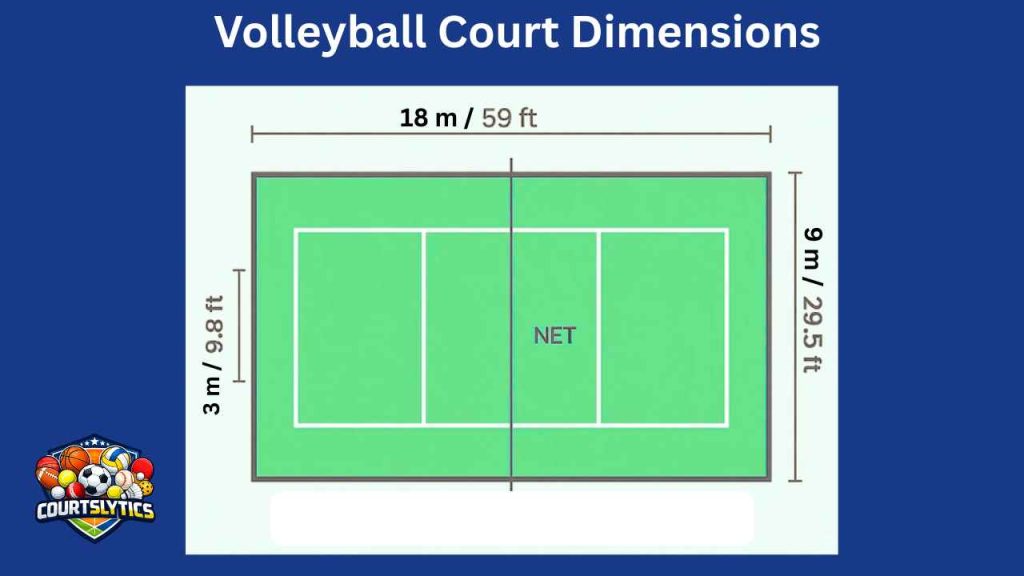
- Playing court length: 59 feet (18 meters)
- Playing court width: 29.5 feet (9 meters)
- Total area of playing court: 1,740.5 square feet
- Center line: Divides the court into two equal 29.5 ft × 29.5 ft squares
- Attack (3-meter) lines: Placed 9.84 feet (3 meters) from the center line on each side
- Service zone: Starts at the end line and extends backward into the free zone; width matches the court (29.5 feet)
- Line width: 2 inches (5 cm) for all boundary, center, and attack lines
- Free zone (minimum): 9.84 feet (3 meters) on all sides
- Free zone for FIVB, World, and Olympic events: 16.4 feet (5 m) along the sidelines and 21.33 feet (6.5 m) behind the end lines
- Total recommended area with full free zone: Approximately 98–102 feet long × 63–66 feet wide
- Minimum ceiling height: 23 feet (7 meters); 41 feet (12.5 meters) strongly recommended for elite play
- Volleyball net height in feet – Men / Men’s divisions: 7 feet 11⅜ inches (2.43 m) measured at center – Women / Women’s divisions: 7 feet 4⅛ inches (2.24 m) – Co-ed (usually follows men’s height)
- Antennae: Extend 31.5 inches (80 cm) above the net on each side of the net; top 27.6 inches striped red/white
The full playing surface with minimum free zone covers roughly 3,822 square feet, while elite venues often provide closer to 6,500 square feet to allow safe diving and rapid transitions.
Beach / Outdoor Volleyball Court Dimensions in Feet
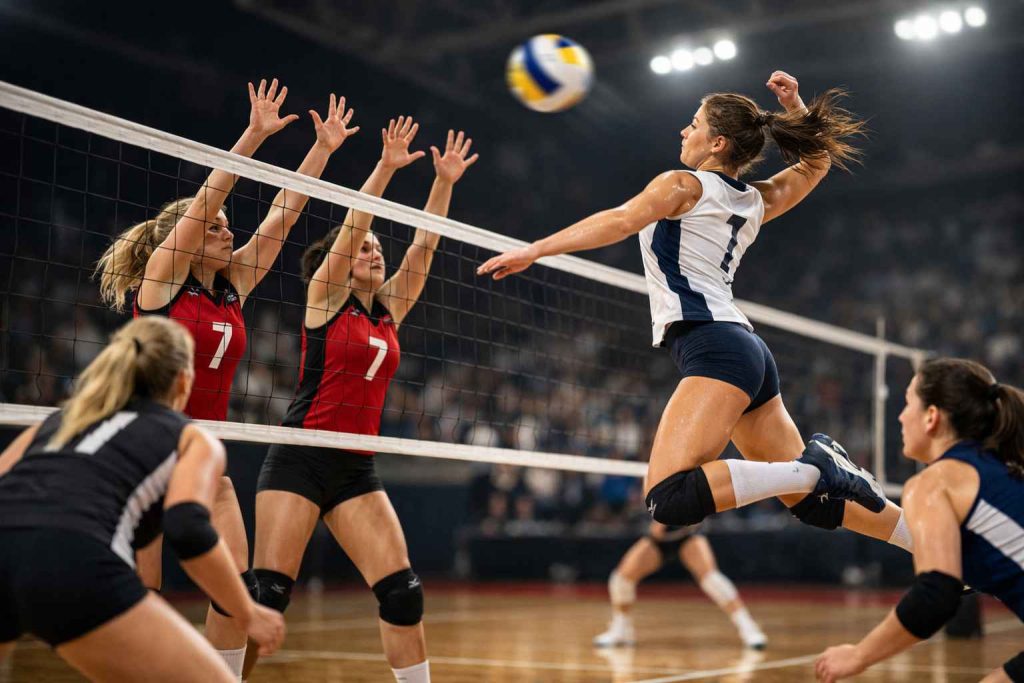
Beach volleyball uses a smaller court to emphasize individual skill, longer rallies, and adaptation to uneven sand:
- Playing court length: 52.49 feet (16 meters)
- Playing court width: 26.25 feet (8 meters)
- Total playing area: ≈ 1,377 square feet
- Free zone (minimum): 9.84 feet (3 meters) on all sides
- Free zone for major FIVB/AVP events: Frequently 16.4 feet or more on sides and ends
- Net height in feet: Same as indoor – Men: 7 ft 11⅜ in – Women: 7 ft 4⅛ in
- Lines: Usually marked with brightly colored boundary ropes or bands (2 inches wide equivalent)
- Surface: Level sand, minimum 16 inches deep in competition
The smaller dimensions make defense-to-offense transitions faster and place greater emphasis on endurance and ball control in variable wind and sand conditions.
High School, Youth, and Recreational Variations
- NFHS (U.S. high school) court – Length: 60 feet – Width: 30 feet – Attack line: 10 feet from center line (slightly rounded from 3 m) – Clearance: Minimum 6–10 feet recommended around perimeter – Net height: Matches FIVB (7 ft 11⅜ in boys, 7 ft 4⅛ in girls)
Many school gyms mark exactly 60 ft × 30 ft because it fits neatly into standard basketball court layouts and simplifies tape application.
- Youth divisions (common U.S. modifications) – Ages 10–12: Net often 6 ft 6 in to 7 ft; court sometimes reduced to 50–55 ft × 25–28 ft – Ages 13–14: Net usually 7 ft (boys) or 6 ft 11 in–7 ft 4 in (girls); full-size court increasingly common
Recreational backyard or park courts frequently use the high-school approximation (60 ft × 30 ft) for convenience.
Step-by-Step Guide: How to Mark a Regulation Indoor Volleyball Court
- Choose and prepare the surface Select a flat, non-slip area (hardwood, synthetic sports flooring, or properly leveled sand for beach). Sweep and clean thoroughly.
- Establish the centerline Find the exact middle of your available space and mark a 29.5-foot-wide line across the width. This becomes the net line.
- Mark the sidelines and end lines From each end of the centerline, measure 29.5 feet perpendicular in both directions and connect to form the 59 ft × 29.5 ft rectangle. Use a laser measurer or 100-foot tape for precision.
- Place attack lines Measure 9.84 feet (exactly 3 meters) from each side of the centerline and draw parallel 2-inch-wide lines across the full width.
- Mark service zones Behind each end line, mark a 29.5-foot-wide zone extending at least 20 feet back (more in elite venues).
- Install net system Position net posts so the net spans exactly 29.5 feet between the antennae and hangs at regulation height (measure in the center and at both ends—net may sag no more than ¾ inch).
- Add antennae Attach flexible antennae poles directly above each sideline so they extend 31.5 inches above the net.
- Mark and clear free zone Extend boundary markings at least 9.84 feet beyond all lines (ideally 16.4–21.3 feet for competition). Remove all obstacles.
- Final verification Double-check every measurement from multiple points. Walk the court to ensure no trip hazards exist.
- Test setup Hang a regulation ball and perform basic serves, sets, and spikes to confirm feel and safety.
Volleyball Court Dimensions Comparison Table
Conclusion
Understanding volleyball court dimensions in feet is fundamental for safe, fair, and high-quality play at every level—from casual backyard games to Olympic arenas. The official indoor measurements of 59 feet by 29.5 feet, combined with generous free zones, allow athletes to perform explosive jumps, quick defensive dives, and precise ball placement without fear of boundary violations or collisions.
Beach volleyball’s more compact 52.5 ft × 26.3 ft layout creates a different dynamic that rewards individual skill and endurance. High school and youth variations provide practical flexibility while still teaching core techniques that transfer directly to higher levels.
Accurate court setup prevents injuries, reduces disputes during matches, and ensures players can focus on strategy and execution rather than worrying about whether a ball was in or out. Facility managers benefit from these exact specifications when budgeting for flooring, lighting, and seating.
Coaches use the dimensions to design effective drills—practicing serves from regulation distance, training blockers at the correct net height, or teaching back-row attackers to respect the 3-meter (9.84 ft) line.
As volleyball continues to grow worldwide, especially with increased participation in schools, community centers, and beach tournaments, knowing these volleyball court dimensions in feet empowers everyone involved to create optimal playing environments. Whether you are taping lines in a gym, staking a beach court, or simply curious about the sport’s geometry, these timeless measurements remain the foundation of one of the world’s most exciting team sports.
Frequently Asked Questions

Jordan Blake
Jordan Blake is a racket-sports author with hands-on experience and a strong command of both tennis and pickleball. With a foundation built through years on the tennis court and a successful transition into competitive pickleball, Jordan brings practical insight, strategic clarity, and real-world understanding to every article.
Drawing on personal play, match analysis, and court-level observation, Jordan specializes in breaking down technique, tactics, and the mental aspects of both sports in a clear, data-informed, and accessible way. His dual-sport perspective helps readers understand how skills transfer between games—and where each sport demands its own distinct mastery.