

Padel Court Dimensions in Feet: Length, Width, and Standard Sizes
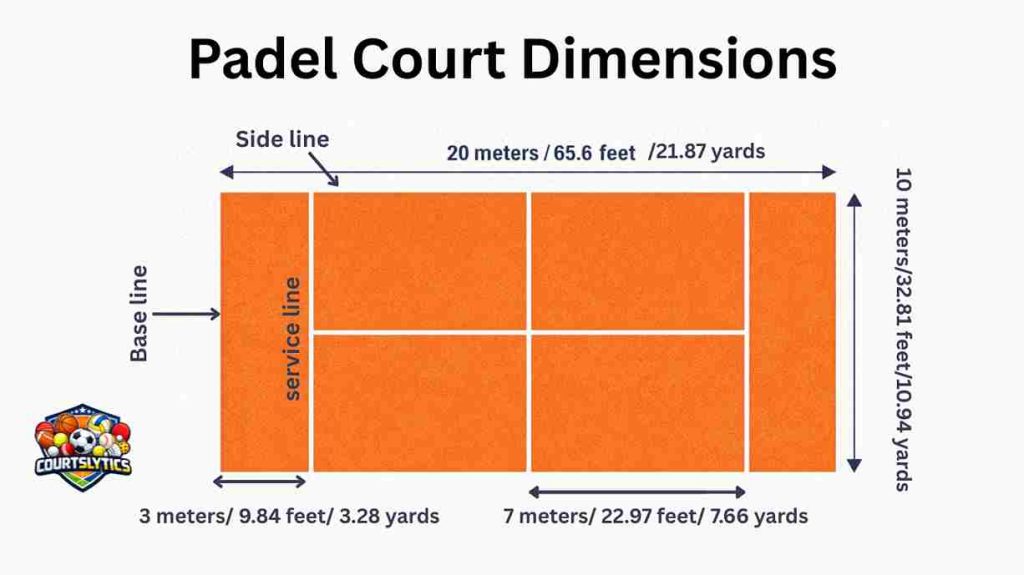
Padel continues to grow as a globally recognized sport, with standardized facilities essential for safe play and competitive consistency. Central to this growth are the padel court dimensions in feet (≈ 65.6 × 32.8 ft) and official measurements in meters (20 × 10 m), established by the International Padel Federation (FIP). Accurate padel court length in feet, padel court width in feet, and overall padel court dimensions in square feet ensure that every court meets regulatory requirements and supports high-level gameplay.
These specifications are critical not only for professional tournaments but also for recreational and training facilities worldwide. Facility owners, architects, and sports authorities must understand singles padel court dimensions in feet, paddle tennis court dimensions in feet, and paddle ball court dimensions in feet to guarantee player safety, consistent ball behavior, and eligibility for sanctioned competitions.
Beyond the basic footprint, proper court design involves net placement, wall specifications, service line distance, and clearance space. Adhering to padel court standard size in feet and single padel court size in feet ensures uniformity across venues, allowing players to transition seamlessly between courts without adjustments. Understanding these official padel court dimensions in feet is a fundamental first step in facility planning.
Quick Reference: Specific Measurements and Layout of Padel Courts
Regulatory Authority and Standardization
The International Padel Federation (FIP) serves as the authoritative body defining padel court dimensions 20×10 meters official (≈ 65.6 × 32.8 ft). Through technical manuals and official rulebooks, the FIP ensures all courts comply with precise measurements, wall heights, net positions, and service box configurations. Regulatory standardization guarantees that courts meet both safety and competitive requirements.
Courts constructed without adherence to FIP standards may face safety issues, unpredictable ball behavior, or disqualification from official tournaments. This is why all professional and recreational facilities aiming for quality and longevity follow padel court dimensions 20 x 10 official FIP specifications.
By providing uniformity across countries and playing levels, the FIP allows players to experience consistent court behavior regardless of location. Additionally, standardization simplifies design, construction, and maintenance. Architects and contractors can rely on fixed parameters, such as court footprint, clearance space, and wall layout, to design functional and compliant facilities.
Regulatory oversight also reinforces competitive integrity, ensuring matches are conducted under controlled, measurable, and predictable conditions worldwide.
Court Size and Playing Area
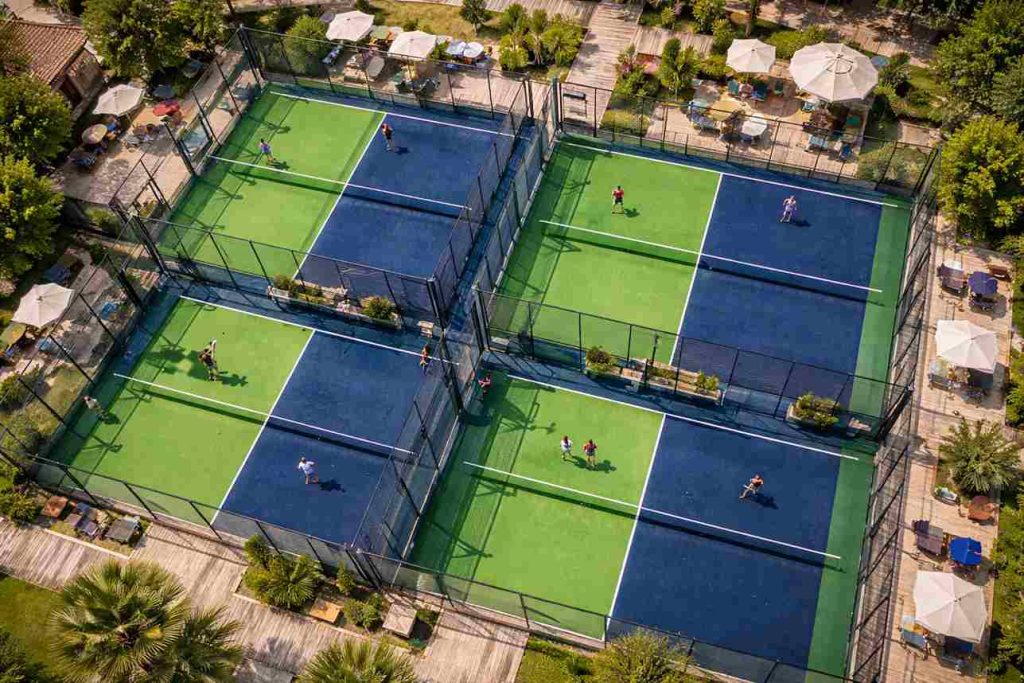
A regulation padel court adheres strictly to padel court dimensions 20 x 10 m official (≈ 65.6 × 32.8 ft), forming a rectangular playing surface of 200 square meters (≈ 2,153 sq ft). This footprint applies to all levels of play—recreational, amateur, and professional—ensuring universal consistency.
Unlike sports with open courts, padel incorporates walls into gameplay, making enclosure part of the official playing area. The back wall is 4 meters high (≈ 13.1 ft), while the side walls follow a stepped layout: 3 meters (≈ 9.84 ft) at the rear and 2 meters (≈ 6.56 ft) at the front, with mesh fencing extending to a total of 4 meters (≈ 13.12 ft).
Precise adherence to these measurements is essential, as deviations can affect ball rebound, service legality, and player safety. Proper layout also includes padel court dimensions and space requirements, such as minimum clearances of 0.5–1 meter (≈ 1.64–3.28 ft) around the enclosure, and indoor ceiling height recommendations of 6–10 meters (≈ 19.7–32.8 ft).
Correct application of padel court layout dimensions ensures courts are safe, playable, and compliant for sanctioned competitions.
Net Specifications and Service Line Placement
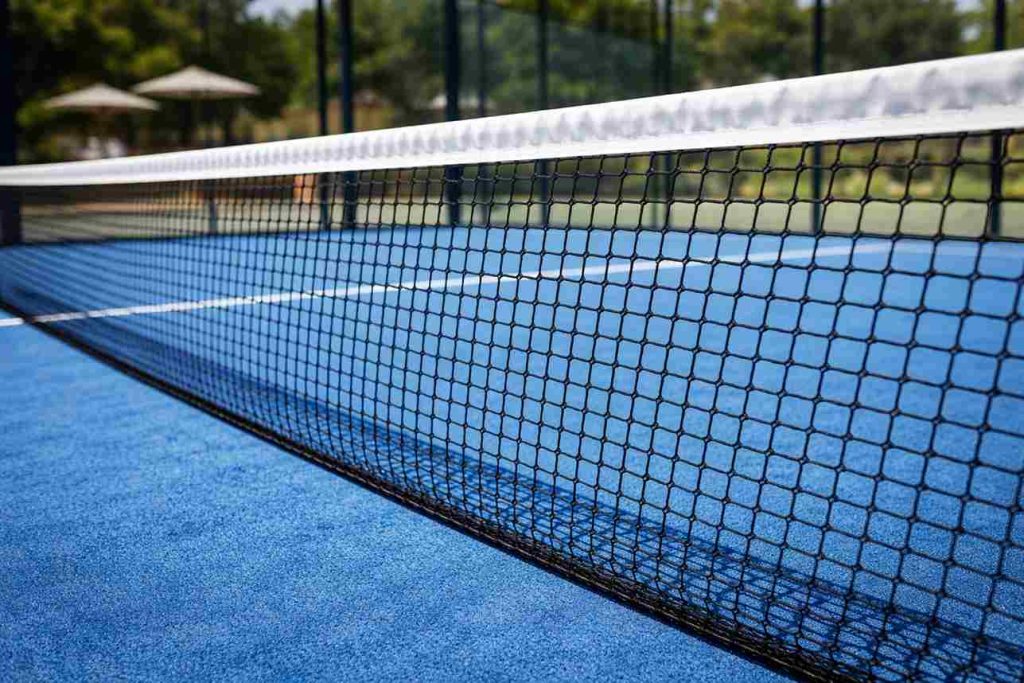
The net is a critical element in padel court dimensions 20m x 10m (≈ 65.6 × 32.8 ft), dividing the court into two equal halves. Its official height is 0.88 meters (≈ 2.89 ft) at the center and 0.92 meters (≈ 3.02 ft) at the sides, designed to balance offensive and defensive play.
Maximum width aligns with the court’s 10 meters (≈ 32.8 ft). Precise tension and positioning of the net are vital for predictable ball trajectory, fair service execution, and competitive integrity. The service line, positioned 6.95 meters (≈ 22.8 ft) from the net, defines the legal service zone. Padel court dimensions service line distance from net is uniform across all FIP-regulated courts, ensuring consistent gameplay.
Lines are 5 centimeters (≈ 2 in) wide, highly visible, and considered part of the playing area. Proper application of padel court net dimensions and service line placement is crucial, as incorrect measurements can compromise rules enforcement. Together, these specifications maintain fairness, encourage strategic play, and uphold FIP standards for both recreational and professional matches.
Wall Materials and Enclosure Requirements
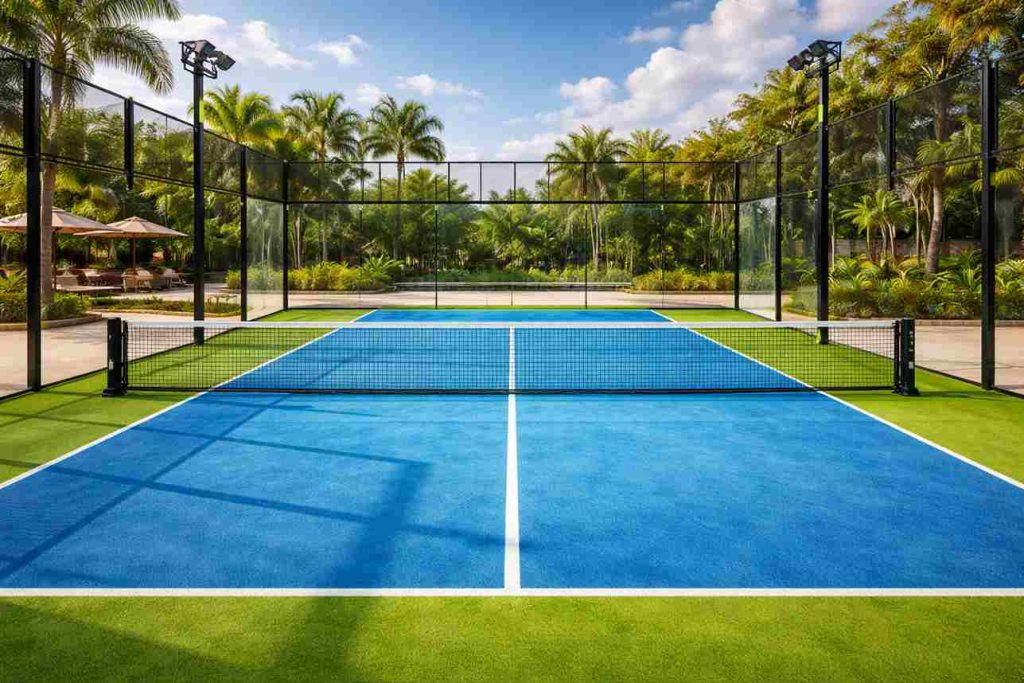
Walls are integral to padel court dimensions 20×10 official (≈ 65.6 × 32.8 ft), shaping gameplay and rebound behavior. Back walls are typically 3 meters of tempered glass (≈ 9.84 ft) with a 1-meter mesh extension to reach 4 meters (≈ 13.1 ft). Side walls follow a stepped pattern, with rear sections reaching 3 meters (≈ 9.84 ft) and front sections at 2 meters (≈ 6.56 ft), again topped by mesh fencing to meet full height requirements.
Proper material selection, alignment, and secure anchoring are essential. Padel court glass dimensions must be consistent, with vertical panels placed without gaps or misalignment to ensure predictable ball rebounds. Any irregularity in wall height or construction can compromise safety and affect competitive play.
Compliance with FIP-regulated wall specifications ensures that all courts, regardless of indoor or outdoor location, meet official requirements. These walls not only contain gameplay but also enhance strategic depth, as players can use rebounds in rallies—a hallmark feature of official padel play.
Clearance and Safety Considerations
While the playing surface adheres to padel court dimensions 20×10 meters official (≈ 65.6 × 32.8 ft), additional space is needed around the court for safety, movement, and maintenance. A minimum clearance of 0.5–1 meter (≈ 1.64–3.28 ft) is recommended on all sides, with a total footprint of at least 12 × 22 meters (≈ 39.4 × 72.2 ft) for optimal usability.
Indoor facilities require adequate ceiling height (6–10 meters / ≈ 19.7–32.8 ft) to accommodate lobs and overhead shots. Padel court dimensions and layout must also account for spectator pathways and service areas. Inadequate clearance increases injury risk and restricts player mobility during high-intensity rallies.
Outdoor courts require UV-resistant materials and drainage systems to maintain consistent surface quality. By adhering to these space requirements, facilities ensure safety, regulatory compliance, and a consistent playing experience. Understanding these considerations is essential for architects, contractors, and facility operators planning courts that meet padel court dimensions 20 x 10 official FIP guidelines.
Indoor vs Outdoor Court Specifications
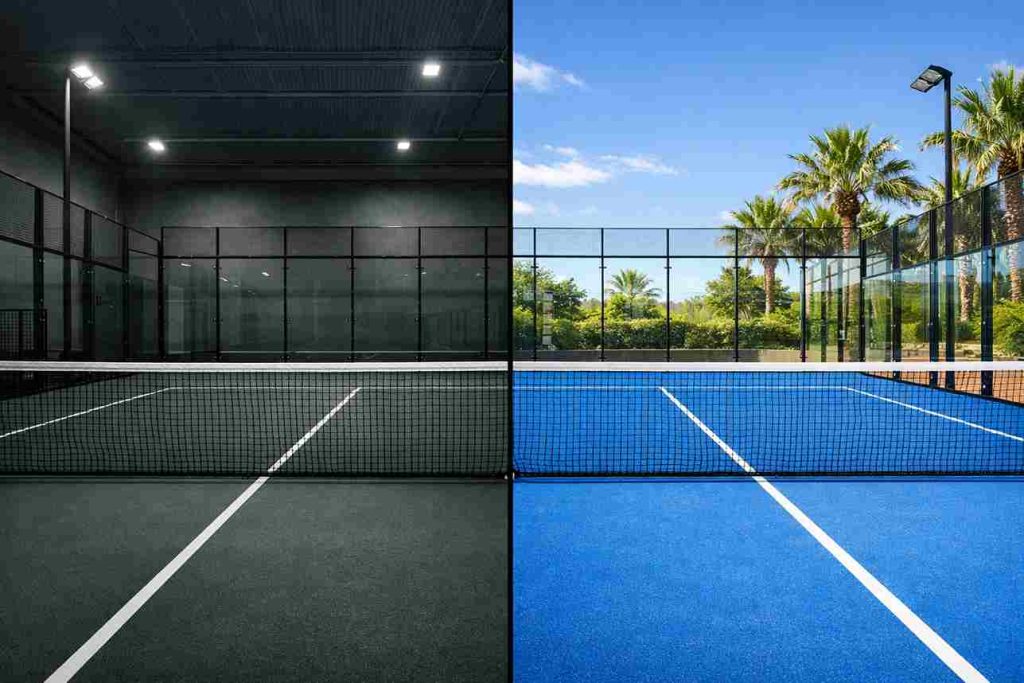
The padel court dimensions 20×10 official (≈ 65.6 × 32.8 ft) remain consistent for both indoor and outdoor facilities, but environmental and construction considerations differ. Indoor courts require controlled lighting between 500–750 lux and climate management to maintain optimal temperature and humidity.
Ceiling height is particularly critical to prevent interference with overhead shots. Outdoor courts must use weatherproof surfaces, UV-resistant materials, and proper drainage systems to prevent water accumulation. Despite these environmental differences, all net, wall, service line, and playing area measurements must comply with padel court dimensions 20m x 10m official (≈ 65.6 × 32.8 ft) standards.
Material selection, lighting, and ventilation should enhance player comfort without altering the official footprint or layout. Proper integration of indoor and outdoor requirements ensures that both recreational and competitive courts maintain consistency in ball behavior, safety, and adherence to FIP specifications. Facilities that follow these guidelines uphold regulatory compliance and long-term usability.
Indoor vs Outdoor Padel Court Specifications
Comparison of Official and Regulatory Dimensions
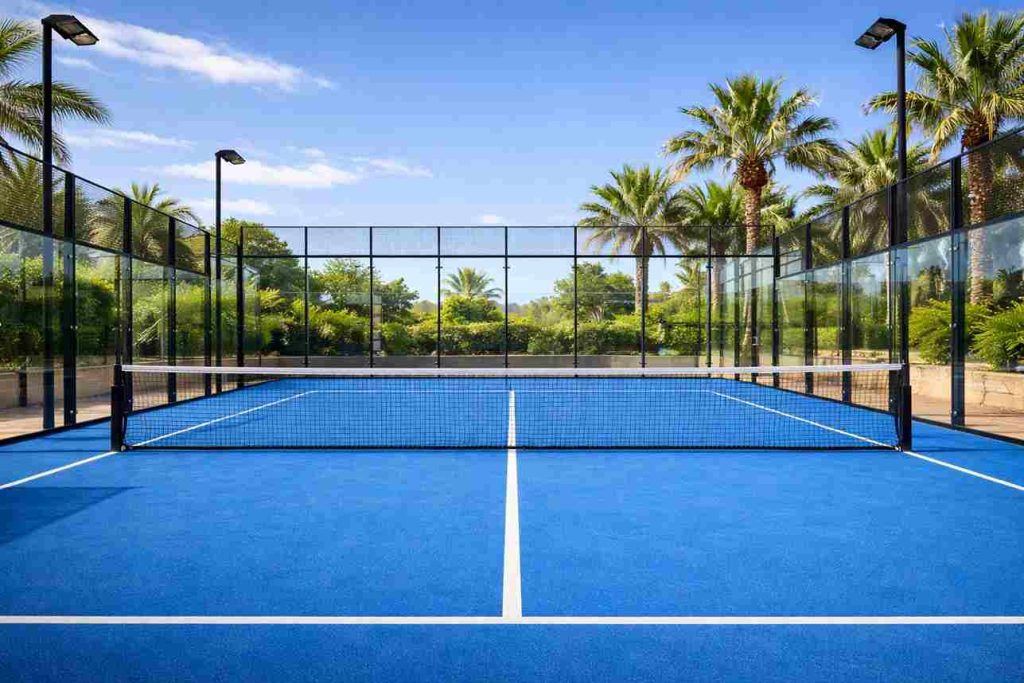
While “official” and “regulatory” terms are often used interchangeably, they serve distinct purposes in padel court dimensions 10×20 official (≈ 65.6 × 32.8 ft) planning. Official dimensions provide a reference for recreational play, while regulatory dimensions define mandatory measurements enforced by the FIP for sanctioned events.
A court may match official size but still fail regulatory compliance if wall height, net placement, or clearance does not meet standards. For professional play, padel court dimensions 20 x 10 official FIP (≈ 65.6 × 32.8 ft) must be strictly adhered to. Regulatory compliance ensures predictable ball rebound, player safety, and eligibility for tournaments. Facilities must consult technical manuals and FIP-approved PDFs to verify measurements.
Standardization across countries ensures fairness, uniform gameplay, and quality control. Understanding the difference between official and regulatory dimensions allows facility owners, architects, and tournament organizers to construct courts that serve both casual and competitive needs.
Conclusion-Padel Court Dimensions in Feet
Adhering to padel court dimensions 20 x 10 meters official (≈ 65.6 × 32.8 ft) standards is essential for player safety, consistent gameplay, and compliance with the International Padel Federation (FIP). The fixed 10 × 20-meter footprint, precise net height, regulated wall structures, and defined service zones collectively create an environment conducive to fair competition, strategic depth, and long rallies.
Compliance is not optional for facilities intending to host leagues or professional tournaments. Correctly implementing padel court dimensions 20m x 10m official FIP (≈ 65.6 × 32.8 ft), including glass and mesh specifications, service line placement, and clearance space, ensures predictable ball behavior and player movement. Indoor and outdoor environments can differ in lighting, climate, and material considerations, but the fundamental layout remains identical, reinforcing uniformity across venues worldwide.
By following these specifications, architects, facility operators, and investors make a long-term investment in quality, safety, and usability. Courts built to FIP standards retain their value, support competitive play, and meet the expectations of players, governing bodies, and spectators, securing the sport’s global growth and integrity.
Frequently Asked Questions: Padel Court Dimensions in Feet

Jason Miller
Jason Miller is a padel-focused sports writer with hands-on experience across competitive and recreational play. With years spent training, competing, and studying match dynamics on modern padel courts, Jason brings a practical, player-first perspective to every piece he writes.
His expertise lies in analyzing padel-specific strategy, including court positioning, wall usage, net control, and partner communication. By combining real-game observation with technical breakdowns, Jason delivers clear, actionable insights that help players improve decision-making, consistency, and match awareness.
Jason’s writing emphasizes what truly wins points in padel—smart shot selection, tactical patience, and teamwork—making his content valuable for players at all levels. His straightforward, analytical approach has made his work a trusted resource for those looking to better understand and elevate their padel game.
